
Therése Fridström Montoya – an Unconventional Figure?
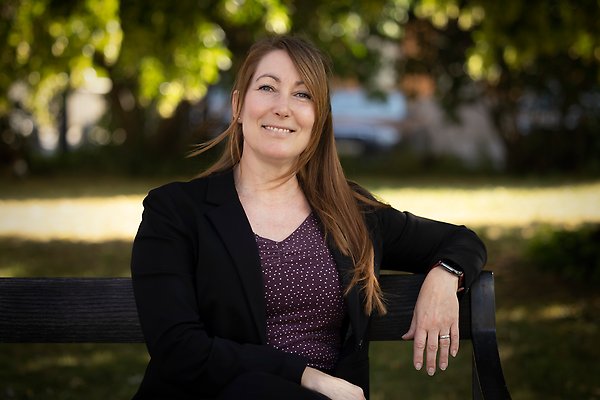
Therése Fridström Montoya Photo: Mikael Wallerstedt
It is the 100‑year anniversary these days. And to mark the occasion, a book is being released titled “En liten vital 100-åring – Festskrift till 1924 års lag om verkan av avtal, som slutits under påverkan av en psykisk störning.”
This portrait is about the book’s editor, Therése Fridström Montoya, who describes herself as something of an Unconventional Figure at the Faculty of Law. We will return to why a little later.

Her interest in law stems from a strong desire to work for people in vulnerable situations. Therése thought that law would be the right path. But a bit into the law program, she noticed that it seemed to be all about “money, contracts, and companies,” which she found terribly boring. Eventually, a classmate told her to quit and work with people instead.
Said and done—she switched to social work studies. After a few years, she realized the importance of law within social work. That’s when the idea of earning two degrees was born. What strength that combination could have. And so she completed both a social work degree and a law degree. After that, she worked for several years in the real world: within the Swedish Prison and Probation Service, the Swedish Social Insurance Agency, and the National Association for People with Intellectual Disabilities. It was in the latter workplace that she encountered the issue that—fifteen years later—became her doctoral thesis. That was where the initial seed was planted.
When it comes to people with intellectual disabilities, they have, on one hand, extensive rights—human rights, as well as rights under Swedish legislation such as LSS (the Act on Support and Service) and the Social Services Act—but on the other hand, they often lack the ability to claim these rights themselves. So an intermediary is needed. There are various forms of legal representation, such as court‑appointed guardians and trustees.
Her dissertation question became: Do these two worlds—the social‑law sphere and the world of legal representatives—work together? The answer, unfortunately, is no.
Another part of her dissertation dealt with issues of power: What view of humanity do we have within the legal system that leads us to conclude that some people cannot represent themselves? “We have such a strong belief that once we have declared something to be a right, then everything is settled. But we must think one step further. Not all people have the ability to demand these rights, and then they become nothing more than documents on paper.”
Sweden has ratified an international convention on the rights of persons with disabilities, in which we have pledged to guarantee equality before the law for all people. But we do not live up to this. It is no easy task for someone with a disability to, for example, appeal a decision from the Social Insurance Agency.
So what safeguards do we have? In certain situations, it is possible to have a legal representative appointed. But who is eligible for one, and how capable are they? What regulations apply to their assignments? How is it ensured that they do not misuse their responsibilities? There are many problems here. And in individual legislative contexts, the issues are often not thought through. For example, the law might state that a person must consent to receive care—but if the person cannot consent, who should do so on their behalf? That has not been considered. One cannot simply place that responsibility on a guardian, because the person has not been legally incapacitated. These are my questions. They are interesting, meaningful, and important, and they affect a very large number of people.
Disability as a research area is particularly interesting because there are so many dimensions to what a disability is. A disability arises in the interaction between the individual and the environment. You may have an impairment of some kind, but it does not necessarily hinder your functioning if the environment is adapted. But as soon as you find yourself in a non‑adapted environment, you experience a disability. Today, there is broad consensus that the problem does not lie with the individual, but with society. We must reduce disabilities by making the adaptations necessary for society to be inclusive for everyone. But society is still structured around some kind of “norm‑person.”
“The book that has just been published is the latest piece of a large puzzle that I am trying to assemble—mapping how things work in relation to various disabilities and different areas of law. It deals with people with mental disorders and how the old law from 1924 is applied today. My own contribution to the book focuses on how today’s courts understand what a mental disorder is, and how legal acts—such as entering into a contract—can be affected when a person had a mental disorder at the time the legal act was performed. But the book’s various chapters address many other issues related to the law as well.”
So why is Therése Fridström Montoya considered an odd bird?
There turn out to be several reasons. As mentioned, she is both a lawyer and a social worker, and she conducts legal research on topics that are quite unusual. “I have the best research questions in law, and I think I am the only one—at least in Sweden—who works with these issues from this perspective.”
Another reason she is somewhat unusual is that she completed her doctorate in one subject and then became an associate professor and lecturer in another. She earned her doctorate in public law, with a dissertation that is as much public law as private law. Legal representation is regulated under private law, while social rights pertain more to public law—so the two fields fit together. And given her background as a social worker dealing with social services legislation, public law seemed like the right field. But a few years after her dissertation, she realized that everything she wrote concerned legal representation and ambiguities elsewhere in the legal system regarding the authority of legal representatives. At that point, her career progression within public law stalled, so she switched to private law.
Therése’s second book after her dissertation dealt with Homo Juridicus—the capable human being in law—and the normative image of the human being reflected in legal doctrine. We have no consistent principles for this. There are many cases where this becomes sharply apparent: “Can we really consider this legal act valid?” “Is this person truly able to consent?” “This person cannot perform legal acts—he is severely demented.” That may be true, but why? Based on what?
Despite her deep commitment to these questions, she sometimes finds it very discouraging to be a legal scholar.
“You write and write, but no one ever reads what you write.”
Hopefully, the new book can signal a shift in a different direction.
Facts about Therése Fridström Montoya
- Associate Professor and Senior Lecturer in Private Law
- Degree in Social Work, 1998
- Law Degree, 2000
- PhD in Public Law, 2015
- Associate Professor in Private Law, 2019
- Director of the Centre for Disability Research (CFF)