
Research at the intersection of crisis and constitution – a portrait of Olof Wilske
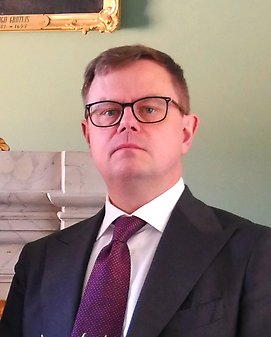
Olof Wilske Photo: Lasse Blom
How well prepared is the Swedish state for crises, and how resilient is our democratic constitutional state for the future? These are some of the questions that Olof Wilske, Senior Lecturer and Associate Professor of Constitutional Law at Uppsala University and based at Campus Gotland, wrestles with on a daily basis. In his research, he explores the strengths and weaknesses of the constitutional framework—not only in theory, but in practical application when it truly matters.
Wilske has long been interested in constitutional law, but his work currently revolves mainly around two areas: constitutional preparedness—meaning how well society is legally equipped to handle crises—and Sweden’s constitutional history, in which he maps the development and use of the constitution over time.
The first area is especially relevant today. In collaboration with the Swedish Civil Contingencies Agency (MSB) and the Swedish Defence University, he examines the extent to which the Swedish legal system is capable of handling peacetime crises such as pandemics or natural disasters—but also extremely serious scenarios such as war. It is, as he describes it, a “patchy quilt” of regulations, in which lines of responsibility between authorities, municipalities, and the state are often unclear. The snowstorm on the E22 highway in Skåne, where cars were stranded and authorities struggled to determine who had decision‑making authority, is one example that clearly illustrates this legal uncertainty.
Wilske sees a fundamental dilemma in balancing decisiveness and legal certainty: How far may the state stretch legal rules in an acute crisis? How much can—and should—democratic norms give way in favor of speed and efficiency? Sweden, for example, has no constitutional rules governing states of emergency in peacetime, which sets us apart from many other countries.
At the same time, he emphasizes that the protection of democracy is not only about the written law. “A strong constitution alone cannot withstand powerful forces if they truly want to overturn the social order. It is the people’s democratic awareness and their willingness to protect the rule of law that becomes decisive,” he says.
For Wilske, it is therefore just as important to study and strengthen democratic culture—and this is where his second major research interest comes in: constitutional history. By understanding how Sweden’s legal order has developed, what compromises shaped it, and how the principle of legality took root in society, he hopes to contribute to the future constitutional resilience of the country.
One area where democracy’s foundations became very visible was during the COVID‑19 pandemic. Wilske noticed how constitutional issues suddenly became common knowledge: What may the state actually decide? How are constitutionally protected rights balanced against infection control? “There was an educational function there, where the public became aware of the boundaries of the rule of law,” he argues.
In addition to his research, Olof Wilske is also engaged in teaching. As the only legal scholar at Campus Gotland, he often teaches first‑semester students. Here he encounters both curiosity and concern—not least in light of young students’ sometimes skeptical attitudes toward democratic decision‑making and their longing for authority or rule by experts.
However, Wilske has not always worked in academia. After completing his doctoral degree—where he wrote about the role of judges from both a legal‑theoretical and a professional‑sociological perspective—he worked for both the Parliamentary Research Service and the Swedish Agency for Public Management before returning to the university, this time as a lecturer on Gotland, where he now lives with his family.
Moving there was both a private and professional decision. Together with his wife, who is a physician, he sought a different life than the one offered by academic Uppsala—and found it in the Gotland landscape.