
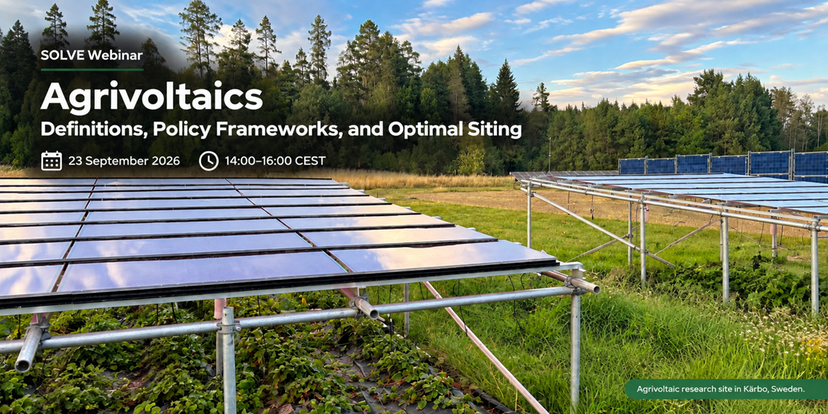
SOLVE Webinar: Agrivoltaics: Definitions, Policy Frameworks, and Optimal Siting
Date: 23 September 2026
Time: 14:00–16:00 CEST
Location: Online via Teams
Language: English
Registration is required.
About the Webinar
Join us for an open webinar hosted by SOLVE, focusing on agrivoltaic systems—the integration of agricultural production and solar energy generation through photovoltaic technologies.
The webinar will bring together researchers and experts from across Europe to discuss the definitions and key characteristics of agrivoltaic systems, current policy and regulatory frameworks in Europe and beyond, and approaches for identifying optimal locations and suitable areas for agrivoltaic deployment.
The presentations will be followed by a roundtable discussion, providing an opportunity to reflect on current challenges and future directions for agrivoltaics.
Programme
14:00 — Opening of the meeting
14:05–14:15 — Welcome and Introduction
Assoc. Prof. Pietro Elia Campana
Mälardalen University, Sweden
14:15–14:30 — Anatoli Chatzipanagi
Joint Research Centre (JRC), Belgium
Status of agrivoltaic systems in Europe and beyond: Definitions and policy frameworks
14:30–14:45 — Prof. Christian Dupraz
INRAE – National Research Institute for Agriculture, Food and Environment, France
Agrivoltaics definitions and policies in France
14:45–15:00 — Dr. Max Trommsdorff
University of Freiburg / Fraunhofer ISE, Germany
Agrivoltaics definitions and policies in Germany
15:00–15:15 — Prof. Stefano Amaducci
Catholic University of the Sacred Heart, Italy
Agrivoltaics definitions and policies in Italy
15:15–15:30 — Dr. Michele Croci
Università Cattolica del Sacro Cuore, Italy
Approaches for optimal siting of agrivoltaic systems
15:30–15:35 — Coffee Break
15:35–16:00 — Roundtable Discussion
Led by Assoc. Prof. Pietro Elia Campana, Mälardalen University, Sweden
Abstracts & Bios
Ms. Chatzipanagi Anatoli (JRC, Belgium)
Status of agrivoltaic systems in Europe and beyond: definitions and policy frameworks
Abstract
Agrivoltaics is gaining increasing attention as a strategy to combine renewable electricity production and agricultural production on the same land, potentially reducing land-use competition while supporting the energy transition. However, its rapid development has also highlighted the importance of clear definitions and appropriate regulatory frameworks. This presentation provides an overview of the current state of agrivoltaics in Europe, examining the transition from pilot projects towards broader policy and market uptake. Different national policy approaches and regulatory models are discussed, together with key unresolved issues concerning agricultural activity, land eligibility, permitting, incentives, and the definition of agrivoltaic systems. The European experience is also placed in an international context to identify relevant lessons from emerging agrivoltaic markets outside Europe. Finally, the presentation discusses remaining gaps at EU level and recent institutional and policy initiatives aimed at facilitating the responsible deployment of agrivoltaics across Europe.
Short bio
Anatoli Chatzipanagi is a Project Officer in the Energy Efficiency and Renewables Unit of the European Commission’s Joint Research Centre (JRC), where she focuses on photovoltaics. Her work involves scientific and techno-economic analysis to support the accelerated deployment of PV in line with the EU climate and energy objectives, as well as stakeholder engagement and policy support. She leads the Commission’s annual assessment of PV technology maturity, development and trends, value chains, global markets and EU positioning, and is active in agrivoltaics. Her previous research focused on thin-film PV technologies and Building Integrated Photovoltaics (BIPV). She has also briefly worked in the field of sustainable mobility.
Prof. Christian Dupraz (INRAE, France)
Agrivoltaics definitions and policies in France
Abstract
Agrivoltaics (AVs) are defined and constrained by the French APER law dated 2023. Ground-PV projects are strictly forbidden on agricultural land in France with very few exceptions on long duration fallows. Therefore AVs are estimated to become the main PV sector in France within the next 10 years.
However, AVs projects in France must comply with very strict criteria: a minimum 90% of the agriculture crop yield calculated on the AVs area, a maximum 10% of the land surface lost for agriculture, a preservation of the farm income from agricultural products, a compulsory monitoring and reporting of agricultural yields. AVs projects are subject to a planning authorisation, a binding opinion from a local committee (CDPENAF) and, where applicable, environmental assessment and public-participation procedures. The process is extremely slow, and may take as long as 3-5 years before the array can be constructed. For several reasons, AVs are in deep trouble at the moment in France. On one side, strong supports of nuclear energy are campaigning against renewable energies and managed to reduce the target of renewable energies in the French multiannual energy planning. On the other side heavy requirements on AV projects by the APER law increase the CAPEX and LCOE of AV projects compared to standard ground-PV projects. More than 2 GWp of before-APER law projects (dated before 9 May 2024) are currently clogging up the calls for tenders published by the French Energy Regulatory Commission. No AVs projects were winners the last 2026 call. The government intention is to reduce drastically the public financial support to renewable energy production by publishing "neutral" calls where all technologies (wind, ground-PV, roof-PV, AVs, etc) are competing freely. AVs are not able to compete with wind projects or ground-PV projects dated before the APER law. AVs associations are campaigning to support the idea of either a dedicated AV call, or a premium support for AVs projects to compensate for the extra costs needed to fix the APER law high requirements. Advanced technologies such as agronomically optimized trackers are in trouble to compete with simple fixed panels technologies. Several AVs companies in France are facing deep trouble and reduce their payroll by firing part of their staff. A darker cloud poses an existential threat to the whole renewable energy sector : the far-right may win the presidential election in 2027 and is opposed to all renewable energies, including AVs.
Short bio
Christian Dupraz is a director of research at INRAE, Montpellier, France, with a focus on agroecology, agroforestry and agrivoltaism. He pionnered AVs research by setting up the first experimental AV array in 2010 in Montpellier and detailing the AV concept and efficiency in a fundational paper published in 2011. During the next decade he contributed to the design of dynamic AV systems with tracking panels monitored for optimisIng the crop productivity. He organised the first world congress on AVs in 2020, and since then has organized all the Agrivoltaics congresses, including the 2026 one in India next October. He is a member of the board of the French "France Agrivoltaisme" association, and is part of the scientific committee of the French national cluster on Agrivoltaics. He is a member of the French Agriculture Academy, and was the founding president of the European Agroforestry Federation and of the International Union for Agroforestry. He currently serves as the Editor in Chief of the "Agroforestry Systems" journal where several papers on agrivoltaics are published. He serves as an advisor to the French government on Agrivoltaic policy.
Dr. Max Trommsdorff (University of Freiburg, Germany)
Agrivoltaics definitions and policies in Germany
Abstract
Germany has developed one of the most advanced regulatory frameworks for agrivoltaics in Europe. Over recent years, agrivoltaics has been increasingly integrated into renewable energy, agricultural, and planning legislation, complemented by technical standards such as DIN SPEC 91434. These developments have significantly improved market access and created a clearer framework for combining agricultural production and photovoltaic electricity generation.
At the same time, the German agrivoltaics market remains strongly shaped by the economic and regulatory conditions for conventional ground-mounted PV. While agrivoltaic systems can offer advantages in terms of land-use efficiency, agricultural resilience, and access to additional land, their higher investment and operating costs remain a major challenge. Recent changes and ongoing discussions concerning support mechanisms therefore have important implications for the competitiveness of different agrivoltaic system designs.
The presentation will provide an overview of the current German framework and market situation, discuss recent policy developments, and highlight key research and implementation challenges for the further development of agrivoltaics in Germany.
Short bio
Max Trommsdorff is an agrivoltaics researcher at Fraunhofer Institute for Solar Energy Systems ISE and the University of Freiburg, Germany. He has been working on agrivoltaics since 2014 and has contributed to its development from early research and demonstration projects toward large-scale implementation and policy integration. His research focuses on the interactions between photovoltaic systems and agriculture, including system design, agricultural performance, economics, and regulatory frameworks.
At Fraunhofer ISE, he established and led the Agrivoltaics group and has coordinated numerous national and international research activities. He is actively involved in international agrivoltaics collaboration, including the IEA PVPS Task 13, and has contributed to the development of German standards and policy frameworks for agrivoltaics. He is also a co-organizer of the international AgriVoltaics Conference series and has been involved in the conference since its first edition in 2020. At the University of Freiburg, he conducts research and teaching on agrivoltaics and sustainable land-use systems.
Prof. Stefano Amaducci
Agrivoltaics definitions and policies in Italy
Abstract
This presentation provides a concise overview of the definitions, regulatory framework, and policy landscape for agrivoltaics in Italy. It introduces how agrivoltaic systems are defined and classified within the Italian context, highlighting the key requirements for integrating agricultural production with photovoltaic electricity generation while preserving agricultural land use. Particular attention is given to the evolution of national regulations, technical standards, and support mechanisms, including the criteria used to distinguish agrivoltaic systems from conventional ground-mounted PV installations. The presentation concludes by highlighting current implementation challenges and the role of policy and technical standards in supporting the sustainable deployment of agrivoltaics in Italy.
Short Bio
Stefano Amaducci is Full Professor of Agronomy and Field Crops at the Università Cattolica del Sacro Cuore in Piacenza, Italy, where he directs the AgriPV_LAB experimental infrastructure and coordinates the Bachelor's degree programme in Agricultural Sciences and Technologies. A pioneer in agrivoltaics research since 2014, his work focuses on crop ecophysiology, agrivoltaic systems, carbon farming, precision agriculture, and the optimisation of integrated food–energy systems. He is co-founder of TSPIN, an academic spin-off developing advanced Digital Twins for system optimisation, and President of the remote-sensing consortium CITIMAP. He served as Chairman of the AgriVoltaics 2022 World Conference and contributed to the development of Italian technical standards for agrivoltaic systems.
Dr. Michele Croci (Università Cattolica del Sacro Cuore, Italy)
Approaches for optimal siting of agrivoltaic systems
Abstract
Where agrivoltaics can be deployed is not one question but several, and the method has to change with the scale at which it is asked. This talk follows the same problem down two levels, and the comparison it invites is not between the resulting numbers, which rest on different bases and are not commensurable, but between what each scale is able to see. At the global scale, suitability rests on coarse land-cover, climate and terrain layers. In the areas classified as excellent, agrivoltaics could supply some 66–385 PWh of electricity per year. Adding a single infrastructural criterion, proximity to existing power lines, cuts that estimate by roughly a factor of six. A headline potential is therefore an upper bound conditional on the constraints it has been asked to respect, not a map of where to build. At the national scale the binding criteria are different. In a two-stage assessment for Italy, regulatory and physical exclusions left 6.23 million hectares of farmland evaluable, scored through a spatially explicit fuzzy multi-criteria model. A second stage then screened what no raster map can represent: whether an individual field remains workable by machinery once panel rows are installed. That criterion alone removed more than half the evaluable land, leaving 1.49 million fields covering 2.95 Mha, concentrated in the 1–20 ha band. What remains is around 1.9 TWp, roughly twenty-four times Italy's 2030 solar target of about 80 GWp, and some 24% of the country's utilised agricultural area, against the 0.8–3% ceiling set by Law 4/2026. Once the analysis descends to the field, the limit on agrivoltaics in Italy proves to be regulatory rather than physical.
Bio
Michele Croci is a researcher in agronomy, remote sensing and crop modelling at Università Cattolica del Sacro Cuore, Piacenza, and co-founder of TSpin srl, a spin-off working on the optimisation and monitoring of agrivoltaic systems. His research combines satellite and UAV data with crop growth modelling, applied to agrivoltaics, precision agriculture and yield prediction. He also works on GIS-based techniques to optimise agronomic and technical processes, including the selection of suitable sites for the development of agrivoltaic plants. He teaches Basics of Precision Farming