
Svante Arrhenius – Sweden’s first Nobel laureate and climate research pioneer
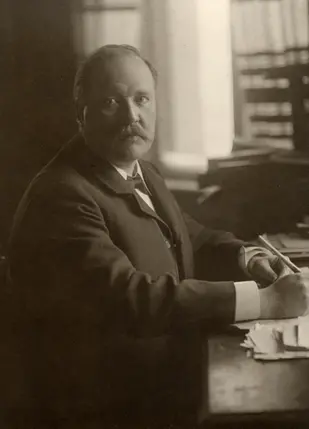
Svante Arrhenius at his desk.
- Svante Arrhenius was the scientist who discovered how salts dissolve spontaneously in water and conduct electricity.
- His theory of electrical dissociation encountered opposition from his superiors at Uppsala University, but soon won recognition and became the foundation of modern physical chemistry.
- His best-known contribution to chemistry is the Arrhenius equation, which describes how reaction rates depend on temperature.
- He was awarded the Nobel Prize in Chemistry in 1903 for his theories on electrolytes, and was the first Swede to win a Nobel Prize.
- He was one of the first to calculate in quantitative terms how carbon dioxide affects the Earth’s temperature – he presented his first climate model as early as 1896.
From student to trailblazer – Arrhenius’s years in Uppsala
Svante Arrhenius arrived at Uppsala University in 1876 as a young student with a keen interest in mathematics and physics. He was soon attracted by experimental physics and began to work at the Department of Physics, where he studied electrical conductivity.
Arrhenius wanted to choose physics as his main subject while conducting studies in the borderland between physics and chemistry. However, the professor of physics in Uppsala considered this inappropriate and thought he ought to choose chemistry as his main subject. He had to apply to the Royal Swedish Academy of Sciences in Stockholm to find someone who was willing to be his supervisor.
His doctoral project concerned the way in which salts dissolve in water and conduct electricity. His theory of electrolytic dissociation proposed that salts divide into ions spontaneously when they dissolve in water, without any need to add electricity. This was a radical idea that challenged established theories.
When the time came to defend his thesis in Uppsala, he received a low grade. This limited his chances of an academic career at the university and he had to make do with an unsalaried post as docent in physical chemistry.
A few years later, Svante Arrhenius presented an equation describing the relationship between temperature and reaction rate. Today, it is known as the Arrhenius equation and is a fundamental tool for chemists all over the world.
A pioneer in climate modelling
Towards the end of the century, Arrhenius began to take an interest in the Earth’s climate. Using physical calculations, he investigated how changes in the amount of carbon dioxide in the atmosphere could affect the temperature on Earth. He concluded that a 50 per cent increase in the carbon dioxide level would cause the average temperature to rise by more than 3 degrees. He later revised this figure to 1–2 degrees, which is more or less the same as in modern calculations (1.5–2 degrees). He had also calculated that heating would be faster at greater latitudes than near the equator.
What makes his work particularly remarkable is his methodology. Arrhenius used data on infrared radiation and absorption, and made manual calculations that took months to complete. He divided the Earth into zones and calculated how thermal radiation is balanced between the Earth’s surface and atmosphere – an early example of climate modelling.
Arrhenius believed it would be 3,000 years before the carbon dioxide level had risen by 50 per cent. Interestingly enough, he did not see higher carbon dioxide levels as a threat, but rather as a factor that could counteract a future ice age and benefit agriculture in cold regions.
He carried out this work at Stockholm University College, where he advanced from lecturer in physics to professor of the same subject and ultimately vice-chancellor.
His climate model was criticised and forgotten, but having been rediscovered in the 1950s, it is now the foundation of modern climate research. It is now evident that the carbon dioxide level has gone up considerably faster than Arrhenius foresaw, but his calculation of the relationship between carbon dioxide and average temperature stands up well even today.
First Swedish Nobel prize for theory that changed chemistry
Although Arrhenius’s theory of electrolytic dissociation encountered criticism in Uppsala, it soon won international recognition. This was partly because of support from prominent fellow researchers Jacobus van ’t Hoff in Amsterdam and Wilhelm Oswald in Riga. The theory explained why certain solutions conduct electricity and laid the foundation for modern physical chemistry. His work also had practical consequences in areas such as electrochemistry and battery technology.
In 1903 Arrhenius was rewarded with the Nobel Prize in Chemistry. This was the first time a Swede had received a Nobel Prize and helped strengthen Sweden’s position in international science.
At the banquet on Nobel Day, 10 December 1903, Arrhenius’s former chemistry professor in Uppsala, Per Teodor Cleve, also put the record straight:
“Twenty years ago, a young Bachelor’s student showed up at my laboratory, saying: ‘Professor, I have come up with a new chemical theory.’ Well aware of the fact that the mortality rate among such offspring of genius is very high, I listened to the young man’s views on the connection between chemical affinity and electric conductivity, but I must confess that they were utterly beyond my comprehension.”
Arrhenius continued to develop his ideas and wrote several influential books. His research helped establish physical chemistry as a separate field of research, in which mathematics and physics are used to understand chemical processes.
A many-sided optimist
Svante Arrhenius was married twice. He had four children and was the grandfather of chemist Svante Wold and professor of clinical bacteriology Agnes Wold.
Arrhenius was not just a theorist; he was also a man with wide-ranging interests in arts and humanities. He approached the world with great curiosity and wrote popular science books on subjects ranging from cosmology to the origins of life. He was especially interested in ways of bringing scientific ideas to the attention of a wider audience and firmly believed that science promised humanity a bright future.
He also had a social network among the international scientific elite and participated actively in academic debates. On some accounts, however, he could be stubborn and defend his ideas very forcefully.
In his free time, he enjoyed nature and travelling. He spent time abroad, which enriched his international perspectives. His interest in big issues – such as the climate, the universe and the future of humankind – confirms that he was not a person to content himself with narrow specialisations.
Involvement in racial biology
For a while, Svante Arrhenius was a member of the governing board of the Swedish Society for Racial Hygiene. The society advocated the establishment of a state institute of racial biology, which came about in 1922.
In certain contexts, Arrhenius expressed sympathy with the idea that science and social planning could be used to ‘improve’ the human race. These ideas were relatively widespread in his time, but are now severely criticised and associated with serious ethical problems.
Text by David Naylor and Ulrika Hurtig.