
Meet the new Director of Studies at the Department of Mathematics: “With good teaching, students feel that we care”
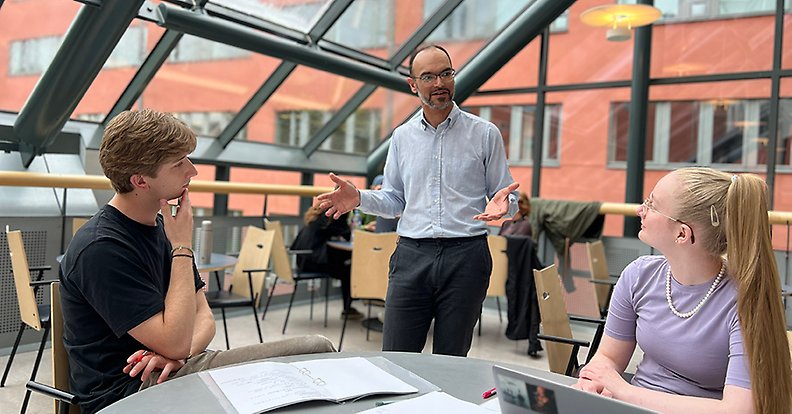
Seidon Alsaody has taught thousands of students over the years. Students’ questions have not only helped him develop his teaching – they have also given him new perspectives on mathematics. Photo: Marie Chajara Svensson
Seidon Alsaody, an award-winning teacher and researcher in algebra and algebraic geometry, became the new Director of Studies at the Department of Mathematics on 1 July. He succeeds Inger Sigstam, who retires after many highly appreciated years in the role. For Seidon, the new position means less time in the classroom, but also an opportunity to contribute to education in a new way and to take a more long-term approach to educational matters at the department.
Earlier this year, he was awarded the Uppsala Union of Engineering and Science Students’ (UTN) Gold Medal of Merit for his contributions to students at the Faculty of Science and Technology. The citation highlights his ability to convey mathematics as something “beautiful, comprehensible and human” – a description that means a great deal to him.
“I am particularly touched that the students highlight something that I myself strive to convey. It shows the power of mathematics and what we need to preserve in our teaching.”
Over the years, Seidon has taught thousands of students in some of the faculty’s largest and most fundamental mathematics courses. He is keen to emphasise that teaching is not only about explaining things to others, but also about deepening your own understanding.
“You discover new connections and new ways of looking at things that broaden your own understanding of mathematics. Students’ questions have also taught me to teach better and to choose the examples, explanations and exercises that work best.”
A role built on collaboration
“Teaching is a dynamic process. We are all used to discussing mathematics and research ideas with each other, and I am eager to bring that same approach to teaching.”
Accepting the position as Director of Studies was not an obvious decision. Seidon enjoys teaching, and the new role means that he will have to reduce the amount of teaching he does. Teaching now accounts for around 20 per cent of his working time, roughly equivalent to one large course per year.
“Fortunately, we have many excellent teaching colleagues whom the students will have the pleasure of meeting, so they won’t miss me. I, on the other hand, will miss them!”
What ultimately persuaded him was the support of his colleagues and the sense that he could contribute to teaching at another level.
“Collaboration with my colleagues is really the entire basis for the mandate that comes with the role. Our department is also at an interesting stage, with a new Master of Science in Engineering programme starting and many committed colleagues running different projects or holding important roles. There are many opportunities.”
As Director of Studies, he wants above all to create good conditions for teaching and for colleagues who want to develop their courses. He repeatedly stresses the importance of dialogue among colleagues. The Department of Mathematics is full of ideas and experience, and almost every course contains something that others could learn from.
“Teaching is a dynamic process. We are all used to discussing mathematics and research ideas with each other, and I am eager to bring that same approach to teaching.”
A language for talking about teaching
In recent years, Seidon has been involved in educational development, including through TUR, the faculty’s Council for Educational Development. The experience has given him both a broader perspective on teaching and a more precise language for discussing educational issues.
“It may sound a bit vague, but teaching is really like mathematics in that respect: if you have a scientific language that allows you to formulate your problems precisely, it becomes easier to solve them and see the connections between them.”
The link between teaching and research in mathematics is closer than many might think.
“Mathematics is built on precise structures and statements that are formulated and proved; this is done in the same way in cutting-edge research as in our introductory courses.”
For Seidon, there is therefore no contradiction between being an active researcher and a committed teacher.
“Research adds value. Even in introductory courses, I have often felt that I have been able to teach better precisely because I have been able to make connections to research.”
Building a strong study environment
For Seidon, students’ sense of belonging is closely connected to the teaching itself. Much of the foundation for community, mathematical identity and wellbeing is laid in the interaction between students and teachers in the classroom.
“With good teaching, students feel that we care: they understand that the teacher has put a great deal of effort into their learning. I think that this encourages them to take their own learning even more seriously, particularly if we engage with them well, both in our teaching and in all the activities organised by the department.”
As Director of Studies, he hopes that both students and teachers will feel that they can turn to him.
“That I listen to them, and that they know they can – and are very welcome to – come to me with any questions they have about teaching.”
”I don’t think there is a one-size-fits-all solution.”
Not all academics have the same motivations or strengths. Some thrive with a greater emphasis on teaching, others on research, and many somewhere in between. Seidon sees this variation as an important asset for the department.
“We are a large and broad department, and it is extremely enriching to be able to have in-depth conversations about teaching with some colleagues and about research with others – sometimes the same people, sometimes different ones. For our students, it is important that we have that diversity among our teachers. I intend to have a dialogue with all colleagues who teach, so that I can understand what each individual colleague needs. I don’t think there is a one-size-fits-all solution.”
At the same time, he sees a need to talk more about the quality of teaching, rather than simply the amount of teaching someone does.
“Of course it is difficult, but assessing the quality of research is difficult too.”
He mentions the French term enseignant-chercheur – teacher-researcher.
“In my utopian vision of the university, all academic staff would see themselves in that way.”
From the classroom to the research frontier
Seidon’s research is in algebra and algebraic geometry. More specifically, he studies algebraic groups – groups of symmetries in higher dimensions – and their connections to different types of algebras. He is particularly interested in what are known as exceptional groups.
“They are fascinating because they appear out of nowhere in the classification and are related to different types of algebraic systems with interesting geometric structures. Since I want to understand this over so-called rings and schemes, such as curves and surfaces, rather than in the classical way over one point at a time, I use tools from modern algebraic geometry. I find that these tools give you more than you put into them, and that is what first sparked my interest in the field.”
What drives his research is the desire to understand structures at a deeper level.
“When you begin to see how an algebraic or geometric structure really works and develop a deeper intuition for it, and for how different structures are connected, that, to me, is the crowning achievement.”
He is currently putting the finishing touches to a paper on exceptional groups of type E8. His next project will focus on other exceptional groups and their connections to string theory, in collaboration with his doctoral student and the student’s co-supervisor, who is a professor of theoretical physics.
“It is fascinating to think about how such precise mathematical structures can model our universe. It really is exciting!”
Facts: Seidon Alsaody
Education: Bachelor's degree in Physics, Master's degree in Mathematics, and PhD in Mathematics.
As a student, I was: ... thrilled to be a student at Uppsala University.
Favourite place in Uppsala: All the different cafés around town.
A book I'd recommend: Karin Boye's collected poems.
I like listening to: Powerful singing voices in languages I don't understand.
Something I've always wanted to learn: More languages!
What inspires me: Good teachers.
The best thing about being a mathematician: Discussing fascinating things with interesting people!
Links
UppTalk (in Swedish) with Seidon (the Faculty of Science and Technology’s popular science seminar series): “Algebra + geometry – the key to mathematics’ hidden dimensions” (recorded 21 April 2026)
Citation for Seidon’s 2026 UTN Gold Medal of Merit (in Swedish).