
Sociology students gained important insights directly from Ukraine
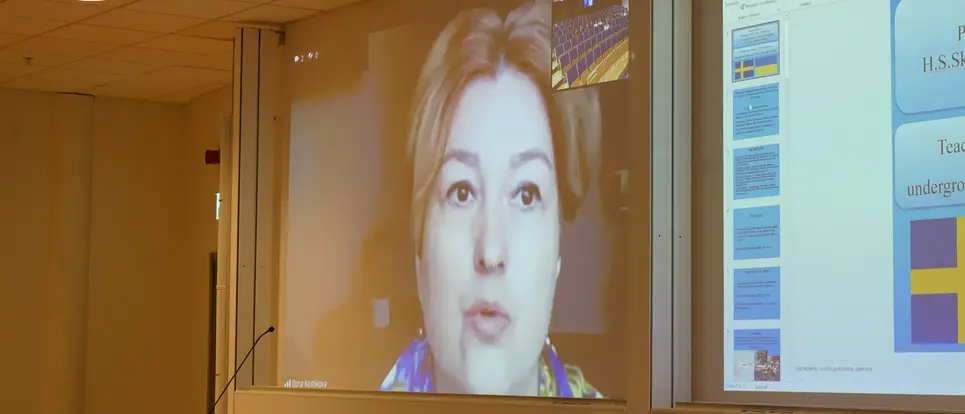
This Zoom lecture by Ukrainian lecturer Professor Ilona Kostikova is one of many international elements of the course. Photo: Erik Åstrand, Uppsala University.
On 29 May, Ilona Kostikova, Professor of Education at Kharkiv National University in Ukraine, lectured remotely to students in the Bachelor’s Programme in Sociology on teaching in schools and teacher education in universities in a war situation.
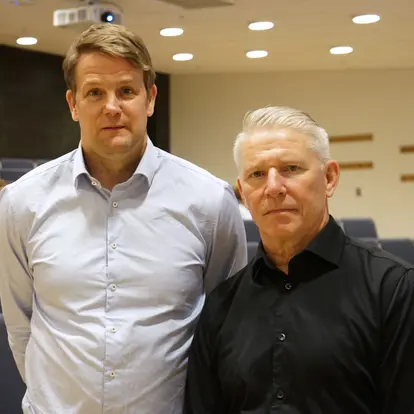
Senior lecturers Henrik Pålsson-Edgren (left) and Jörgen Mattlar, lecturers and researchers at the Department of Education. Photo: Erik Åstrand, Uppsala University.
The lecture, which was part of the course ‘Utbildning och sociala skillnader’ (“Education and social differences”) within the Bachelor's Programme in Sociology, provided insights into how important it is to maintain some form of normality in life, in the midst of all the misery and worry that war entails. Schools and what they teach are very important in this context.
Henrik Pålsson-Edgren, senior lecturer at the Department of Education, organised the lecture.
“Professor Ilona Kostikova's lecture talked about how they are working with teaching in schools and teacher education study programmes at universities in the city of Kharkiv in the midst of full-blown war. To be able to guarantee safety, the subway system has been commandeered, where a very advanced and well-organised school system has been established covering the earliest years of compulsory school all the way up to upper secondary school. Under as safe conditions as possible, the pupils are transported to these schools to give them the opportunity to go to ‘normal school’ and interact with other schoolchildren,” he says.
For more and deeper insights
It is generally valuable for sociology students to understand the importance of education in the context of society as a whole, but of course it is also always important to gain more knowledge and insights about the very serious, and in many instances catastrophic, situation in Ukraine, and not just from traditional media, podcasts and social media,” emphasises Henrik Pålsson-Edgren.
“It’s beneficial for the students to meet with, listen to and talk to a teacher from Ukraine so they can learn about how, despite extremely difficult conditions, teachers there are trying to maintain the education system and a relatively normal existence for children so that everyday life keeps on functioning as normally as possible,” says Henrik.
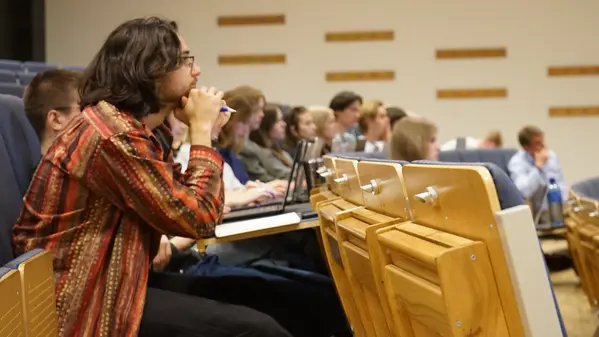
The students gained an understanding of how education, particularly in times of crisis, can play a nation-building role. Photo: Erik Åstrand, Uppsala University.
In sociology, knowledge of collective identities of various kinds is central, which was also a main theme in Ilona Kostikova’s lecture.
“The students gained an understanding of how education can serve as a nation-building and ‘uniting’ activity for a country at war where its very existence is de facto in danger. So it is really no wonder that in Ukrainian schools they sing the national anthem virtually every day and are emphasising the Ukrainian language and culture, which was a bit of an eye-opener for the students,” says Henrik Pålsson-Edgren.
Regular international elements in the programme
Henrik Pålsson-Edgren also aims to always include international elements in the teaching of the programme, such as bringing in visiting lecturers through Erasmus exchanges. These international perspectives are very important for the students, he argues.
“We’ve had a researcher from France and Rwanda, Eric Mutabazi, who gave a lecture on the content of textbooks in Rwanda decades before the genocide. Another teacher and researcher from France, Marie Elise Hunyadi, lectured on the French education system from an educational sociology perspective. A third example was researcher Maria José Flores’ lecture on how Franco’s regime in Spain affected education in Spain. I always try to plan in visiting lecturers when I can,” he explains.
Johan Ahlenius
Facts
Students from both the Bachelor’s Programme in Sociology and the upper secondary school teacher education programmes were invited to attend this lecture.
The Bachelor’s Programme in Sociology at Uppsala University is a collaboration between the Department of Sociology and the Department of Education.