
Gerd Enequist – pioneer in human geography and Uppsala University’s first female professor
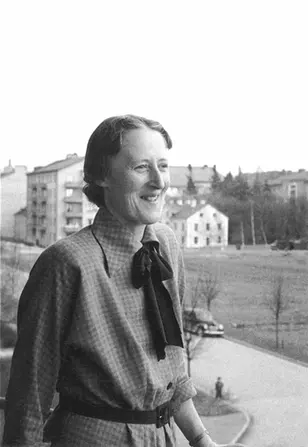
Gerd Enequist in Uppsala in 1949, the year she was appointed Professor of Human Geography.
- In 1949, Gerd Enequist became Sweden’s first professor of human geography.
- She was the first woman to be appointed professor at Uppsala University.
- As a member of the Road Planning Committee from 1954 to 1958, she played a part in national spatial planning.
- Enequist was a member of the editorial committee for Atlas över Sverige (Atlas of Sweden) and was responsible for several of the map sheets.
- She was committed to the cause of gender equality and played an active role in the debate on women’s ordination during the 1940s and 1950s.
In 1949, Gerd Margareta Enequist (1903–1989) became Sweden’s first professor of human geography and, at the same time, the first female professor at Uppsala University. Her appointment marked both a personal breakthrough and the establishment of human geography as an independent academic discipline.
As head of subject, she played a pivotal role in the emergence of modern human geography in Sweden. At Uppsala University, she built up a research community that quickly made an impact. During her time, around twenty researchers obtained doctorates, several of whom later became professors.
Enequist’s work was characterised by a firm belief in the role of science in society and a close link between research and practical application, notably in her analyses of regional disparities and their significance in spatial planning.
Reading the landscape
For Gerd Enequist, the landscape was the key to understanding the conditions influencing people’s lives. She emphasised the importance of field studies and argued that knowledge arises from engagement with real-world environments – villages, towns and everyday landscapes. In her view, studying both rural and urban environments enabled researchers to understand how human labour and social development have left their mark on the landscape. Her focus was on the interaction between people and nature, rather than on each in isolation.
This approach gave human geography a clear empirical foundation and a close link to contemporary social issues.
 Zoom image
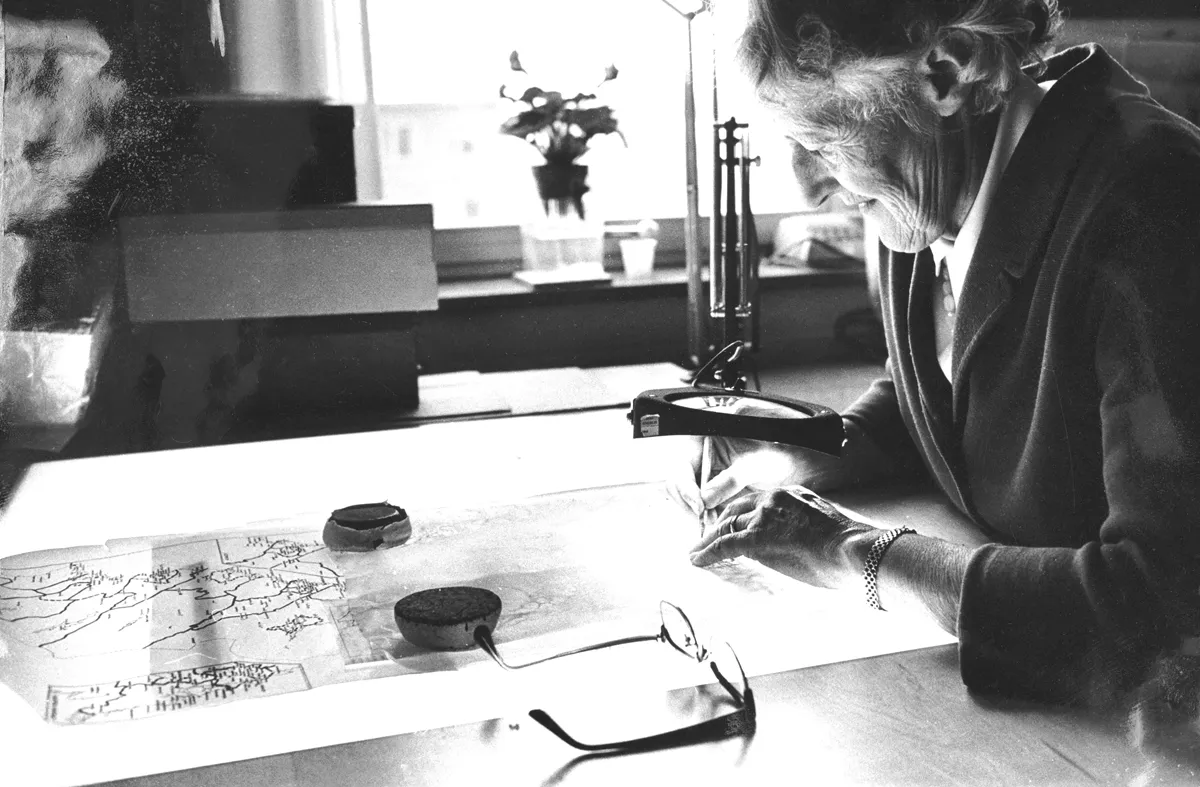
Gerd Enequist in 1968.
Maps as knowledge
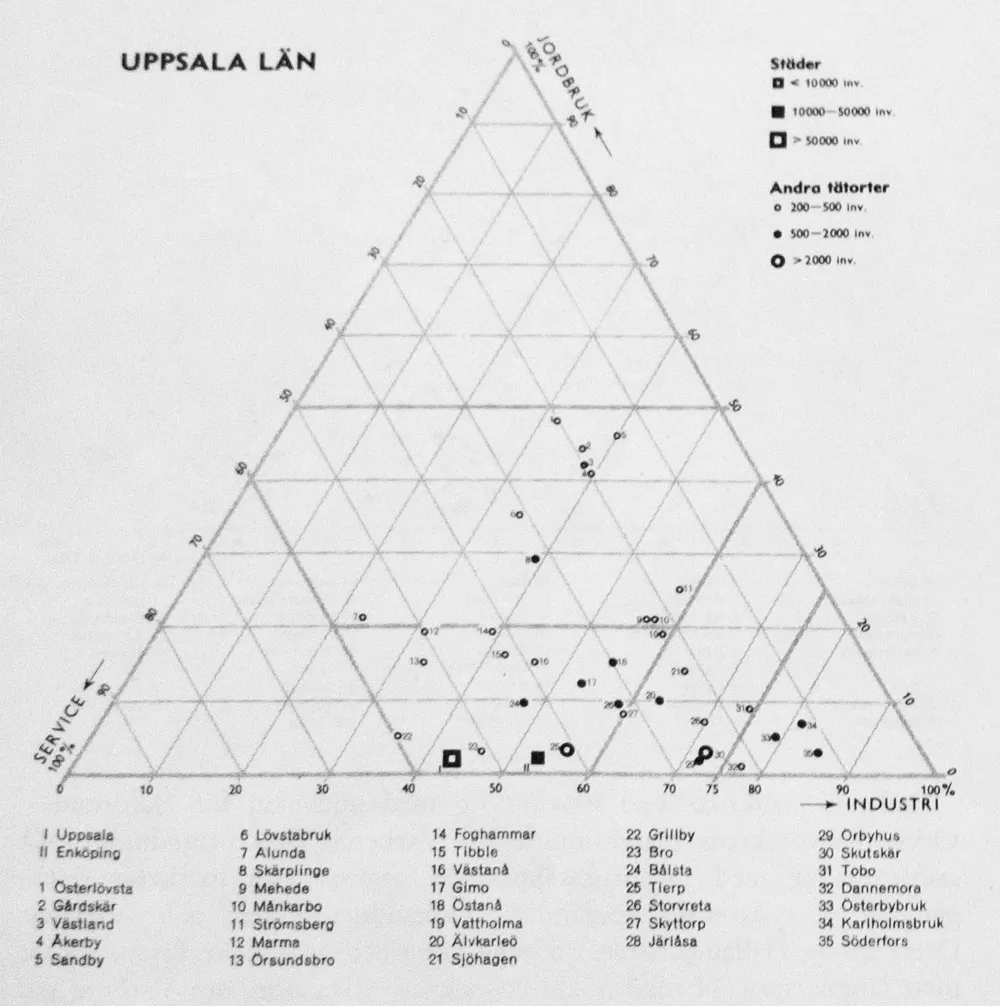
One of Gerd Enequist’s most significant contributions was the development of triangular diagrams for analysing the economic structure of localities. The method made it possible to compare three variables – agriculture, industry and services – simultaneously and to illustrate their interrelationship as proportions of a whole.
This type of visualisation made it possible to position different towns and regions in relation to one another and classify them according to their economic structure. The diagrams gave visibility to regional variations, settlement patterns and the predominant economic activities in different areas.
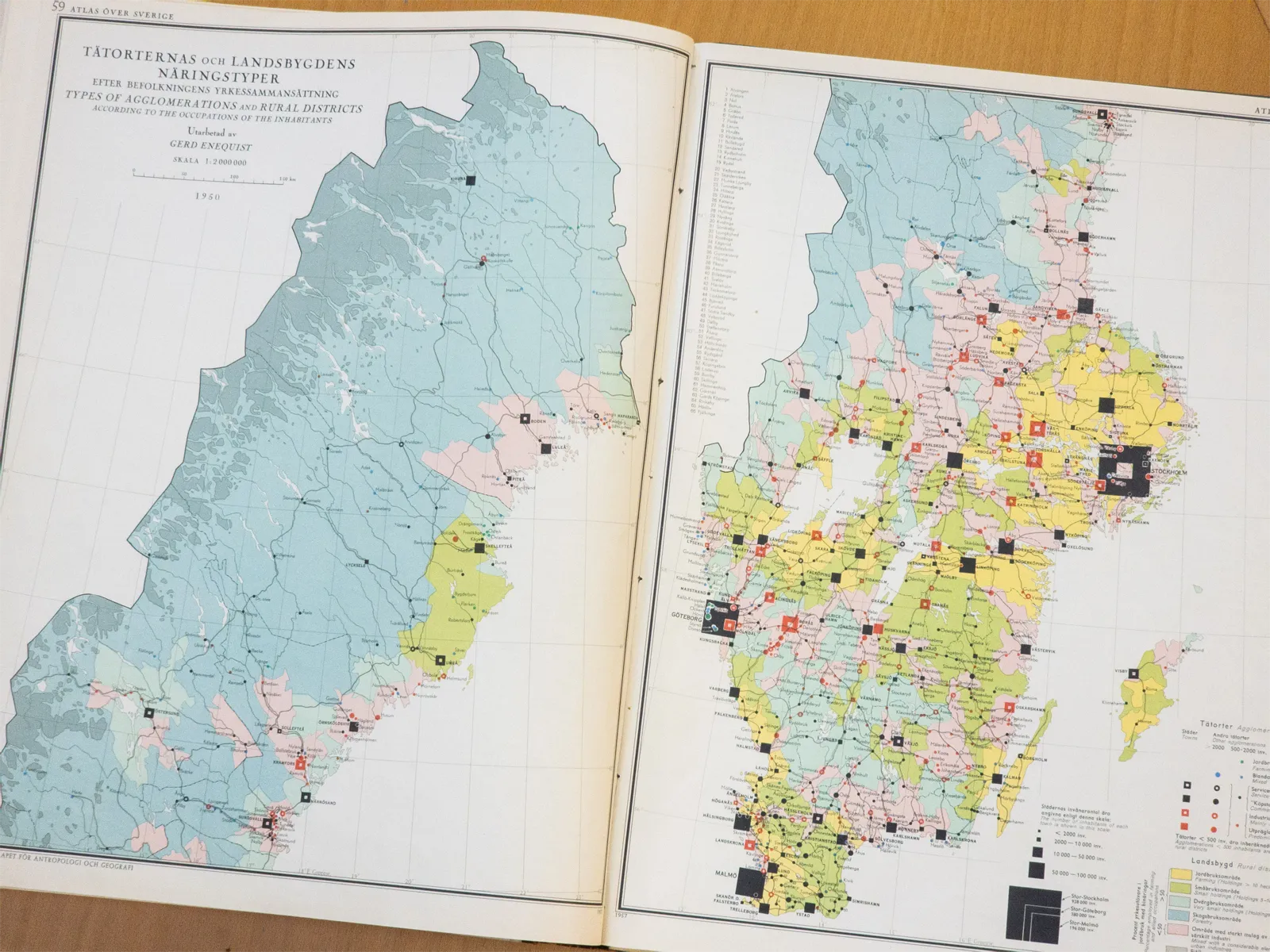
These analyses were used in the Atlas över Sverige (Atlas of Sweden, 1953–1971), in which Enequist was responsible for several map sheets. Here, cartography and social analysis were combined to describe regional structures.
Enequist viewed the map as a key scientific tool for communicating and interpreting complex relationships within society. Her work helped to make geographical knowledge more accessible and useful outside academia.
“It is a very grave deficiency that our country lacks a scientific description of Sweden, and it is my view that we must focus our efforts on producing one.”
– Gerd Enequist advocates the creation of a Swedish atlas in her inaugural lecture as a newly appointed professor, October 1949.
 Zoom image
One of the map sheets from the Atlas of Sweden produced by Gerd Enequist. It shows the division of the country into different types of economic activity, which are indicated by different colours on the map.
 Zoom image
One of Gerd Enequist’s triangular diagrams showing how communities in Uppland are distributed across the three axes of agriculture, services and industry.
Advocate for geography as a whole
Enequist regarded geography as a coherent field of knowledge. She compared the subject to medicine, where a shared object of interest – the human being – provides a common focus for different perspectives. In a similar way, she considered that the Earth’s surface served to give a fundamental unity to the study of geography. When geography was divided into physical geography and human geography, she was critical. She argued that this division risked undermining the overall perspective. She also emphasised that human geography remained dependent on knowledge of natural conditions such as soil types, climate and landscape.
Her work was characterised by repeated endeavours to strengthen the position of human geography within the discipline of geography.
Research that shaped spatial planning
Enequist had a firm belief in the potential of science to contribute to social progress. She took a particular interest in issues of regional imbalance and the rural exodus, which she saw as reflecting a lack of knowledge in planning processes.
For her, research was closely linked to practical social issues. She herself played a part in national spatial planning as a member of the Road Planning Committee from 1954 to 1958.
Through her students and their subsequent work, her ideas also came to influence urban and regional planning in Sweden during the post-war period.
Committed to justice and gender equality
Gerd Enequist was a woman of strong principles and was deeply committed to issues of justice and gender equality. She played an active role in the debate on women’s ordination during the 1940s and 1950s and argued that women should enjoy the same conditions as men.
When her opinions fell on deaf ears, she decided to step down from her roles within the church, including her position on the Uppsala Parish Council. Her actions demonstrate a consistent stance on issues relating to women’s rights.
Fredrika Bremer was a major source of inspiration for Enequist and helped shape her views on the situation of women in society.
Gerd Enequist and Uppsala University today
Gerd Enequist’s work had an enormous influence on the development of human geography at Uppsala University. As the first professor in the subject, she helped to establish and shape a research and teaching environment that would prove to have a lasting impact.
Her emphasis on the interaction between people and the landscape, as well as her use of empirical field studies, were key factors in the development of the subject. Her work on linking geographical knowledge to spatial planning also had a significant impact through the students who studied in Uppsala in her time.
As the University’s first female professor, she has a rightful place in the University’s history and in efforts to raise the visibility of women’s contributions to academia.
Text by Fatemeh Khudadadi.
Further reading: Forsberg, G 2021 Gerd Enequist – Pionjär i byxkjol. Lärda i Sverige. Stockholm: Langenskiölds förlag