
Does it matter which Migration Agency official handles or decides an asylum case?

Foto: Mostphotos
That question has been examined by a group of researchers using register data from the Swedish Migration Agency and Statistics Sweden (SCB). The findings are published in a new Delmi report and show that officials’ gender, experience, educational background, or country of birth do not affect the outcome of asylum decisions.

Henrik Andersson. Foto: Mikael Wallerstedt.
In the Delmi report Who Are the Swedish Migration Agency’s Case Officers and Decision-Makers, and Does It Matter?, researchers Henrik Andersson, Kristoffer Jutvik and Linna Martén analysed approximately 55,000 first-time asylum applications and 814 case officers and decision-makers at the Swedish Migration Agency during the period 2020–2023.
Based on detailed register data, the report provides a unique picture of those working with asylum determination in Sweden. Its purpose is to contribute new knowledge about how the asylum process functions in practice. The findings show that the group of case officers and decision-makers at the Swedish Migration Agency is highly educated. More than 90 per cent have completed at least three years of post-secondary education, and one-third hold a law degree. Around 70 per cent are women, while just under 20 per cent were born outside Sweden.
A central aim of the study was to investigate whether the officials’ backgrounds are associated with asylum grant rates. The researchers found no statistically significant differences between women and men, between legally trained staff and those with other educational backgrounds, or between more and less experienced case officers.
“The findings provide no clear evidence that the background characteristics we examined systematically influence the likelihood of granting an asylum application. This is an important result from the perspective of legal certainty and procedural fairness,” says Henrik Andersson, Researcher with Uppsala Immigration Lab.
The researchers did, however, identify differences in processing times. More experienced officials have longer average processing times, although much of this difference can be explained by their greater involvement in more complex cases. The study also shows that processing times vary between applicants from different countries of origin.
The researchers therefore recommend further analysis of where in the process cases tend to become delayed and how workloads can be distributed more efficiently. Shorter processing times could benefit both applicants and their prospects for integration into society, while maintaining the safeguards necessary to ensure procedural fairness and legal certainty.
Ulrika Wahlberg
Rapport and Policy brief
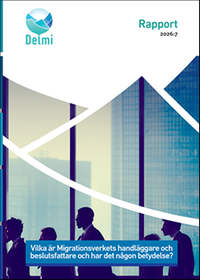
The report and policy brief Who Are the Swedish Migration Agency’s Case Officers and Decision-Makers, and Does It Matter? are available in Swedish for download from the Delmi website.
Vilka är Migrationsverkets handläggare och beslutsfattare och har det någon betydelse?
Podcast
Listen to the Delmi podcast, where researchers Henrik Andersson and Kristoffer Jutvik participate and discuss the findings of the report. (In Swedish)
Beslut i asylärenden: spelar handläggare eller beslutsfattares bakgrund roll för utfallen?