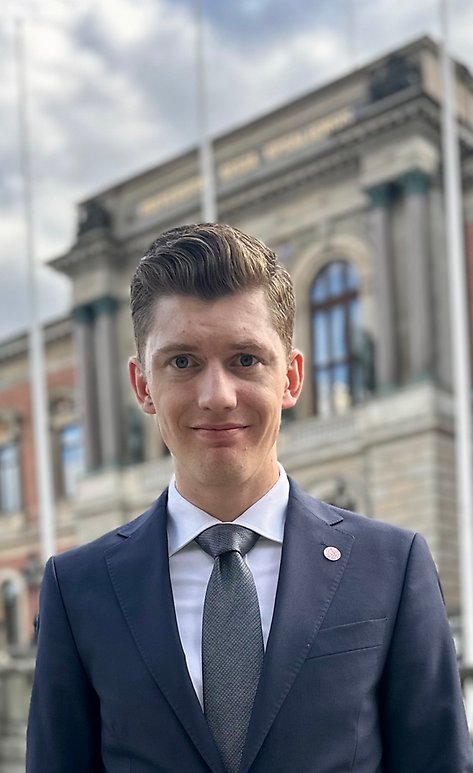
Svante Holgersson
Teaching assistant at Department of Mathematics; Teaching assistants
- E-mail:
- svante.holgersson@math.uu.se
- Visiting address:
- Ångströmlaboratoriet, Regementsvägen 10
- Postal address:
- Box 524
751 20 UPPSALA
Download contact information for Svante Holgersson at Department of Mathematics; Teaching assistants
Short presentation
I am pursuing a degree in Engineering Physics, alongside a Master’s Programme in Mathematics specializing in Financial Mathematics and a Bachelor’s Programme in Business Administration. My academic interests include financial mathematics, probability theory and statistics, with a particular interest in mathematics education and pedagogy.
Biography
I am pursuing a degree in Engineering Physics, alongside a Master’s Programme in Mathematics specializing in Financial Mathematics and a Bachelor’s Programme in Business Administration. In addition, I have an academic background in pedagogy, didactics, and mathematics education.
Alongside my studies, I have experience teaching mathematics at university level, including teaching and supervision, assessment and development of examinations, and the preparation of teaching materials. I also have experience in public outreach and science communication. In addition, I have held numerous academic positions of trust and other roles within education and science. My most recent appointment was as a jury member for the finalists of the Swedish Research Championship (Forsknings-SM) 2026.
Research
The following presents my most recent academic works. For those interested in reading the full works, they are available through the links below.
This study examines the relationship between firms’ financial performance and the tone of CEO statements in Swedish listed companies. Using 736 CEO statements from 184 companies, the study analyzes the relationship between profitability and the use of positive and negative language during the period 2021–2024. The results provide no robust statistical evidence of a relationship between financial performance and tone.
This thesis investigates chirality-induced spin selectivity, a quantum phenomenon in which chiral molecular structures can give rise to spin-dependent electron transport. The study uses a numerical single-particle model incorporating spin–orbit coupling to investigate how circularly and linearly polarized light affects spin polarization. The results show that the simulated light pulses did not alter the spin polarization in the studied model, which may, among other factors, be related to the absence of a metal substrate in the model.