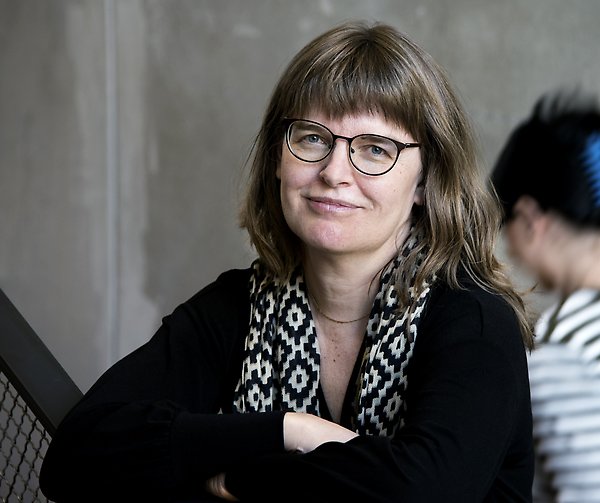
Karin Borevi, professor of political science at Södertörn University
Interview from 2025
Why did you choose to pursue a PhD in political science?
During my undergraduate studies, I discovered that I really enjoyed delving deeper into and analysing various issues. I was interested in history and considered pursuing it for a while, but ultimately I chose political science. Incidentally, the specific reason I applied to start a doctoral programme in political science was that the seminar leader for my thesis defence encouraged me to do so. That meant a lot to me.
What was the best and most difficult part of being a PhD student?
First, I should perhaps say that it is a little difficult to answer this question, as it has been quite a long time since I was a doctoral student myself. I am now actually closer to the experiences that doctoral students that I have been or I am currently supervising have shared with me. However, when it comes to my own time as a doctoral student, I would probably say that both the best and the most difficult thing was finally finishing. Completing the thesis manuscript. My thesis was a monograph, and I found it very difficult to decide when to put the final full stop. But at the same time, it was fantastic to see how all the different pieces fell into place in the final stages and to feel that I had finally finished.
Where do you work today? What does a normal workday look like?
I am now a professor of political science and have been working at Södertörn University in Stockholm for eleven years. I mainly work with research and teaching, but also have some administrative duties. My working days vary quite a lot depending on the period. Some weeks are more focused on teaching, when I am responsible for courses, lectures, seminars and examinations, while others are dominated by research, collaboration with colleagues on various research projects, writing articles and other publications, or applying for external funding. My working hours are largely determined by deadlines. But then, of course, there is a rolling schedule of meetings, research seminars and so on, and sometimes my job involves travelling to international conferences or other research trips. My duties are generally very varied.
Has your PhD experience at Uppsala University helped you in your career?
My doctoral studies provided me with an invaluable foundation for my continued career in academia. Those years were truly formative for me in terms of knowledge, experience and approach to research and teaching. I continued to work at the department for quite a few years after my thesis defence, and the experience I gained during that time has also been central to my continued career. I sometimes reflect on how I was trained in many ways, both as a researcher and a teacher, during my time at the Department of Government in Uppsala – and it is not entirely easy to distinguish my doctoral studies from the period that followed.
What is your best memory from your time in Uppsala?
It is very difficult to pick out one memory, and as I mentioned earlier, I still have many contacts and collaborations with colleagues at Uppsala University, both at the Department of Government and other departments and research environments. But my best memories are probably still centred around all the fantastic colleagues and friends I have met, worked with and socialised with. And I have a lot of magical memories from parties at the department that are still hard to beat!
What advice would you give to current PhD students in political science?
It may not be direct advice, but if I could tell tell my former self as a doctoral student something, it would be that the periods that felt slow or filled with doubt were often precisely when I was about to take a step forward in my dissertation work.
What would you say to someone who is considering applying to the PhD programme?
I can recommend doctoral studies in political science for anyone interested in studying politics. The programme provides a good foundation both for those who want to continue in academia and for those who are interested in other jobs in Sweden or abroad.
Education
Karin Borevi graduated from the PhD program in 2002 with the dissertation Välfärdsstaten i det mångkulturella samhället
Today, she is a professor of political science at Södertörn University