
Student Projects
Eco-friendly Defect Passivation in 2D Semiconducting Materials
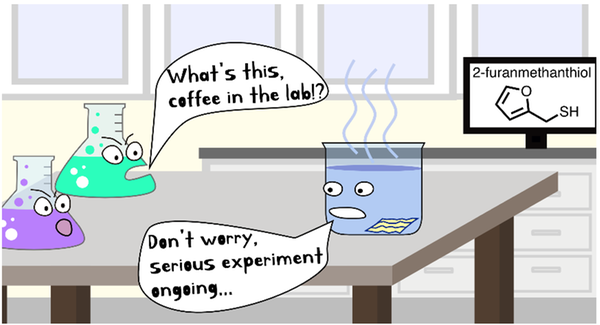
Since the 2010 Nobel Prize in Physics, related to the monolayer two-dimensional (2D) material graphene, the interest in similar materials has grown markedly. The discovery of 2D semiconducting materials based on transition metal dichalcogenides (TMDs), with the chemical structure MX2 (M=Mo, W; X=S, Se, Te), has opened up new interesting possibilities in optoelectronic devices, since they possess excellent properties well suited for optoelectronic applications, like high extinction coefficients due to the strong excitonic effects, exceptional mechanical properties, as well as chemical and thermal stability, to highlight a few. In this project, we will develop eco-friendly chemical treatments to passivate the defects of 2D materials, investigate the effect with photoluminescence and Raman measurements, and charge transport measurements. We will also develop the mechanistic picture for the defect passivation with X-ray spectroscopy.
Contacts
Probing charge dynamics in liquids with THz spectroscopy
%20image2.png)
The movement of charge is the basis of a wide range of fundamental processes in molecular physics, catalysis, biology, and materials science. Photo-excitations, the formation and breaking of chemical bonds as well as electron and proton transfer all involve delicately balanced movements of charge between different atoms and along specific molecular bonds. In our group, we are developing new spectroscopic methods based on ultrashort THz, optical and X-ray pulses to study charge dynamics in molecular processes with relevance in catalysis and light-harvesting. In this project, we will use single-cycle THz pulses generated from a femtosecond laser source to study the response of the solvent environment to the charge-transfer excitation of a transition metal dye. We will investigate how such an impulsive change of the molecular charge distribution interacts with the electric field of the surrounding polar solvent to understand the long-range charge propagation effects in homogeneous liquid environments following the creation of confined molecular electron-hole pairs.
Contacts
Seeing the making and breaking of chemical bonds with X-ray spectroscopy

Molecular bond breaking and bond formation are at the heart of molecular transformations. Understanding how to manipulate chemical bonds by breaking and making them in small and unreactive molecules such as in methane or carbon dioxide is of utmost importance for sustainable societies. This fundamental challenge in catalysis research is the basis for functionalizing the unreactive molecules into valuable compounds such as methanol. In our group, we perform time-resolved X-ray spectroscopic experiments at large-scale facilities like X-ray synchrotrons and X-ray lasers to follow such chemical reactions in real time of molecular transformations. In this project, we will investigate how specific homogeneous transition-metal catalysts mediate molecular transformations of small molecules. We will investigate how orbital interactions evolve on the relevant timescales from femtoseconds to microseconds and how they help breaking and making molecular bonds.
Contacts
Simulating fundamental processes in chemical reactions
.png)
Theoretical modelling of a chemical reactions often offers a unique way of understanding the fundamental properties that drive it. Most chemical reactions can be simply understood in terms of changes of electronic configuration and motions of nuclei. Computational studies involving quantum-chemical approaches hence have a very high degree of success in giving new and comprehensive insight. In our group, we focus on finding new ways to use time-resolved X-ray spectroscopy to understand chemical reactions at the level of atoms and electrons and for interpretation of the X-ray spectra we use quantum-chemical simulations. In this project we will simulate the time-resolved X-ray spectroscopic signatures for the photo-initiated dynamics in transition-metal complexes at the TDDFT, ROCIS and RASSCF level of theory. Furthermore, excited state molecular dynamics and reactivity simulations of such photochemical processes will also be explored. We will learn what it is that drives the reaction with the aim to find rules for how to best convert sunlight into new molecules.
Contacts
Fundamental Processes in Liquids

Our research addresses questions that are at the very basis of e.g. atmospheric chemistry, biophysics and our renewable energy related projects. This work focusses on intermolecular interactions in liquids (e.g. hydrogen bonds in water) and how they react to changes of the system like the solution of salts or varying temperatures. We aim to understand how such changes take effect on the molecular level and the tool for our investigation is photoelectron spectroscopy. This technique allows us to obtain spacial and temporal information about our samples. Thus we can investigate the surface propensity of solutes in a liquid or investigate dynamics on a femtosecond timescale. Since we strive for a holistic understanding, we also combine our experiments with investigations on clusters or molecules in the gas phase.
Our experiments usually take place at the synchrotron light sources SOLEIL, Paris (France), BESSY, Berlin (Germany), MAX IV, Lund (Sweden) or LNLS / SIRIUS, Campinas (Brazil). During the experiments we work closely together with scientists from other institutions with diverse scientific backgrounds.
Interested students ideally have a background in chemistry, physics or a related subject and should be open to acquire knowledge from other scientific fields since our projects often use methods from physics applied to questions motivated from chemistry.
Contact
Biophysics and Biochemistry
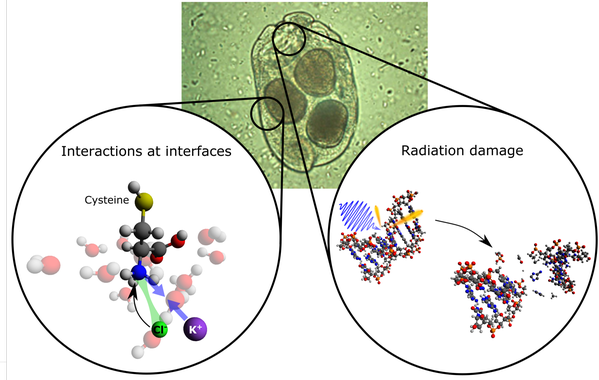
Our group addresses how biological processes work on the molecular scale and we employ photoelectron spectroscopy to obtain the desired, molecular-level information. Currently, we are working on two main topics:
- Radiation-induced damage to biologically relevant molecules
- The surface propensity of organic molecules in aqueous solutions
Radiation-induced damage
Whenever we travel in high altitude (e.g. flying in a plane) or receive an X-ray of the skeleton, we are subjected to radiation induced damage. If high-energy photons interact with matter they can trigger a multitude of reactions we currently lack detailed knowledge of. Consider two cases: A photon hits a biomolecule directly and ionizes it. The molecule may either dissociate directly or undergoes further relaxation and then breaks apart. Which of the two cases takes place? That is determined by which molecular level has been initially ionized and the structure of the molecule. However, we are currently not able to predict precisely which parameters favour one over the other process and that’s what our research focusses on.
Surface propensity of molecules
The biological relevance of the second aspect of our research, the surface propensity of biomolecules, becomes apparent when considering all the interfaces between aqueous solutions and e.g. protein surfaces or cell membranes in the body. We try to learn under which conditions ions and molecules are either repelled or drawn to these interfaces and what the driving forces for these dynamics are. By understanding these, we contribute to resolving questions about e.g. protein folding and the transfer of molecules through membranes. This aspect of our research is closely related to the fundamental properties of solutions, which is another one of our research topics.
We use synchrotron light sources in Europe and abroad for our experiments. The most commonly used synchrotron facilities by our group are SOLEIL (Paris, France), BESSY II (Berlin, Germany), MAX IV (Lund, Sweden) and SIRIUS (Campinas, Brazil). The research projects are carried out in collaboration with other researchers from all around the globe and with very different scientific backgrounds. Therefore, interested students should be open to acquire knowledge from other scientific fields but their own as part of the project work and should have a background in biology, chemistry, physics or a related field.
Contact
X-ray spectroscopy of bimetallic complexes
%20image1.png)
Cooperative effects between two or more metal atoms are at the core of the high catalytic efficiency of metalloenzymes, with which nature facilitates important molecular transformations such as water splitting in photosynthesis as well as the production of methanol in methane monooxygenase. The metal-metal interactions introduce degrees of freedom such as metal-metal bond order and polarity, which are absent in monometallic systems and which strongly influence the reactivity of systems with two or more metal atoms. In our group, we use X-ray spectroscopy to investigate the chemical bonding in transition metal catalysts to understand the mechanisms with which they drive specific molecular transformations. In this project, we will use resonant inelastic X-ray scattering (RIXS) to investigate a series of model bimetallic complexes. We will spectroscopically characterize different metal-metal bonding configurations in an effort to gain novel insight into how metal-metal cooperativity influences catalytic reactivity and function.
Contact
Molecular dynamics simulations of protein molecules in laser fields
Abstract
Simulation study of how the native atomic structure of a protein is affected as it is exposed to a laserfield. Lasers are used as optical tweezers and this study aims to understand how the electric field, the laser field, actually affects the protein structure. The project will involve learning how to use the molecular dynamics program GROMACS.
Contact
Validating water models for molecular modeling
Abstract
In molecular modeling water is often present in one way or another. There are over 50 different water models used by scientists when modeling different phenomena. This project is about comparing the physical and chemical properties of a subset of all the available models to decide which models that are good at what. The project will involve learning how to use the molecular dynamics program GROMACS and learning how to evaluate simulations.
Contact
Nanoscale Device Physics
Overall theme
Device physics forms the foundation for modern day electronic marvels. Understanding the charge and spin transport, their manipulation in new functional materials is key to the future electronic devices, energy and sensing applications. Nanoscale device Physics is an exciting area of research, where we fabricate nanoscale devices with innovative designs, through state-of-the-art nanofabrication techniques in cleanroom and perform charge/spin transport experiments to uncover the prospect of novel materials and their devices for future applications. The following is a brief outline of the current projects.
Novel graphene spintronic devices
Experimentally realized in 2004, graphene, a one atom thick crystal of carbon atoms placed in a honeycomb lattice, is a material with superlative properties and holds promise for next generation electronics. Spin of electrons, a quantum mechanical property, is responsible for magnetism in solids and forms the basis for an evolving field called ‘Spintronics’. Most successful existing applications of spintronics are the high capacity memory storage devices such as hard disks and MRAM. Research in spintronics is a way for future low power, faster electronic devices. Graphene is prime to spintronics, because it is the best known material for transporting spin information of electrons over long distances. It is anticipated to play a major role in the future of spin based devices in electronics. In this project, our aim is to investigate new spintronic devices of graphene with an aim to enhance their performance with novel device schemes like graphene devices on new substrates that have never been explored before.
Charge and spin transport in new 2D crystals
Two dimensional crystals (2D) are a new class of materials which show special properties for their confined geometry. These crystals are like atomic planes pulled out of bulk crystals having layered structure (stacks of 2D crystals). Graphene, an atomically thin semi-metal is one such crystal that is widely studied and reported in the last decade. In addition, there are semiconducting crystals such as MoS2, WS2, Black Phosphorus which are promising for future transistors, insulating crystals such as h-BN, Fluorographene promising for substrates and tunnel barrier applications, and there are other crystals with exotic properties like topological insulators such as Bi2Se3, Bi2Te3 etc. The number of materials in the 2D crystal library is increasing continuously, making the field a lot to be explored. In this project, going beyond the existing crystals, we will investigate the charge and spin transport in new/emerging 2D crystals that show long term promise for applications in nanoelectronics and spintronics.
Magnetic domain wall based devices
A magnetic domain wall separates two domains (regions in space having different directions of magnetic moment) of magnetization in a magnetic material. In the past decade a significant understanding has been developed about the manipulation of domain walls using charge or spin current and their prospect for memory and logic applications. It is now possible to engineer magnetic nanostructures with specific magnetic orientation and domain walls, which can be further manipulated by external magnetic, electrical or optical stimulus. In spite of previous developments, there is plenty of room for new developments that can form the basis for newer technologies. In this project, our aim would be to engineer magnetic nanowires with domain walls, image the domain walls using Magnetic force microscopy and manipulate them using charge and pure spin currents. The nanowires will be fabricated using the state of the art e-beam lithography technique at the Ångström Microstructure Laboratory, which will be followed by the said experiments. In the next step such magnetic structures will be integrated with non-magnetic spin current carriers such as aluminum or graphene nanowires in pursuit of novel spintronic devices.
Contact
Molecular dynamics of organic molecules on water surfaces
Abstract
The behavior of small organic molecules on water surfaces is important for atmospheric chemistry. Molecules that show surface preference have a larger possibility to interact with the surrounding atmosphere. We have studied how small organic molecules such as carboxylic acids and alcohols behave in a water/gas interphase both experimentally and using molecular dynamics. This project is focused on doing a simulation study of how the structure of different organic molecules affect the molecules' surface preference. Simulations will be done using the molecular dynamics package GROMACS and will be strongly connected to experimental results from studies at synchrotron sources such as MAXlab.
Contact
High-resolution imaging of single particles using X-ray Free Electron Lasers by reducing the background scattering of gases
Structure solution from single particles such as proteins is the holy grail of structural biology. This was one of the goals in mind during the development of X-ray free electron lasers (XFELs). XFELs with their intense brilliance and pulse length on femtosecond scale mean a paradigm shift for structural biology.
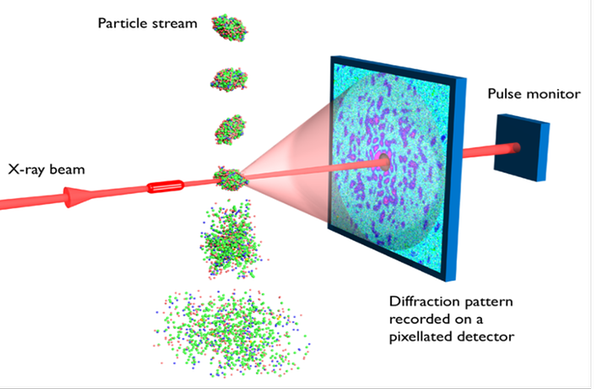
Image source: Henry Chapman, CFEL. Science, 2007, 316, 1444-48.
So far high-resolution single particle imaging (SPI) has not been achieved. Compared to other methods, SPI suffers from low signal intensity, which is determined by the sample properties and the XFEL parameters. In order to improve the signal to noise ratio the sample environment must be improved. With our current setup, an electrospray aerosolizer used for sample delivery in combination with the ‘Uppsala injector’, we are able to deliver particles of 70-2000 nm diameter into the XFEL-beam.
The project aims at reducing the background noise created by various gases used for aerosol injection, by using specially a designed capillary head to reduce the mass flow of sheath gases required to maintain a Taylor cone. And to track particles down to 20 nm using Rayleigh-scattering microscopy as they exit the injector.
Interested students ideally have a background in engineering, physics or a related field and have some knowledge of coding in Python not compulsory. Also, should be open to acquire knowledge from other scientific areas since our projects reach across the borders of traditional scientific subjects.
Contact
Contact
- Programme Professor Condensed Matter Physics of Energy Materials
- Håkan Rensmo
- Head of Division
- Nicusor Timneanu
- Visiting address: Ångström Laboratory, Regementsvägen 10, house 6, floor 0.