
The instant after the Big Bang crucial
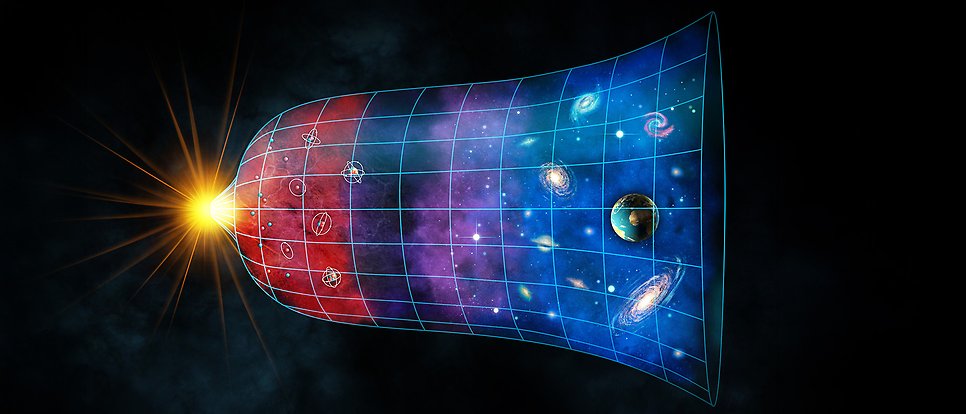
Illustration of Big Bang. Photo: Getty Images
Gravitational waves from the instant immediately following the Big Bang can teach us more about how the universe is structured. For example, we might be able to get a better idea about what dark matter is, says Rikard Enberg, professor of theoretical physics.

Rikard Enberg. Photo: Mikael Wallerstedt
Things that happened in the first billionth of a second after the Big Bang are still affecting the universe to this day.
“There’s a lot that still we don’t understand, like dark matter,” says Rikard Enberg, professor at the Department of Physics and Astronomy, whose research is based around that very first instant in the history of the universe.
“When you observe the universe, it looks like something is missing. If you measure how fast a normal galaxy rotates at different distances from its centre, you find that it moves faster than it should according to Newton’s laws. Here, the solution might be that there is more matter than what we can observe – the more matter, the faster the rotation. This is what we mean by dark matter – it doesn’t reflect light and so it’s invisible, but it does have gravity."
Dark matter can also explain certain characteristics of the cosmic background radiation and how galaxies move around each other. You could think of it as a new particle in particle physics.
“We try to learn about dark matter by studying the early universe,” says Rikard Enberg.
The universe is still expanding
Just after the Big Bang, the universe was a million billion degrees hot. Since then, it has been expanding all the time, which lowers temperature. In intergalactic space, it is now about -270 degrees Celsius.
“Phase transitions – such as when water becomes water vapour or ice, or when magnets demagnetise – may have led to gravitational waves forming in the instant just after the Big Bang and these gravitational waves could be the bridge between particle physics and cosmology that would help us understand the evolution of the universe,” says Rikard Enberg.
In 2017, Rainer Weiss, Barry C. Barish, and Kip S. Thorne received the Nobel Prize in Physics for their work that enabled the observation of the gravitational waves resulting from a collision between two black holes, opening a new window on the universe. However, gravitational waves formed in the early universe cannot be observed with the method used by the Nobel Prize winners.
“That experiment is far too small to observe the gravitational waves from the early universe, which have a much longer wavelength. And they’ve been flying around since the Big Bang of course. But based on the theory, they should exist everywhere,” says Rikard Enberg.
Gravitational waves could provide answers
Researchers are now developing experiments that would enable them to observe gravitational waves from the early universe. One such is the Laser Interferometer Space Antenna (LISA) experiment, in which three satellites orbiting the Sun will in 2035 exchange laser beams between each other in a triangle. If the distances between the satellites alter, this may be due to this type of gravitational wave.
Rikard Enberg also mentions Pulsar Timing Arrays (PTA) which look at pulsars (dead neutron stars), that sometimes move towards each other. His research group will use calculations to show if this could be due to gravitational waves from a phase transition process in the early universe.
Several new telescopes and satellite instruments are also being developed. The gravitational waves are a key to understanding more about what happened just after the Big Bang.
“We are simply curious about why the universe looks the way it does and how it is structured,” says Rikard Enberg.
Sigrid Asker