
Allvar Gullstrand – Nobel laureate and pioneer in the science of vision

Allvar Gullstrand (1862–1930) was an ophthalmologist, researcher and professor at Uppsala University.
- Gullstrand’s two greatest innovations, the slit lamp and the reflection-free ophthalmoscope, are still used for eye examinations today.
- The 1911 Nobel Prize in Physiology or Medicine was awarded to Gullstrand for his studies in the optics of the eye.
- Gullstrand was a member of the Nobel Committee for Physics from 1911 to 1929 and its chair from 1922 to 1929.
- In 1894, Gullstrand became the first professor of ophthalmology at Uppsala University.
- From 1914, Gullstrand held a personal professorship in physical and physiological optics at Uppsala University.
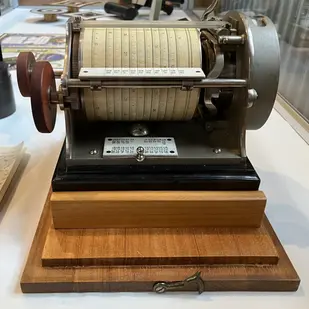
Allvar Gullstrand’s calculator, which can be used for multiplication, division and calculating logarithms and sinus values.
Gullstrand’s eye model a major breakthrough
Gullstrand regarded the eye as a finely tuned optical instrument. By analysing how light is refracted in the various parts of the eye, he was able to describe the process of vision with a precision that had previously been lacking.
His most famous contribution is the ‘Gullstrand eye model’, a mathematical description of the refractive power of the eye. It provided researchers and doctors with a new tool for understanding visual impairments.
Allvar Gullstrand also demonstrated how the optical unit ‘dioptre’ could be used to calculate optical systems in which the object and its image are situated in media with different indices of refraction – such as in the human eye. By dividing the distance by the medium’s refractive index, the same formulas could be used as when the object and image are in the same medium. This represented a significant simplification in standard optical calculations.
His work combined medicine, physics and mathematics in a way that was unusual for the time. It was precisely this combination of theoretical rigour and clinical relevance that made his research so influential – and which led to the Nobel Prize. Even today, his theories form the basis of modern ophthalmology.
Innovations that transformed eye care
In addition to his theoretical advances, Gullstrand also developed instruments that revolutionised eye examinations. His two greatest innovations were the slit lamp and the reflection-free ophthalmoscope. Both these instruments are still used in eye care, in a further refined form.
The slit lamp was used to light up the patient’s eye for examination and produced a much stronger and more focused beam of light than the lamps used previously. It improved the ability to examine the transparent parts of the eye and could, for example, reveal cloudiness in the aqueous humour, which is common in various eye diseases. The lamp was also used in combination with Allvar Gullstrand’s other major innovation, the reflection-free ophthalmoscope.
The reflection-free ophthalmoscope made it possible to examine the eye without distracting light reflections from the cornea and other layers of the eye. It allowed the doctor to look into the eye through its optically sharpest part, the centre of the pupil, whilst simultaneously shining light into the eye through the optically inferior outer edges of the pupil. Together with the German optics company Carl Zeiss, he developed production models of this device, and they also collaborated to improve eyeglasses, microscopes and other diagnostic instruments.
His contributions to the ophthalmologist’s toolkit also included methods for measuring the shape of the corneal surface and for diagnosing paralysis of the extraocular muscles.
Gullstrand’s innovations were the result of his practical orientation: research should not only explain the world, but also improve people’s lives. Several of Allvar Gullstrand’s inventions and instruments can be seen at the Museum of Medical History in Uppsala.
 Zoom image
A early version of Allvar Gullstrand’s reflection-free ophthalmoscope for examining the eye fundus.
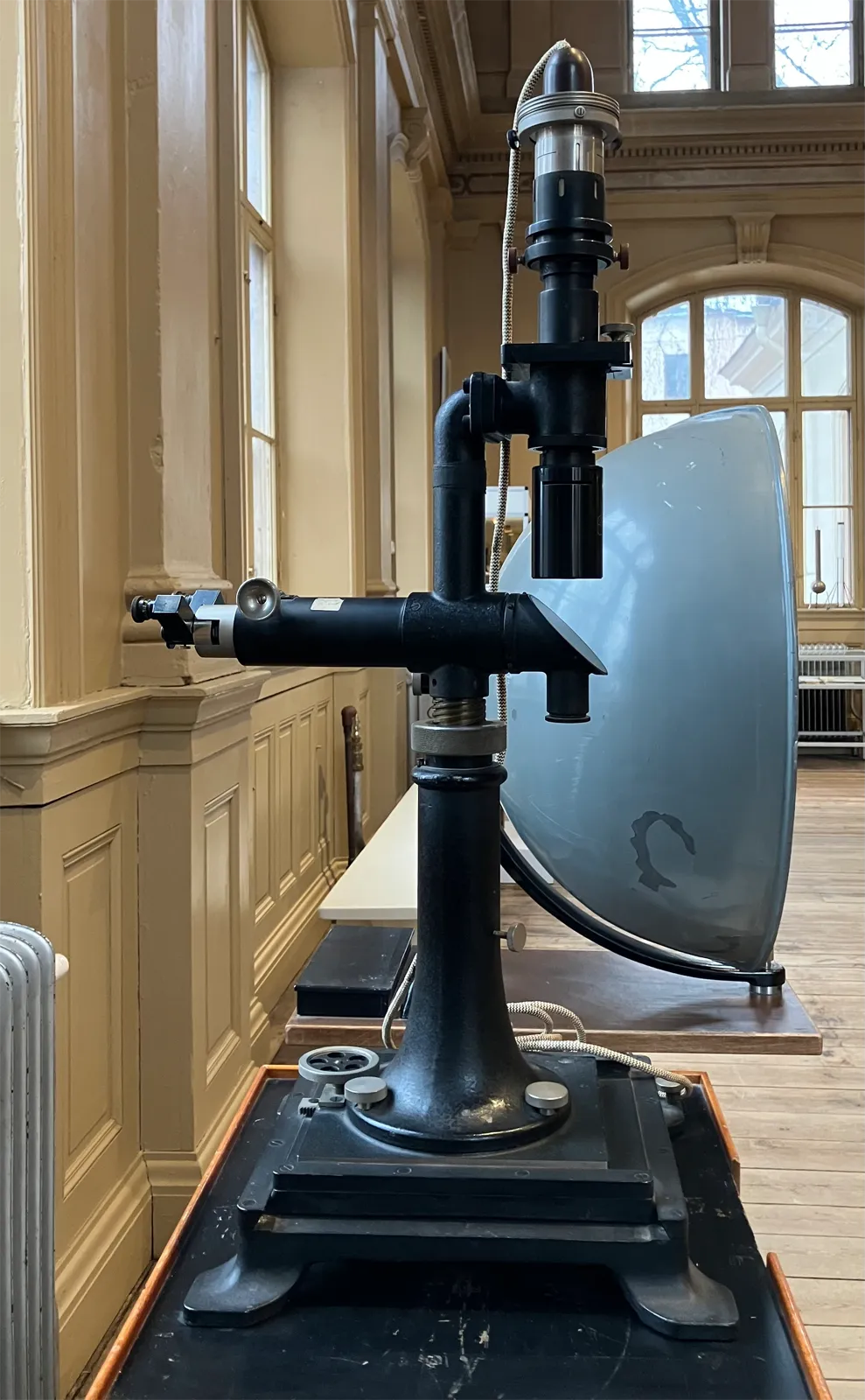 Zoom image
A production model of Gullstrand’s reflection-free ophthalmoscope, manufactured by Carl Zeiss in Germany, is on display at the Museum of Medical History.
Allvar Gullstrand and the Nobel Prize
When Gullstrand was awarded the Nobel Prize in Physiology or Medicine in 1911, it was in recognition of his life’s work on the refractive properties of the eye. In fact, he was nominated for the Nobel Prize in Physics that same year, but turned it down in favour of the prize in Physiology or Medicine. This makes him the only person to have both received and declined the Nobel Prize.
In his speech at the Nobel Banquet, Gullstrand emphasised his view of the prize as a responsibility rather than an end in itself:
“... the hope that I may be able to make good use of the opportunities afforded by the Nobel Prize for the benefit of my scientific research.”
 Zoom image
Allvar Gullstrand’s diploma for the 1911 Nobel Prize in Physiology or Medicine. Source: Alvin
A complex and uncompromising personality
Contemporary accounts describe Gullstrand as brilliant and determined, but also demanding and arrogant. He was known for his meticulousness and his sharp intellect, but also for being uncompromising on scientific matters.
One example of his forthrightness was when he declined the offer to succeed Johan Widmark as Professor of Ophthalmology at Karolinska Institute. He felt that the position would get in the way of his research. Instead, he suggested to Professor Albin Dalén at Lund University that he should apply for the post. When Dalén also objected that this would hinder his research, Gullstrand replied: ”Certainly, but that’s a smaller loss.”
His personality reflected a scientific ideal in which precision and truth took precedence over everything else.
Allvar Gullstrand and Albert Einstein
Gullstrand himself was a member of the Nobel Committee for Physics from 1911 to 1929. His role in the Nobel Prize deliberations was not without controversy – he was known for his strong opinions and high standards.
Albert Einstein was nominated for the Nobel Prize in Physics on numerous occasions, including by such eminent figures as Max Planck and Niels Bohr. However, Einstein was a theoretical physicist, and according to the terms of Alfred Nobel’s will, the prize was to be awarded for achievements of proven, not theoretical, value to humanity. Gullstrand was one of several people who opposed Einstein being awarded the prize.
The issue of a Nobel Prize for Einstein came to a head in 1921 when the prize in physics was left unawarded because the committee could not agree on a recipient. Einstein did eventually receive the 1921 Nobel Prize in Physics, but not until the following year – and not for his groundbreaking theory of relativity, but for his work on the photoelectric effect.
Allvar Gullstrand and Uppsala University today
Gullstrand’s legacy lives on at Uppsala University. His interdisciplinary approach – where medicine meets physics and mathematics – continues to influence research and education.
In fields such as medicine, biophysics and optics, researchers continue to build on the principles that Gullstrand helped to develop. Modern ophthalmological research, including diagnostic imaging and vision correction, has its roots in his work.
His emphasis on rigour, measurability and societal benefit also reflects the University’s core values: that science should be both rigorous and relevant.