
Carl Wilhelm Scheele – the Uppsala chemist who discovered oxygen and chlorine
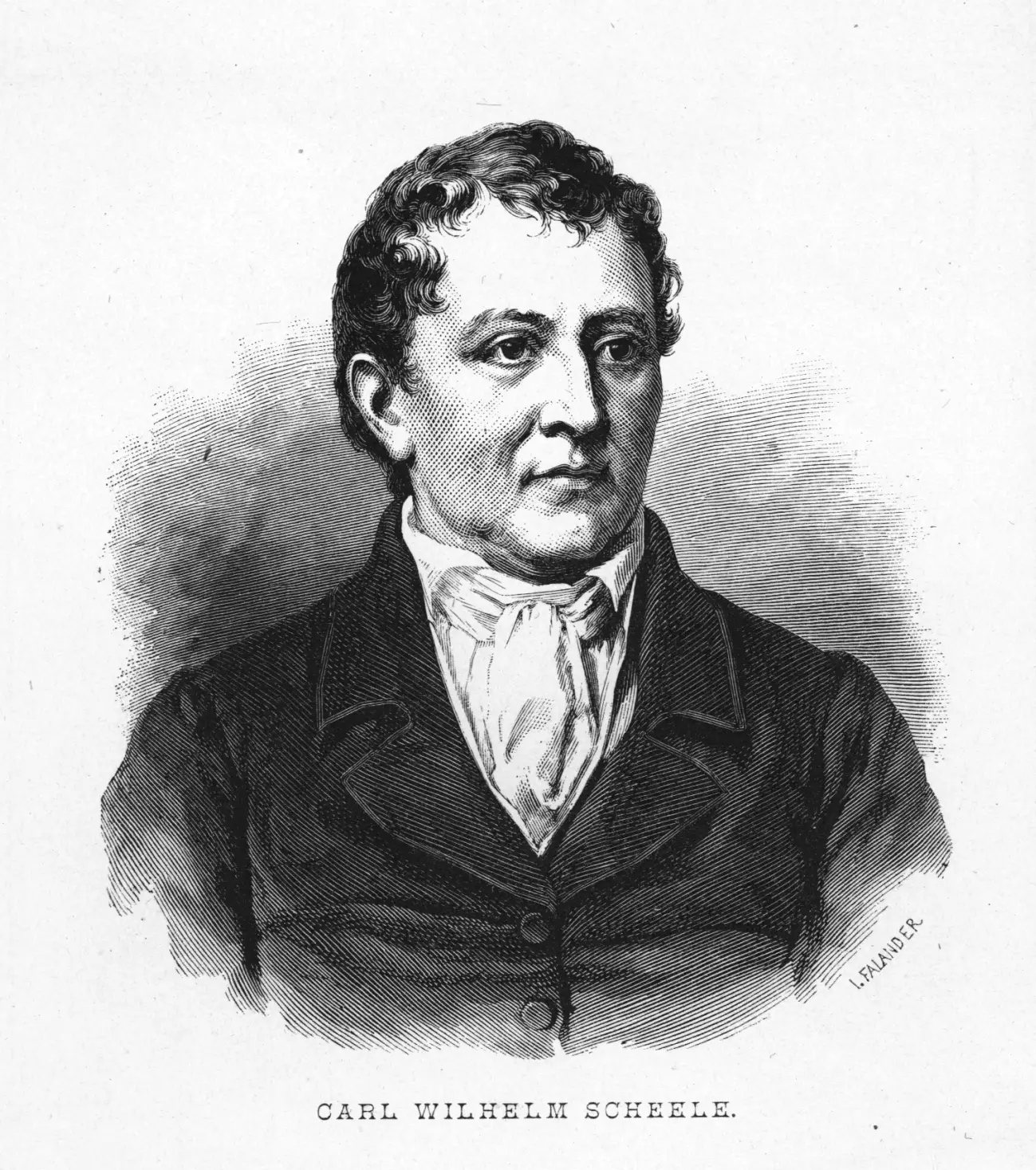
- Carl Wilhelm Scheele (1742–1786) is today regarded as one of the most significant chemists of the 18th century.
- He is credited with the discovery of oxygen and chlorine. He was also the first to isolate a number of organic acids.
- Carl Scheele worked as a chemist in Uppsala, using simple equipment but meticulous methods.
- Through his collaboration with Torbern Bergman at Uppsala University, his discoveries gained wider recognition.
- Several of his discoveries were published late, which meant that others were sometimes credited with them.
From pharmacy apprentice to world-leading chemist
Carl Scheele’s path into science did not lead through university lecture halls, but through practical work as a pharmacy apprentice. He was born in Stralsund in what is now Germany, a town that at the time belonged to Sweden. He began his training in the pharmacy profession at an early age. Despite his family’s financial difficulties, he was sent to Gothenburg as a teenager to become an apprentice to a chemist. This path gave him access to chemical substances, laboratory equipment and – not least – a daily life filled with experimentation and analysis.
In 1770, he arrived in Uppsala and joined the Uplands Wapen pharmacy, which was situated where the Åhléns building now stands. The pharmacy itself still exists, but has moved into one of Uppsala’s shopping centres.
During his years as an apprentice and practising chemist, Scheele developed an exceptional aptitude for experimentation. He studied the existing chemical literature on his own and combined theoretical knowledge with practical experiments. The chemist’s shop served as his laboratory, where he systematically investigated the properties and reactions of substances.
It was also in this environment that his scientific curiosity truly began to flourish. Scheele was not content merely with reproducing known results; instead, he asked his own questions and tested new hypotheses. This independence came to characterise his entire scientific career. His career illustrates how the pharmacy system in the 18th century could serve as an important breeding ground for chemical research, far beyond the direct control of the universities.
Major chemical discoveries: oxygen, chlorine and organic acids
Carl Scheele is perhaps best known for his many discoveries of chemical substances, including several elements – even though the concept of elements did not yet exist at that time.
As early as 1772–1773, he discovered what would later be called oxygen, but he did not publish his discovery until 1778 in his book Chemische Abhandlung von der Luft und dem Feuer (Chemical Treatise on Air and Fire). For this reason, Joseph Priestley is also regarded as the discoverer of oxygen, having isolated the element in England in 1774. Carl Scheele also demonstrated that air consists of oxygen and nitrogen.
During the 18th century, when Carl Scheele was active, it was believed that all combustible materials contained a substance called phlogiston – a belief shared by Carl Scheele himself. Without fully understanding it, he demonstrated that different substances have different oxidation numbers, but he interpreted this to mean that they have different concentrations of phlogiston. The French chemist Antoine Laurent de Lavoisier subsequently demonstrated that combustion is in fact oxidation, and also gave oxygen its name.
Carl Scheele also produced a number of organic acids, including citric acid, lactic acid and tartaric acid, which helped to advance our understanding of organic substances. Many of the substances he was the first to describe still play a central role in chemistry and industry.
Working methods and scientific ideas
Carl Scheele’s research was characterised by a consistently experimental approach. He placed observation and practical work at the centre of his work. Through repeated experiments and meticulous notes, he was able to ensure that his results were reliable and reproducible.
He used simple equipment – flasks, retorts and heat sources – but handled them with great skill. He observed changes in colour, smell and taste, which were key factors at that time.
He died in 1786, aged just 43. He showed signs of mercury poisoning, but according to the entry in the parish register, he died of consumption. It is likely that he died prematurely as a result of all the toxic substances he handled in unsafe laboratories.
Scheele’s work helped pave the way for the chemical revolution that gained momentum in the late 18th century, when chemistry began to break free from the traditions of alchemy and develop into a modern natural science. Chemistry evolved from a qualitative science into a quantitative one, in which chemical processes could be quantified.
World-renowned chemist – a ‘hidden figure’ in Sweden
Although Scheele spent most of his professional life outside the major academic centres, he was far from isolated. Through correspondence and personal contacts, he was part of an extensive scientific network that spanned Europe. A particularly important role was played by the chemist Torbern Bergman at Uppsala University, who recognised Scheele’s talent early on and helped to disseminate his findings.
His connection with Uppsala proved crucial to his scientific breakthrough. Through Torbern Bergman and other academic figures, his work gained wider circulation and legitimacy. He was also elected to the Royal Swedish Academy of Sciences in 1775, which further strengthened his standing within the scientific community. His work was translated into many different languages, and he was elected to both the French and Italian academies of sciences.
Although Carl Scheele became well known within the scientific world, he remained relatively unknown in Sweden. It is said that when Gustav III arrived in Turin during his Italian tour in 1783–1784, it was there that he first heard of Carl Scheele. Gustav III then wrote home to Sweden and gave orders for him to be honoured with the Order of Vasa, but by mistake the order was awarded to another Scheele.
Meticulous, tenacious and unassuming
As a person, Carl Scheele is portrayed in historical sources as reserved and deeply committed to his work. He did not actively seek fame or academic positions, but seems to have been driven primarily by a strong curiosity and an interest in the laws of nature. This attitude probably contributed to his productivity, but may also have meant that he was sometimes overshadowed by more established scientists.
Scheele often worked alone and under conditions that would today be considered hazardous. He handled toxic substances without the protective equipment that has since become standard, and it has been suggested that his early death may have been due to prolonged exposure to dangerous chemicals.
Contemporary accounts describe him as a man of great rigour and integrity. He was methodical in his work and meticulous in documenting his findings. His life illustrates the conditions under which many early scientists worked – characterised by both intellectual freedom and significant personal risks.
Text by David Naylor and Ulrika Hurtig.