
Performing the rhythm of life: Interpretation of time in Olivier Messiaen's organ works
Details
- Period: 2014-01-01 – 2016-12-31
- Budget: 2,550,000 SEK
- Funder: Swedish Research Council
- Type of funding: Project grant
Description
Music tells the rhythm of life, but how does the musician do it?
One of our most common ideas about music is that it goes deeper into the human being than words and awakens our innermost being to life. By being present in the musical process, something happens to us and our relationship to both ourselves and the world around us. The idea appears in different cultures and times, but in the Western tradition it is also connected in a special way with the Romantic view of art and the emergence of modern society. As early as around 1800, philosophers reacted to the disadvantages of an industrial and rationalized society where the relentless ticking of the hands on the clock has become the sign of a time that is running away from man. The philosopher Schelling was one of these and argued that there is a deeper rhythm in life, a natural movement forward where man can also find harmony with himself and the world around him. Just like him, later thinkers (including Bergson , Husserl and Deleuze ) have also argued that rhythm is the most important characteristic of music; it allows listeners to sense their own human rhythm of life and can change the experience of time so that it becomes intense, dramatic and creative instead of static and uniform.
Hardly any modern composer has let such thoughts characterize his music as much as the Frenchman Olivier Messiaen ( 1908-1992 ). In his music, he consciously tried to translate speculative ideas about the rhythms of music into a new music that would be as flexible, agile and complex as life itself. With his own theory of music, he created works that would ecstatically re-create the listeners' steadily disappearing history by bringing them into a new landscape of strong colors and an intense presence of time; a music where the past and the future have become parts of a shimmering present. This project examines how musicians can perform this music in order to allow such a change to occur. How do you play a repertoire that has the ambition to change people's experience of themselves and the world?
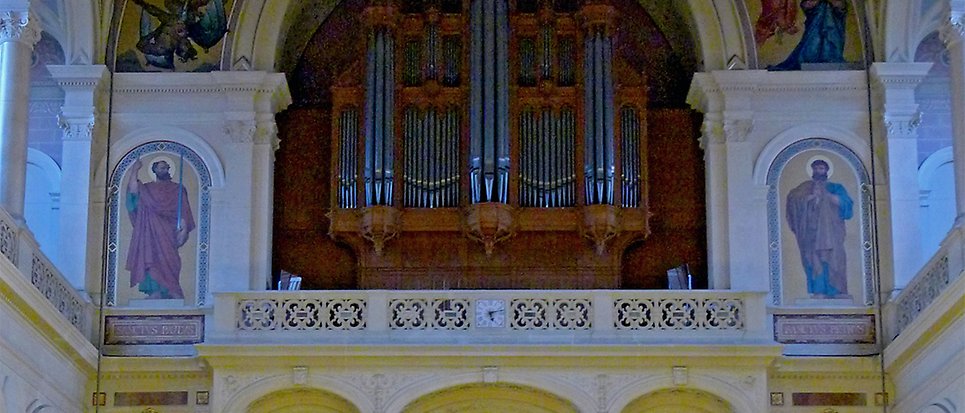
For Messiaen, the organ was throughout his life the instrument where he himself tried to achieve this, in the vast sea of reverberations of various churches. He was truly at home at "his " own organ in the church of Sainte Trinité in Paris. Where he could try out his music at the playing table, listen to how the sound slowly died away between the arches and write down the result between the musical lines. Yes, this specific situation became part of the pieces themselves and for decades now skilled travelling organists have tried to create something similar with completely different instruments and in completely different types of acoustic rooms. Among musicians, there is hardly any group that is as dependent on the conditions of the room as organists, musicians who let entire church rooms be filled to the brim with the rhythms of the roaring organ pipes.
In this project, as an organist at the playing table and through the remaining sound memories of microphones, I will explore how it is possible to recreate that special experience of the time of the room that Messiaen tried to note in his organ works. I will examine how he wrote them down, how he himself played them at the organ in Trinité and then go to Paris myself to let his works once again set the sound waves of the air in motion in this ?organ Mecca? After developing a picture of how the music there itself recreates a rhythm of life, I will travel to other instruments and other sound rooms in search of the same experience. To do the music justice, different tempos are required, different times for the music to fade out, changing timbres and rhythms, and variations in how fiercely the sound of the pipes is born and dies. Through tedious work, such differences will be tested, documented, and analyzed to finally be able to summarize a picture of what is required to adapt each performance to the demands that the rooms place on the musician, often hidden far away on a platform up against one of the short walls.
With the help of Messiaen's music and the organ, it is possible to show how acoustics forms part of each composition.
Project members
Publications
-
Olivier Messiaen och musikens ursprung
Part of Ikaros - tidskrift om människan och vetenskapen, 2021
-
Olivier Messiaen's Livre d'Orgue: Complete performance at Uppsala Cathedral 26 september 2015
2015
-
2015
-
2015
Contact
- For enquiries:
- Jonas Lundblad