Alumnus of the Year on choosing wrong and ending up right
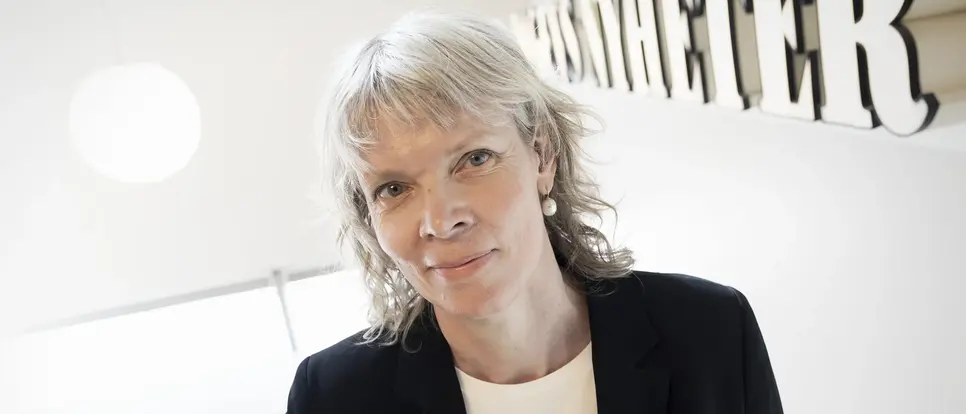
Maria Gunther Axelsson, Alumnus of the Year at Uppsala University: “I’m incredibly honoured to have received this award.” Photo: Mikael Wallerstedt, Uppsala University.
This year’s Uppsala University Alumnus of the Year 2026, Maria Gunther Axelsson, regularly encounters conspiracy theories and disinformation in her role as an experienced science journalist. Her journey to where she is now has taught her a lot about what's right and what's wrong.
The award citation reads that as a science journalist, Maria Gunther Axelsson has distinguished herself by always defending correctness over simplifications and sensationalism.
“It warms my heart to hear that, because that is my aim. Of course what I write must be simple enough for the readers to understand, but it must not be wrong. It must be right. It must be correct,” she says.
Unexpected pathways
While she says that everything she has learned, she learned at Uppsala University, Maria says that she has otherwise built her career on “choosing wrong”. After completing her high school studies in science in her home city of Örebro, she had her sights set on Gothenburg.
“I wanted to go to Chalmers, just like my big brother. But in spring 1987 Uppsala University of Technology, as it was then called, sent out a magazine called Upteckaren (Discoverer) to everyone who had completed a science and technology programme at high school. They wrote that Uppsala is like Paris but smaller, or as the physicists say: "Uppsala is like Paris, but with a higher density." I thought that was quite a good joke. It’s actually solely due to that sentence in that magazine that I applied to the engineering physics programme in Uppsala,” she explains.
She was very happy in Uppsala.
“It’s a fun city to study in, especially engineering physics in a city dominated by humanities students. You meet an awful lot of people who studying a lot of other things. At Chalmers, for example, it’s just engineers of course,” says Maria.
The wrong choice can also be the right one
But then came a turning point where she “chose wrong”, as she keeps coming back to. When she completed her Master of Science in Engineering degree in 1993, Sweden was in a recession.
“There were no jobs. So I started my PhD in experimental particle physics, which included working at CERN in Geneva. My focus area was strange quarks, a heavier variant of the elementary particles that make up protons and neutrons in the nucleus of an atom. At that time, the USA was building the world’s largest particle accelerator in Texas. Then that project was shut down while I was still a doctoral student. Suddenly, half of all the jobs for particle physicists in the world had disappeared!” she remembers.
She started working in the burgeoning IT industry where there were plenty of jobs.
“When I defended my thesis in 1998, the first IT boom had just started. I worked then as a systems developer and IT consultant. Then the IT bubble burst shortly after the turn of the millennium. I was unemployed, so I decided to take the one-year extension course in journalism in Uppsala,” explains Maria.
Onwards towards journalism
After her journalism course, she returned to the Department of Radiation Sciences in 2003 and worked with Nordugrid, a network of computers for complex and large computations. But then she decided to focus fully on journalism.
“In the early 2000s, there were a lot of jobs in journalism. Then the newspaper industry also crashed when people no longer wanted to buy newspapers. It feels like I always managed to choose industries that were just starting to go downhill when I started working in them,” she says.
But she feels that this variety of experience has given her very broad knowledge and in particular the insight that there are always other pathways to pursue.
“You can always jump on and succeed elsewhere. If you have an education like I got in engineering physics, you really have great opportunities,” says Maria.
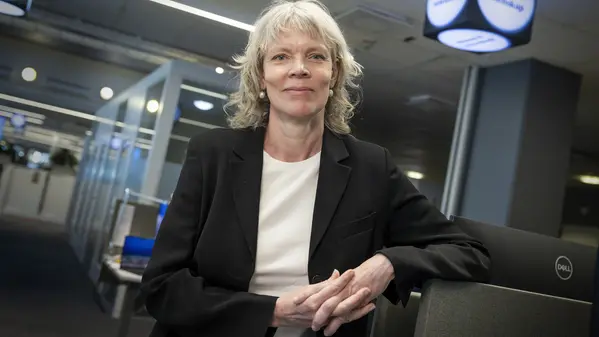
Maria Gunther Axelsson likes being close to the research front as a science journalist. Photo: Mikael Wallerstedt, Uppsala University.
Ever-curious storyteller
Maria Gunther Axelsson says that even though she enjoyed the research environment at the University, as a science journalist she gets to be even closer to the research front.
“It’s a great privilege to be able to interview researchers who are passionate about what they do. One day I’m talking to a microbiologist who is studying new viruses and the next I’m interviewing an astronomer who studies black holes. I’m curious by nature. I want to know how the world works. It’s also lots of fun to write and talk about it,” says Maria.
The challenges of working as a science journalist can be heavy-going, however. She receives a lot of emails from science deniers who don’t believe in climate change or the theory of evolution. This poses a constant challenge: to stand up for and take on the fight against disinformation and fake news.
“It’s a job that never ends. When you come up against conspiracy theories, you have to tell people how research works, what we can say about the world, and what we can’t say about the world. Of course I do get a bit sick of it sometimes, but I like the challenge and in particular I don’t like it when science gets misused,” says Maria.
From intern to experienced science editor
Maria Gunther Axelsson feels that she’s had a very enjoyable working life. She’s had the opportunity to work with so many different things and it’s all come from the fact that right from the start, she says, she has always “chosen wrong”. So has she finally landed right for real?
“Throughout my career I’ve opted for things that then didn’t work out so well. But it’s really great working at Dagens Nyheter. I came to the newsroom for the first time as an intern during my journalism course. Karin Bojs was my supervisor then, and I learned a lot from her. After that I got some temporary jobs and freelance assignments, but now I’ve been at the newspaper since 2013, when Karin Bojs left and I succeeded her. Initially I was entirely alone in writing about science and now we’re a whole department,” she explains.
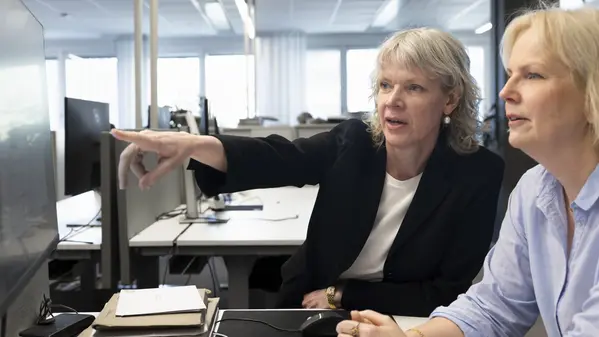
“I work for a newspaper that thinks that covering science is very important,” says Maria Gunther Axelsson. Here with colleague and medical reporter Anna Bratt (right) at Dagens Nyheter’s newsroom. Photo: Mikael Wallerstedt, Uppsala University.
She emphasises that there are lots of benefits to being a science journalist at Dagens Nyheter.
“We have a large audience, so researchers want to talk to us, and we get space to write about science. I work for a newspaper that thinks that covering science is very important.”
Uppsala is still home
Maria Gunther Axelsson still lives in Uppsala and has also occasionally returned to Uppsala University after her degrees.
“I like Uppsala very much and find it a really great place to live. It’s fun to live in a university city. It adds a nice touch to the city,” says Maria.
When the subject area of engineering physics in Uppsala celebrated its 50th anniversary, Maria Gunther Axelsson was one of the anniversary’s lecturers.
“I talked about how to build a career by choosing the wrong one. Like I said, I’ve switched career paths many, many times,” she laughs.
However, her Alumna of the Year lecture will not be about choosing wrong, but about something that feels entirely right for our time: covering science credibly amidst all the disinformation.
“Yes, it will be about how to inspire trust in a time of so much fake news. I get very excited about challenging conspiracy theories and unscientific ideas,” she says.
Johan Ahlenius
Facts about Maria Gunther Axelsson
Born: 1968
Employed at: Dagens Nyheter as a science editor since 2013.
Other roles: Since she left the academic world, she has returned to Uppsala University on several occasions, for example as a lecturer at the 50th anniversary of engineering physics in Uppsala.
Education: Science programme at high school in Örebro. 1988–1993, studied the Master of Science in Engineering Physics programme specialising in radiation sciences at Uppsala University. After graduating, she started her doctoral degree in radiation physics at Uppsala University, where a large part of the work was carried out at CERN in Switzerland. She defended her doctoral thesis in 1998. She returned to Uppsala University to study journalism and graduated in 2003.
Experience and previous assignments: After gaining her doctoral degree in 1998, she worked for a number of years in the IT industry as a systems developer and consultant. She also had jobs as a researcher and teacher at the Department of Radiation Sciences at Uppsala University. Maria lived with her family in Vienna, Austria from 2005 to 2011, where she worked with climate research at the International Institute for Applied Systems Analysis (IIASA) outside Vienna from 2010 to 2011.
From the award citation: Maria Gunther Axelsson is one of Sweden’s most important voices for science, critical thinking and popular education. As science editor at Dagens Nyheter, for many years she has played a pivotal role in efforts to combat disinformation, resistance to facts and pseudoscience. With her sharp mind, her deep knowledge of the subject, and her great journalistic integrity, she conveys research findings in a way that both the public and researchers can feel confident int. In an era of increasing distrust in science and rapid flows of information, her contributions are invaluable.
As a science journalist, she has distinguished herself by always defending correctness over simplifications and sensationalism. Her texts are balanced, educational and anchored in scientific method, while also reaching out broadly and in an engaging way. She has also shown courage and thoughtfulness in highlighting difficult and socially important questions from a scientific viewpoint – always with an ambition to enhance the public’s education in science. Maria Gunther Axelsson is a role model for how science can be communicated with both precision and passion. Her tireless efforts to improve the public’s understanding of research make her particularly worthy of the Alumnus of the Year award.