
P4C in Swedish schools
Partnering for Change (P4C) is a Canadian intervention model completely new in the Swedish context, which is based on interprofessional collaboration, partnership and knowledge transfer to create inclusive learning environments for students in need of support.
P4C is a stepwise model (Response-to-intervention) (Missuana et al., 2012) that includes both risk and protective factors for exclusion, school failure and mental health. This hierarchical model for health promotion interventions based on universal, selective and individual prevention has been used in school settings. Interventions based on this type of model
have been successful in supporting not only children with disabilities, but the participation of all children (Haug, 2020).
The project's hypothesis, supported by previous research (Hughes., Dexter., 2011; Haug, 2020), is that adaptations and measures implemented at a general, group and individual level via the structure of the P4C model create an inclusive learning environment for all students and can be assumed to contribute to better resource utilization based on the sustainability goals in Agenda 2030 regarding good health, well-being and education.
Universal design
Interventions in the form of environmental adaptations such as digital support and universal design for learning (UDL) have the potential to influence participation and goal achievement in school for students with
disabilities and in need of special support. Despite initiatives for children in need of special support, there is a large proportion of children who lack participation and engagement, suffer from mental illness and do not achieve knowledge goals.
Inclusive learning environment
An inclusive learning environment is a prerequisite for learning, development and good health. The project is theoretically anchored in the environmentally relative and person-centered Model of Human
Occupation (MOHO) (Taylor, 2017). Human engagement, participation and performance in activities are explained as a dynamic interaction between the individual's abilities and the conditions in the environment. According to the model, the environment offers potential opportunities and resources, demands and constraints and thus constitutes a critical dimension that either supports or hinders a student's activity in school and affects the student's participation and well-being. The school environment should provide children with opportunities to interact with their peers, teachers, education, materials and activities. A central aspect is the design of school activities and how these can be implemented in alternative ways. Over time, there has been a shift in perspective from focusing on limitations in a person's ability to focus on environmental barriers, but it is still common for students to blame the individual for difficulties in school [9].
Partnership – knowledge building
In the project, a Canadian innovation-driven school-based intervention Partnering for Change (P4C) will be implemented and the effects evaluated in a Swedish school where 4C stands for Capacity Building through Collaboration and Coaching in Context [2]. The model is based on interdisciplinary collaboration, partnership and knowledge transfer (capacity building) to create sustainable change that enables students to achieve knowledge goals.
Partnering for Change in the Netherlands
In the Netherlands an innovative and intersectoral collaboration approach called the Partnering for Change (P4C) is used. A new model in the Dutch school context has been tried out in several pilot studies, adapted to the Dutch educational context and evaluated. Currently is in the implementation phase looking at P4C effects on teachers capacity building and development, on pupil’s engagement, health and participation.
The purpose of P4C in the Netherlands is:
- To increase pupils’ prerequisites for school participation and learning, sense of belonging and inclusion in order to prevent mental ill-health, exclusion and school failure by creating an inclusive learning environments using P4C.
- To build and develop capacity among teachers, P4C- occupational therapists, special education teachers and managers to be able to serve diversity of children and co-design an inclusive learning environments, via the network JIP4L- NL.
The Dutch project overview
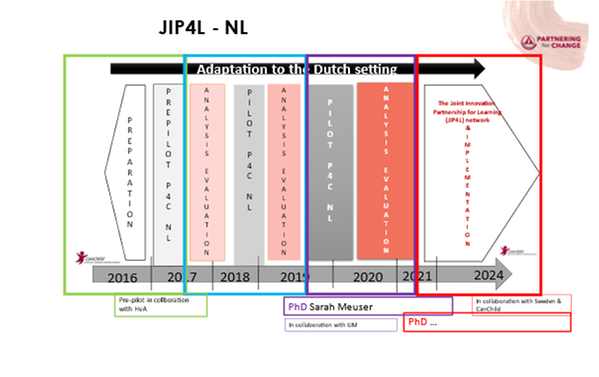
The Dutch project overview
Partnering for Change in Sweden
In Sweden an innovative and intersectoral collaboration research program using the Partnering for Change (P4C), a new model in the Swedish school context, is implemented and evaluated in Swedish Schools.
The overall purpose of P4C project in Sweden is:
- To increase pupils’ prerequisites for learning, participation and mental health by creating an inclusive learning environment.
- To build capacity among teachers, occupational therapists (OT) and special education teachers about pupils with special educational needs (SEN).
- To create a supportive and sustainable network for capacity development through the national and international network JIP4L (CLICK here for JIP4L).
- To evaluate the cost-effectiveness of P4C.
Implementation of P4C in Sweden
The implementation of P4C has been studied systematically starting with an exploration phase (2017-2019), followed by a feasibility study (2019-2020), an adaption to the Swedish process (2021-2022), to an ongoing evaluation study (2022-2025).
Exploring P4C and Feasibility study (2017-2021)
The exploration and adaptation of P4C in Sweden started in 2017. In 2019 a feasibility study was performed to evaluate the feasibility and acceptance of P4C, the chosen outcome measurements and weather the P4C needed to be modified to be applicable in the Swedish context.
The results of the feasibility study were positive and showed that P4C was feasible in Swedish school. P4C was considered as an attractive and applicable approach to create supportive and inclusive learning environments.
The Joint Innovation Partnership for Learning (JIP4L) network (2022-2024)
From the feasibility study, the Swedish team recognized that teachers, schools and organizations might require time and continuous support during the implementation of P4C. As such, the Joint Innovation Partnership for Learning (JIP4L) network (Click back to JIP4L), with The Netherlands will be used as a support structure for local implementation of P4C, as well as to spread the P4C nationwide and internationally.
Intervention study (2022-2025)
From 2022-2025, the P4C will be implemented in Swedish elementary schools. Data collection is ongoing and about 400 pupils will be included in the project.
A non-randomized controlled intervention study design with before, after and follow up measurements is used to evaluate how effective P4C is for pupils regarding participation, well-being and mental health related quality of life in school. In particular, pupil’s engagement and occupational performance in school is seen as essential prerequisite for educational success, mental health and participation.