
About the project
In December 2015, the Swedish Research Council (Vetenskapsrådet) made an unprecedented investment in early medieval research, awarding 50 million Swedish kronor to Professor Neil Price of Uppsala University for a ten-year initiative entitled The Viking Phenomenon.
The project finishes at the end of 2026, and has functioned as an umbrella programme that shelters several sub-strands of research. It brings together an international team of archaeological researchers, focussing their attention on the critical century from 750 to 850 CE, and the decades either side: the time during which the foundations of the early Viking Age were laid.
The project is addressing several core questions:
- Who really were the first Viking raiders, in a specific sense?
- Why did they do what they do?
- What kind of societies produced them, and why did they start to expand so violently into the world at precisely this time?
- In short, what were the origins of the Viking phenomenon?
Among the key issues that we consider are those relating to raiding, slavery, military ideologies, and the nature of long-distance, international contacts and trade as they developed during the Late Iron Age. The development and exploitation of mercantile networks has long been considered as a defining characteristic of the Viking Age, but to what extent were these connections built on earlier interactions? Clear evidence for links with the East, including as far away as the Asian steppe and Tang China can already be found in graves from the preceding Vendel period (c. 550 – 750 CE), but the nature of those contacts has never been adequately explored.
The project is split into two major research clusters each of which is developing and exploring its own research agendas with the aim of addressing these questiosn from various perspectives.
It is important to understand that the project will not provide 'the Answer' to 'the Question' of the Viking Age, but rather a particular set of responses to the questions that we think to ask. Other scholars might choose quite different lines of approach, and this is to be welcomed. Our project is a living one, situated in our own times, as it must be.
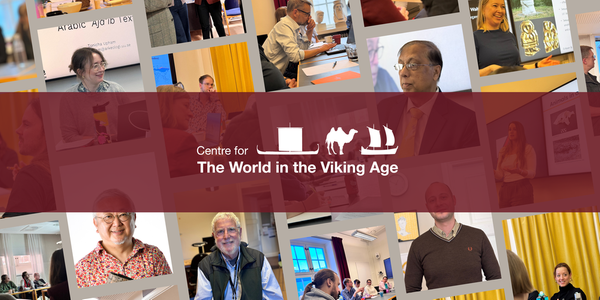
With a new understanding of the Viking phenomenon as its objective, the project has laid the foundations for the new centre of excellence for
The World in the Viking Age (WIVA), also funded by the Vetenskapsrådet as Sweden's leading research cluster for the study of this critical time period in the nation's history. The Vikings are still today the most visible signal of Scandinavian heritage, and this research programme will be deeply embedded with contemporary concerns, presenting the exploration of this long-lasting legacy for the widest possible public.
-
New Research Grant: The World in the Viking Age: A Centre of Excellence at Uppsala University
Part of Current Swedish Archaeology, p. 240-241, 2025
- DOI for New Research Grant: The World in the Viking Age: A Centre of Excellence at Uppsala University
- Download full text (pdf) of New Research Grant: The World in the Viking Age: A Centre of Excellence at Uppsala University

The Viking Phenomenon Logo
This design is taken from a fragmentary bronze mount for a sword scabbard, recovered from a cremation grave at Solberga in Askeby parish, in the Swedish province of Östergötland. The object dates to c.700 CE, the eve of the Viking Age. The figure in the boat - is he a man, a god, or something else? Who or what is the female being in the water below? Is she helping or hindering his fishing attempt? Why was this scene thought suitable to decorate a weapon? The enigmatic motif is known nowhere else, but may once have been easily recognisable from the ancestral stories of the North, most of which are now lost to us. It serves today as an intriguing window on all that we have yet to learn about the Viking phenomenon.

SHM inv. no. 21921. Original drawing by Harald Faith-Ell, 1939; reworked by Andreas Hennius and Södra tornet, 2017-18.
For more information, see Price, N. 2025. The woman in the water: an enigmatic scabbard mount from Östergötland. In Hedenstierna-Jonson, C., Kjellström, A., Ljung, C. & Qviström, L. (eds) Fragment av föremål, platser, kroppar och ord. Upplands Museum, Uppsala.
-
Part of Kungl:Vetenskaps-Societetens årsbok, p. 71-79, Kungl. Vetenskaps-Societeten, 2017
-
Understanding the Viking phenomenon
Part of Årsbok 2022, p. 61-74, Kungl. Vitterhets Historie och Antikvitets Akademien, 2022