
Dynamics
Mobility, Identity and Group Formation
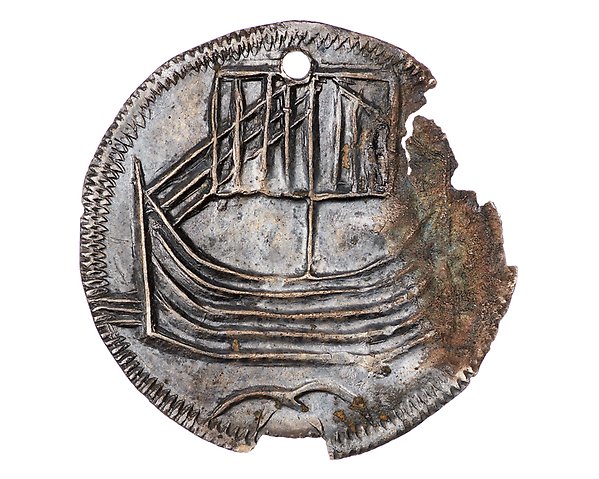
Pendant from a Nordic silver coin minted around 825, probably in the Jutland trading centre of Hedeby. Myrin, Ola. Historiska museet/SHM, (CC BY 4.0)
This theme examines the composition, organisation, and demographic dynamics of Viking raiding groups through an interdisciplinary combination of archaeology and the natural sciences. Scientific methods, including bioarchaeology, genetics, and isotopic analyses, have provided new perspectives on mobility, ancestry, health, and patterns of migration. These approaches challenge traditional assumptions about Viking raiders as homogeneous groups and instead reveal highly diverse and constantly changing communities.

Glass, carnelian and amber beads. Part of a hoard find, Kullsta, Estuna Parish, Uppland. Myrin, Ola. Historiska museet/SHM, (CC BY 4.0)
A central finding has been the importance of group cohesion in contexts where participants often came from different geographical, cultural, and ethnic backgrounds. Shared identities were created through participation in expeditions, common practices, and the adoption of material culture that signalled affiliation and belonging. Archaeological evidence demonstrates how dress, weaponry, ornaments, and ritual practices contributed to the formation of collective identities while accommodating considerable internal diversity.
The project highlights the dynamic nature of Viking communities and the social processes through which temporary groups became enduring networks. Raiding was not simply a military activity but also a mechanism for creating social bonds and cultural exchange across large geographical areas. This work has been supported through collaborations with geneticists and other scientific specialists, as well as workshops such as Warriors and Wounds, which explored the lived experiences of conflict and mobility in the Viking world.
Want to read more? Check out these publications!
-
Part of Unha vida viquinga., p. 303-305, Xunta de Galicia, 2024
-
Part of Viking Women. Between Theory, Text, and Materiality., p. 73-86, Brepols: Turnhout, 2026
-
Part of Viking Women, p. 74-86, Liverpool University Press, 2026
-
Lejre, Uppsala and their North Sea connections
Part of Viking Dynasties, p. 531-543, Aarhus Universitetsforlag, 2025
-
Salme and the Viking Phenomenon
Part of THE SALME SHIP BURIALS, Archaeological Research Collection, Tallinn University, 2023
-
Et kongerige bliver til. Krigergrave og kongsgårde i en foranderlig verden.
Part of Out of chaos. Moesgaard Museum, Aarhus, p. 19-29, Moesgaard Museum, Aarhus, 2022
-
Part of In Varberg, J. & Pentz, P. (eds). Togtet: på rejse i vikingernes verden., p. 219-240, National Museum of Denmark, Copenhagen, 2021
-
A matter of competitive control: Negotiating landscapes of predation in the Viking Age
Part of Landscapes of Movement and Predation, p. 57-80, University of Arizona Press, 2024
-
Part of Socioekonomisk mångfald. Ritualer och urbanitet, p. 27-38, Statens Historiska Museer, Arkeologerna, 2016
Chapter in book

-
Creating a Cultural Expression: On Rus' Identity and Material Culture.
Part of Identity Formation and Diversity in the Early Medieval Baltic and Beyond., p. 91-106, Brill, 2017
-
Identitätsfragen zwischen Kiew und Birka
Part of Die Wikinger. Entdecker und Eroberer, p. 272-286, Propyläen Verlag, 2019
-
Farmer, Raider, Trader, Ruler: Society and People of the Eastern Viking World
Part of Norman Connections, p. 46-57, Verlag Schnell + Steiner GmbH, 2022
-
The first female Viking warrior confirmed by genomics.
Part of American Journal of Physical Anthropology 164/4, p. 853-860, 2017
-
Viking Mobility in the Baltic Sea Region
Part of Viking encounters, p. 61-70, 2020
-
Riksantikvarieämbetet, 2020
-
Population genomics of the Viking world
Part of Nature, p. 390-+, 2020
-
From Nǫrvasund to Grikkland: the Vikings in the Middle Sea
Part of Vikings in the Mediterranean, p. 9-34, 2023
-
Pirate utopias?: Viking camps and aspirational polities
Part of Viking Camps, p. 258-273, Routledge, 2023
- DOI for Pirate utopias?: Viking camps and aspirational polities
- Download full text (pdf) of Pirate utopias?: Viking camps and aspirational polities
-
'Now I am a Bird, and Now I am a Man': Posthumanism, Raptors and the Rus'
Part of Art and Archaeology of Human Engagements with Birds of Prey, p. 166-182, Bloomsbury Academic, 2023
-
‘Now I Am a Bird, and Now I Am a Man’: Posthumanism, Raptors and The Rus’
Part of Art and Archaeology of Human Engagements with Birds of Prey from Prehistory to the Present, p. 166-182, Bloomsbury Academic, 2023
-
Ibn Fadlan and the rituals of the Rus: Vikings on the Volga?
Part of Muslims on the Volga in the Viking Age, p. 177-198, Bloomsbury Publishing Plc., 2023
-
Part of Danish Journal of Archaeology, p. 133-138, 2018
-
The slave markets of the Viking world: comparative perspectives on an ‘invisible archaeology’’
Part of Slavery & Abolition, p. 682-705, 2019
- DOI for The slave markets of the Viking world: comparative perspectives on an ‘invisible archaeology’’
- Download full text (pdf) of The slave markets of the Viking world: comparative perspectives on an ‘invisible archaeology’’
-
The Danelaw reconsidered: colonization and conflict in Viking-Age England
Part of Viking and Medieval Scandinavia, p. 181-220, 2020
- DOI for The Danelaw reconsidered: colonization and conflict in Viking-Age England
- Download full text (pdf) of The Danelaw reconsidered: colonization and conflict in Viking-Age England
-
No one is an island: In-group identities in the Viking-Age Baltic
Part of Relations and Runes: The Baltic Islands and their Interactions During the Late Iron Age and Early Middle Ages, p. 1-9, Riksantikvarieämbetet, 2024
-
Broken worlds: Towards an archaeology of the shatter zone
Part of Journal of archaeological method and theory, p. 871-910, 2021
- DOI for Broken worlds: Towards an archaeology of the shatter zone
- Download full text (pdf) of Broken worlds: Towards an archaeology of the shatter zone
-
Part of Scandinavian Journal of History, p. 414-437, 2022
- DOI for Bound in captivity: intersections of viking raiding, slaving, and settlement in Western Europe during the ninth century CE
- Download full text (pdf) of Bound in captivity: intersections of viking raiding, slaving, and settlement in Western Europe during the ninth century CE
-
Part of Evolution and human behavior, p. 315-324, 2017
- DOI for Male-biased operational sex ratios and the Viking phenomenon: an evolutionary anthropological perspective on Late Iron Age Scandinavian raiding
- Download full text (pdf) of Male-biased operational sex ratios and the Viking phenomenon: an evolutionary anthropological perspective on Late Iron Age Scandinavian raiding
-
Religious belief and cooperation: a view from Viking-Age Scandinavia
Part of Religion, Brain & Behavior, p. 2-22, 2019
-
Polygyny, Concubinage, and the Social Lives of Women in Viking-Age Scandinavia
Part of Viking and Medieval Scandinavia, p. 165-209, 2017
- DOI for Polygyny, Concubinage, and the Social Lives of Women in Viking-Age Scandinavia
- Download full text (pdf) of Polygyny, Concubinage, and the Social Lives of Women in Viking-Age Scandinavia
-
2026
-
The genetic history of Scandinavia from the Roman Iron Age to the present
Part of Cell, p. 32-460000000000000000000, 2023
- DOI for The genetic history of Scandinavia from the Roman Iron Age to the present
- Download full text (pdf) of The genetic history of Scandinavia from the Roman Iron Age to the present