
Is this programme right for you?
What people say about the programme
Listen to what Zakia from Bangladesh thinks about the Master's programme in Mathematics and what it's like to study in Uppsala!
Quotes from our students
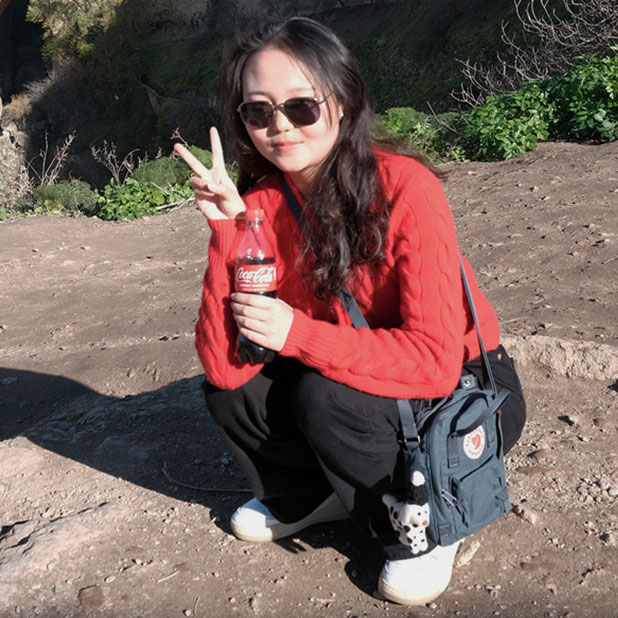
Yanhong, student from China
At Uppsala University you can calm down and study what you are really interested in instead of following the public's preferences
Read the full interview with Yanhong
Why did you choose this programme and this specialisation at Uppsala University?
– My Bachelor's major is within the intersection of applied mathematics and computer science. I am also very interested in data processing, so I wanted to take some statistics courses based on these two. When I checked the information on this programme, I found it meets my requirements. I also wanted to change my learning environment. I studied my Bachelor's in Shanghai, a very busy city, and I wanted to move to a quiet place to continue my graduate studies. So I chose Uppsala.
Has the programme lived up to your expectations so far?
– Generally, it met my expectations. However, some courses had prerequisites that I did not fulfil and I regret that I didn’t study the courses needed to be able to take them.
– The best thing about the programme is that I can choose the courses, immerse myself and discuss the issues that interest me, even if these issues are not as important and valuable in the eyes of others as they are to me.
What is most challenging?
– I think there will be language challenges at the beginning. Another challenge is the climate; the nights are too long in winter. To pass the time I brought a projector and a Switch, and I would play games and watch movies with my corridor mates.
Do you have good teachers?
– Many of the teachers I met in class are very good. I appreciate that the teachers encourage me to immerse myself in my interests and that I don't feel forced to focus on quick profit (ranking and GPA and after – money and fame). If you don’t do research with interest and passion, it will be difficult to persist and conduct in-depth research and not least to enjoy and be happy.
Do you study any other subject than mathematics within the programme?
– Some statistics and IT courses, such as categorical data analysis, high-performance programming and data mining.
What might a typical day look like?
– A typical day involves going to school, doing homework, cooking, exercising, and resting. Besides studying math I like watching football games, drawing, baking, and playing video games.
What are your plans after you graduate?
– I want to work for 2–3 years after graduation and see the 'outside world’. Because I have only been in the school environment so far. After that, I might go back to continue with a PhD.
Where and with what would you most like to work?
– I am currently looking to find a job in Sweden, and I want to work in a gaming company as a data analyst, because games can bring people happiness, just like when I play Switch during the winter. But if I can't find a suitable job in Sweden, I will consider returning to China.
What is the best thing about studying at Uppsala University?
– You can calm down and study what you are really interested in instead of following the public's preferences.
Spring 2024
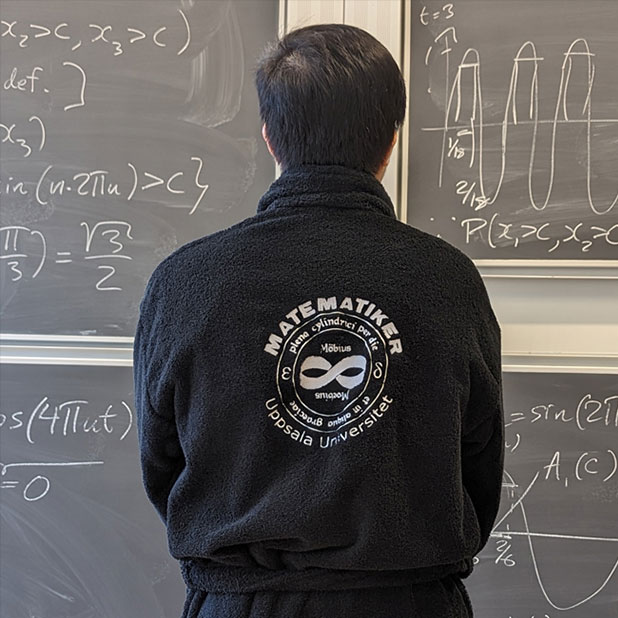
Kelvin, a student from Hong Kong
The best thing here at Uppsala University is that you can retake exams as you wish until you pass them. It makes me less anxious, although I passed all my exams (with good grades indeed).
Read the interview with Kelvin
How do studies at Uppsala University differ from your previous studies?
– The teachers in Uppsala are very nice and helpful. They are pleased to answer your question about lectures or homework which made me a bit surprised. It makes my learning more efficient. Also, the pressure is not as high here as where I studied before and I feel comfortable and less depressed, which indeed improved my performance.
What is most challenging?
– The most challenging thing in Uppsala is getting through the winter. Winter in Uppsala means short daytime and cold weather, which drove me crazy as a person coming from a sub-tropical area. To pass, ensure you get enough vitamin D, as sunlight is scarcer. Stay connected by talking with friends to keep your spirits high. Regular workouts will boost your mood and energy. Lastly, make time for walks to enjoy the fresh air and stay active.
Do you have good teachers?
– All the teachers in the Department of Mathematics are nice! They are helpful and willing to answer your questions. Additionally, they create a supportive learning environment that encourages learning. Their dedication to teaching and passion for the subject matter truly enhance the educational experience.
What are three things you will do this week?
– Attend a lecture, do an assignment, and have fun with my friends.
Where do you hope to be in your career in five years?
– I hope I will work as a PhD student.
What would you like to say to students thinking of applying to the programme?
– The courses and the exams would not be easy here but I believe you will learn a lot of useful knowledge.
Spring 2024

Henri Doerks, a student from Germany
One of the key advantages of the Master's programme, is that it allows you to take many courses from other research areas and structure your studies around your interests with minimal restrictions
Why did you choose this programme and this specialisation at Uppsala University?
– Several factors contributed to my decision to choose Uppsala University. In terms of academics, I was looking for a programme that focused more on applied mathematics, especially on possible applications in finance. I narrowed my search to Scandinavia because of the high living standards, the exceptional English level, and the recommendations I received from friends. However, Sweden was my favourite choice. Finally, I was searching for a true student city to enjoy life besides my studies. After two years, I am more than happy that I ended up in Uppsala and can recommend it without hesitation.
Which courses have been most interesting?
– Personally, I enjoyed the courses that had a direct connection between mathematics and financial applications. My three favourites were Financial Derivatives, PDE with Applications in Finance, and Computer-Intensive Statistics and Applications. Additionally, I highly recommend taking the two available machine learning courses, which provide an interesting and very mathematical introduction to this increasingly important field: Statistical Machine Learning and Advanced Probabilistic Machine Learning.
Do you study any other subject than mathematics within the programme?
– I ended up taking a surprisingly large number of courses in the Computer Science department and even wrote my thesis there on 'Learning Distributed Optimization with Graph Neural Networks'. Overall, this flexibility is one of the key advantages of the Master's programme, as it allows you to take many courses from other research areas and structure your studies around your interests with minimal restrictions. Even external theses with companies are encouraged.
What do you like to do outside your studies?
– In my free time, I like to play all kinds of sports, such as football, hockey or padel. I also love hiking on weekends, skiing in the winter, visiting the Nations, and playing board games with friends.
What are your plans after you graduate?
– I was lucky enough to catch a PhD position in the Department of Mathematics, in collaboration with the Centre for Interdisciplinary Mathematics (CIM) here at Uppsala. I realised that I still enjoy studying and want to dive deeper into certain topics - and Uppsala is a great place for that! So I will spend the next 5 years scratching my head about stochastic control problems with incomplete information.
What would you like to say to students thinking of choosing Uppsala University for Master's studies within this programme?
– Do it! It’s two years you won’t regret.
Autumn 2024
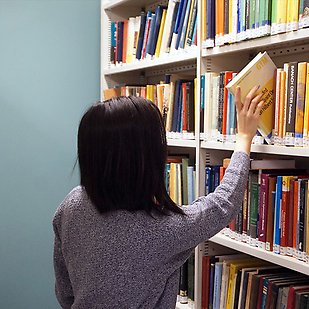
Robin, a student with an interest in analysis
The best thing is the many enthusiastic lecturers/researchers who are knowledgeable and encouraging.
Read the full interview with Robin
Why did you choose the programme, and the specialisation in mathematics at Uppsala University?
– Mathematics gives me moments of enlightenment, a more logical mindset and higher personal value. I really wish more people would give maths a chance as it is a fascinating subject and not as difficult as many believe.
– Uppsala University and its maths department have a good ranking nationwide, and the rent is lower here than in Stockholm.
Has the programme lived up to your expectations so far?
– The teaching quality is clearly higher than in my Bachelor’s programme (at another university in Sweden), during which I also took Master's level courses. On the downside, the course selection within my field of interest (analysis) is a bit limited and I miss an adequate library.
You are in the last semester of the programme, what are you doing your thesis on?
– Pseudo-differential operators, related to mathematical analysis.
What are your plans after you graduate?
– I’m planning on PhD applications, so hopefully, I continue studying as a PhD student at Uppsala University.
What is the best thing about studying at Uppsala University?
– Many enthusiastic lecturers/researchers who are knowledgeable and encouraging, more oral exams and less written exams, plus beautiful scenery during the summer.
Tell us about student life!
– For many, student life means 'party life', to me it means I’m dedicated to my studies while maintaining a good study/life balance. On paper, a full-time student studies 40 hours per week, which is more than enough for me to keep top grades. The rest of the time I spend on cooking, numerous hobbies, gym and hanging out with friends.
– Besides studying math, I like painting, playing the piano, playing with my cat, playing video games, watching TV, baking, and reading novels. In addition to living my life, I take extra courses from the Department of Information Technology.
What would you like to say to students thinking of choosing this programme?
– If you love maths, go for it! And start queuing up for housing already!
Spring 2024
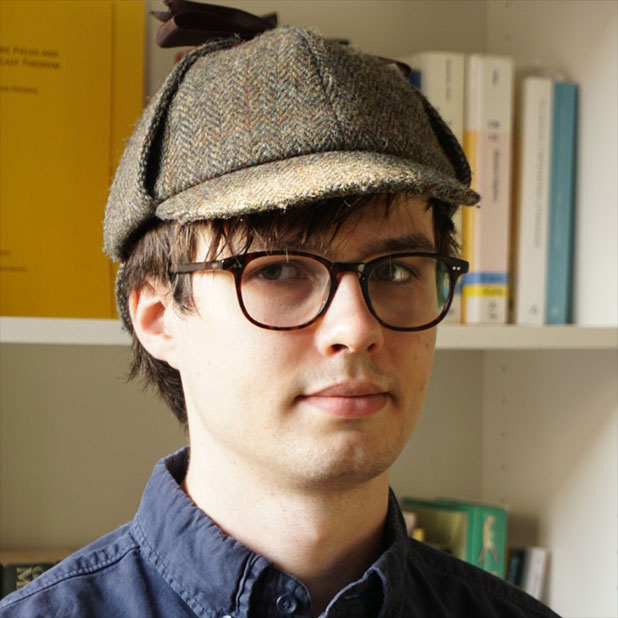
Samuel, a student with an interest in algebra
Uppsala has the most active researchers in my main interests.
Read the full interview with Samuel
Why did you choose this programme and this specialisation?
– I have always been interested in logical problem-solving, so when I started to encounter actual problem-solving in mathematics outside of school, I quickly realised that I had found my great passion.
– I chose this programme because I want to do research in mathematics in the future. That I ended up in Uppsala is a consequence of me being limited to applying within Sweden for personal reasons and that while looking for a suitable university I got the impression that Uppsala has the biggest number of active researchers whose research interests align with mine.
Has the programme lived up to your expectations so far?
– I am overall quite satisfied and sincerely believe that there were no better options available to me. There is a decent range of courses available to me in my main areas of interest and there is a regular and very interesting research seminar in algebra, which is more than I ever would have dared to dream of in my previous department.
What are your favorite courses so far?
– The courses I have enjoyed the most thus far were a reading course in Auslander-Reiten theory and a PhD course in algebraic groups. Officially I took both of these as the course "Selected Topics in Mathematics". This is a flexible course that is remarkably useful for taking courses on topics that are not covered in any regular Master's level courses.
What might a typical day look like?
– I am currently in the middle of writing my Master's thesis so most of my day is centered around this. I typically work on it at home so that I can keep my cat company. Alongside my thesis work I am also taking a course so when I get stuck with something in my thesis but feel like I can still be productive I usually take a look at my coursework instead.
What are your hobbies?
– My biggest hobby is probably reading. I read everything I can get my hands on without spending too much, mainly books that I borrow from my parents or find second-hand. Other than that I mainly enjoy being outdoors. I am fortunate enough to live very near a pleasant forest in which I often take my cat for walks. When I have plenty of time to spare I also like baking and drawing.
– Outside of the programme I work part-time as a teaching assistant at the department and represent my fellow math students in the Master's programme council for mathematics.
What is most fun about studying mathematics?
– What I enjoy most is feeling that I have found something beautiful. This could be an elegant solution to a problem or a good explanation for something that I have not heard from anyone else. I also really enjoy discussing mathematics with my fellow students; they typically have plenty of interesting observations that I would never have thought of myself, while I also hope that they also learn a thing or two from me.
– After the programme I hope to pursue a PhD in mathematics and I would very much like to do so here in Uppsala.
Spring 2024
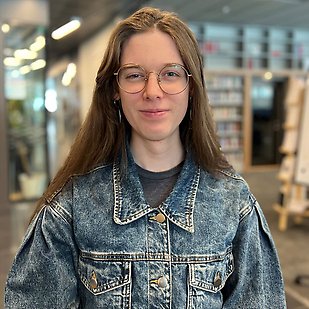
Miranda, a student with an interest in Riemannian geometry and graph theory
I never imagined before that there was so much to learn in maths.
Read the full interview with Miranda
What is the most fun thing about developing in mathematics?
– When I learn new things and manage to connect them with things I already know and see the connections between them, it feels like whole new worlds open up to me. Learning new ways to describe things I've only seen from a certain point of view is also great.
Why did you choose this programme and specialisation?
– I knew quite early on that I would study at university and choose a science programme. Towards the end of high school, I was torn between maths and engineering physics. In the end, I chose maths because I was more interested in theory, rather than applications.
Has the programme lived up to your expectations so far?
– Yes, it has. In many ways, it has even exceeded them. I would never have imagined before that there was so much to learn in maths.
What is most challenging?
– The Bachelor's and Master's theses have been the biggest challenges so far. It has been very instructive, but also very demanding, to study on my own.
Where do you prefer to study?
– It depends. When I've been working on assignments, it's worked very well for me to sit at the University and study with others, but now when I'm working on my Master's thesis, I prefer to sit at home and study.
Do you study any other subject than mathematics in the programme?
– In my Bachelor's programme I studied quite a lot of programming, which was both fun and useful. In addition, during my time at university, I have studied both philosophy and chemistry. It feels good to broaden your horizons and try different things, but I think it has been a bit difficult to find the right one among all the choices available. I'm glad I always had maths to fall back on.
What are your favourite courses so far?
– The absolute best courses I have taken have definitely been Graph Theory, Mathematical Logic and Riemannian Geometry.
Spring 2024

What happens after your studies?
Read about what some of our former students are working on today.
Contact
- For programme-specific information, please contact:
- masters@math.uu.se
- For admissions-related or general information, please contact our applicant support team:
- study@uu.se