
What happens after the programme?
Quotes from our alums
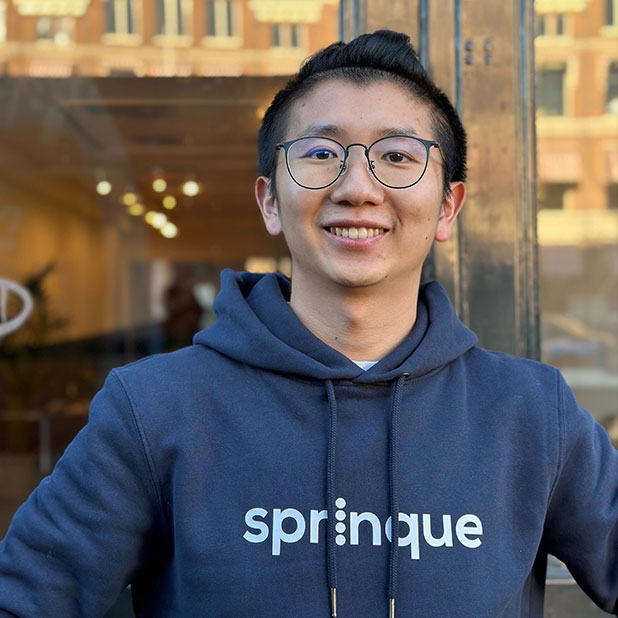
Peiyu Wang, alum, Lead Data Scientist at Sprinque
I am the person who takes leads and is responsible for bringing up ideas and implementing them.
Where do you come from and what is your educational background?
– I’m from China. I studied mathematics as my bachelor's in China, Sichuan University. Then, I finished my master's degree in financial mathematics at Uppsala University
What do you do as a Lead Data Scientist at Sprinque?
– I am responsible for all the machine learning directions within the company. Including integrating GPT4 into our workflow, creating a machine learning model to predict the default probability of our customers and setting corresponding limits, fraud detection with machine learning and generating insights with all the data we have in the company.
How do you cooperate with other mathematicians and other professionals?
– Since we are a start-up, I am the person who takes leads and is responsible for bringing up ideas and implementing them. However, due to my previous five years of experience at Klarna, I still hang out with other data scientists and machine learning engineers in Sweden, to catch up on the latest trends, newly developed models and get industry insights.
Did you take courses in machine learning within the programme?
– Sadly no, when I was studying at Uppsala University, machine learning was still not a thing, and we didn't have courses around that. I learned it while I was working at Klarna. I heard there are more tracks for students to choose from at this point in time, having some machine learning courses will definitely help students be more competitive on the job market.
The use of AI is increasing in all industries. How big is it in the financial industry or the part of the financial industry where you work?
– It is definitely important to have AI integrated into the business model, especially when we are starting up and still need funding from the investors. We need to have a roadmap using AI to be able to innovate the industry, moving forward in a more efficient and smooth direction.
What is the best part of your job?
– The best part of my job is that I can use my skills to impact the business. Seeing millions of EUR going through the model, getting evaluated on the credit risk, and at the same time preventing potential fraud attacks. Also – growing with the business feels amazing!
Where do you work?
– I work from home in Stockholm, since it is a fully remote job. But we meet up in Amsterdam from time to time.
In what ways has your education prepared you for the challenges of your profession?
– I would say it is more the ways of thinking, how you view problems. How you would solve a business problem in a mathematical way.
Do you have any advice for anyone planning on applying for the programme?
– Combine what you learnt with practical problems, and try to start coding as early as possible. Check something like Kaggle and use what you know to solve actual problems.
Spring 2024
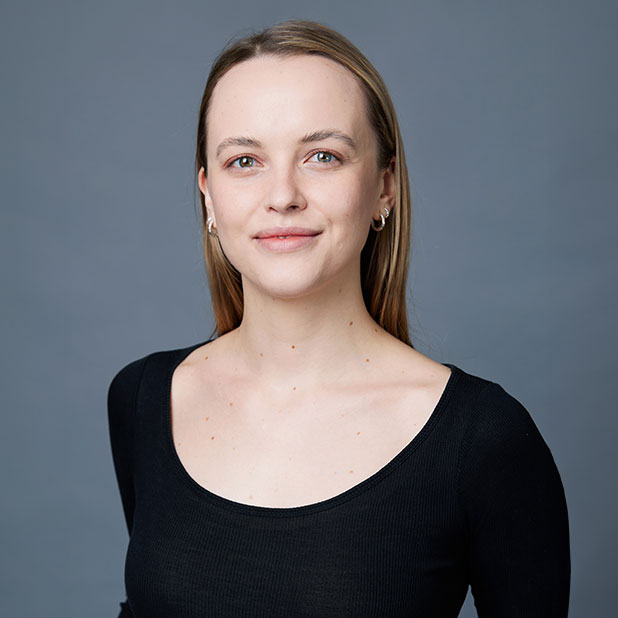
Anna Shchekina, alum, Quantitative Analyst at Handelsbanken Capitial Markets
Delve into the list of requirements such as specific programming languages and topics in finance in job announcements for the roles you see yourselves in and place your focus accordingly.
Where do you come from and what is your educational background?
– I’m from Saint Petersburg, Russia. I have a master’s in Financial Mathematics at Uppsala University and a bachelor’s in Applied Mathematics and Computer Science with a track for Computational Stochastics and Statistical Modelling at Saint Petersburg State University.
What do you do as a Quantitative Analyst at Handelsbanken?
– The fixed-income quant group is responsible for pricing fixed-income derivatives and yield curves. A front office position implies direct proximity to traders and sales, to which we deliver and support various analytical tools.
What do you like about your job?
– There are not so many jobs where one can apply both programming and mathematics at an advanced level. Precision is valued, unlike academia where reaching a certain result is often more important. At Handelsbanken, I particularly like the breadth and variety of tasks at hand and the daily contact with stakeholders.
How did you end up where you are today?
– My first student job was at Itivity where I rewrote a core pricing C++ module for Asian options from their trading system for the use on graphic processing units. Thereafter, I served as a research assistant at the research group at Riksbanken for two years and moved into academia for a brief period only to realise that I missed the more applied area of occupation.
In what ways has your education prepared you for the challenges of your profession?
– The most relevant courses from the practitioner’s perspective were perhaps those in Numerical Methods, especially labs and home projects, all the more because they trained in troubleshooting skills.
What is your relation to mathematics?
– Initially, I was planning to pursue a degree in Business Management but got fascinated by mathematics while preparing for the entrance exams. Having studied languages as the major until my last year in school, getting a high score was a surprise, so I decided to commit to it full time which did not disappoint. My favourite courses at the university were Probability Theory and Stochastic Processes which naturally led me to the idea of trying my hand at the field of financial mathematics.
Do you have any advice for our prospective students?
– Delve into the list of requirements such as specific programming languages and topics in finance in job announcements for the roles you see yourselves in and place your focus accordingly.
Spring 2024

Student interviews
Read interviews with some of our students studying on the programme.
Contact
- For programme-specific information, please contact:
- masters@math.uu.se
- For admissions-related or general information, please contact our applicant support team:
- study@uu.se