
Gotland Forum Newsletters
Gotland Forum's newsletter 2026-01-22
The content below consists of articles linked from the first edition of the Gotland Forum newsletter – published 2026-01-22. Link to the newsletter.

Articles
- Visby 1361 revisited
- Gotland as a Food Place – From Destination to Relationship
- How Digital Tech and Family Support Shape Early Childhood: New Study Launches at Campus Gotland
- How LARP Supports Learning and Democratic Skills: New Studies from Campus Gotland Researchers
- Youth Co-Researchers Present Findings on Mental Well-Being at Campus Gotland
Visby 1361 revisited
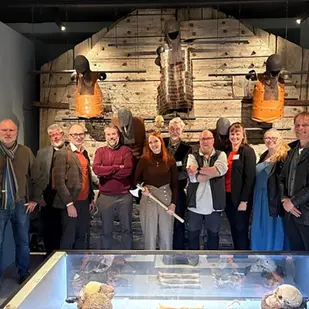
The Battle of Visby took place on 27 July 1361 and was one of the most fateful events in Gotland’s history. In the 14th century, Gotland was a major trading hub in the Baltic Sea, with Visby as part of the Hanseatic League. According to the conventional historical narrative, around 1,800 Gotland farmers were killed when Danish troops under King Valdemar Atterdag overwhelmed the defenders outside Visby’s walls and captured the city. Many of the dead, still wearing their armour, were buried in mass graves at Korsbetningen, creating an archaeologically unique record of medieval warfare and burial practices. Traditionally, the defenders have been portrayed as poorly trained and equipped, largely consisting of young boys and elderly men.
The Visby 1361 Revisited Project challenges this narrative. Led by Patrick Randolph-Quinney (Archaeology, Ancient History and Conservation), the project brings together expertise in bioarchaeology, conflict archaeology, ancient DNA, and medieval weapons and armour.
Using modern archaeological and forensic methods, the project seeks to understand better who the buried individuals were, how they lived, and how they died. The first phase has focused on forensic trauma analysis, including 3D modelling and experimental reconstruction of battle injuries using replicated medieval weapons, demonstrating that several long-held assumptions about weapons, fighting styles, and fatal wounds are incorrect.
In November, the first project activities took place in Visby, funded by DBW Stiftelse, with participation from researchers from Uppsala, Stockholm, and Bradford and Glasgow universities. Alongside research activities and documentary filming, two knowledge-transfer events were held: an international workshop on forensic trauma analysis in archaeology with 40 participants, and a public symposium at Gotlands Museum attended by over 100 people, presenting new research on the Danish invasion of 1361 and its victims.
Gotland as a Food Place – From Destination to Relationship
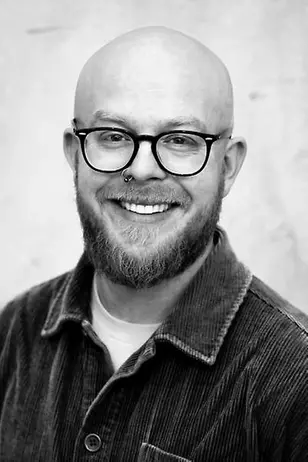
On 24 November, the final seminar for the research pre-study “Gotland as a Food Place” was held at Campus Gotland. Daniel Lövgren, Associate Professor at the Department of Informatics and Media, presented findings from interviews with small and medium-sized food actors across the island.
The study, done within the project Node, which is a regional initiative with Matbyrån and Science Park Gotland in collaboration with Uppsala University, supported by Region Gotland and the European Regional Development Fund, is exploring Gotland as more than a food destination.
It highlights how Gotland’s food system is shaped by year-round relationships between people, knowledge, land, water, economy, tourism, and identity — placing the guiding question “for whom, for what?” at the centre of a sustainable food system.
How Digital Tech and Family Support Shape Early Childhood: New Study Launches at Campus Gotland
Joshua Juvrud, Assistant Professor at the Department of Game Design, together with Olov Nordvall, Associate Professor at the Department of Education, are launching a new research project that explores the impact of digital technology on early child development in two distinct cultures: Sweden and Bhutan.
Moving beyond simple "screen time", they are investigating how adults, from teachers to parents to grandparents, act as essential "scaffolds" that turn passive viewing into active connection. By exploring Sweden's more digitalised society and Bhutan's intergenerational family structures, they will explore how social support and social structures interact with children's development in the digital age - both in homes and in schools.
One goal of the project is to develop frameworks that can be used in both schools and homes to help inform and guide teachers and caregivers.

How LARP Supports Learning and Democratic Skills: New Studies from Campus Gotland Researchers
The Horizon Europe Larpocracy project (2025-2027) is now completing its first year. Larpocracy explores live action role-playing games (larp) and the community events surrounding them as sites for democratic engagement. The project is led by Annika Waern (Informatics and Media) and features Sarah Lynne Bowman (Game Design) along with Ph.D. student Weronika Szatkowska at Campus Gotland.
Two articles from Larpocracy will be featured in the an upcoming Education and Analogue Role-playing Games anthology from CRC Press, one article in the International Journal of Role-Playing on themes related to political themes and democratic deliberation. Additionally, the project premiered its first larp based on this research, The Assembly, at Stockholm Scenario Festival, conducting observational research during the two runs. The team is looking forward to the next year of exploration.
Youth Co-Researchers Present Findings on Mental Well-Being at Campus Gotland
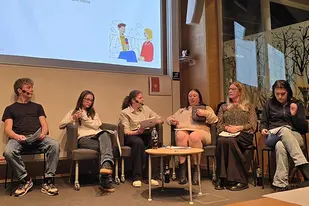
At a seminar on 20 November at Campus Gotland, young co-researchers aged 14–21 presented findings from an interview study on initiatives across Gotland that support youth mental well-being. Around 70 participants from the public sector, civil society, business, and academia attended.
The young co-researchers presented results from interviews with 43 organisations, identifying 85 initiatives with potential to promote youth mental well-being.
They also shared recommendations in five areas, including strengthening existing initiatives, improving outreach to young people, and integrating successful approaches into other activities.
The seminar was part of a regional, research-based development project carried out in collaboration between the CHAP research group at Uppsala University, Region Gotland, Visby Cathedral Parish, and Länsförsäkringar Gotland, with young people actively involved throughout the research process. You can learn more about the project here.
About the newsletter
With the Gotland Forum newsletter, we are launching a regular update on research activities, collaborations, and initiatives connected to Campus Gotland. Our aim is to highlight ongoing work across disciplines, share opportunities for engagement, and provide insight into the projects on Gotland and beyond. Read the latest newsletter here.
Monika Gutestam Hustus, Project manager at the Communications Division: monika.h.gutestam@uu.se.