
Special research initiatives
The Department of Chemistry - Ångström Laboratory developed four strategic and prioritized areas in 2025:
- Chemistry for Circularity
- CO2@UU
- Ångström Electrochemistry Initiative (ÅEI)
- Chemistry Education Research
These areas are presented below.
Chemistry for Circularity
Chemistry for Circularity is a strategic investment in expertise in recycling technology, with a particular focus on hydrometallurgy as a central tool for implementing circular material flows. This is a crucial piece of the puzzle for achieving circularity in the university's materials research.
Part of the initiative is the recruitment of an Assistant Professor with main expertise in recycling technology. The focus is on technically advanced and sustainable methods for recycling strategic materials, for example from batteries, magnets and electronic waste, as well as on connections to bio-based and electrochemical recycling methods.

CO2@UU
CO2@UU is an interdisciplinary research initiative at Uppsala University focused on developing technologies for carbon capture, conversion, and utilization (CCU) to support a fossil-free society. By bringing together expertise in carbon capture, chemistry, biotechnology, materials science, and process engineering, the initiative aims to transform captured CO₂ into valuable products such as fuels, chemicals, and materials.
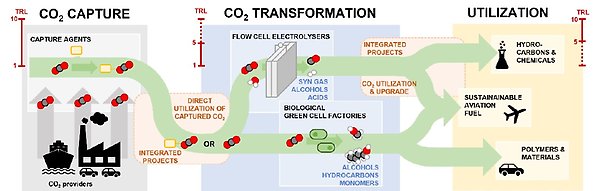
A key objective is to bridge the gap between fundamental research and real-world applications by developing integrated technologies and demonstrating them in collaboration with industry and other stakeholders. The initiative seeks to strengthen Sweden’s leadership in CCU and contribute to a circular, carbon-neutral economy.
Ångström Electrochemistry Initiative (ÅEI)
The Ångström Electrochemistry Initiative (ÅEI) was created to build a community around electrochemistry – a widely used subject in many active research areas and teaching.
The mission is to increase the visibility of the discipline, promote collaboration between different programs, create a forum for discussing scientific efforts, educate and train, and maximize the use of central facilities for research development.

Chemistry Education Research
The Department of Chemistry – Ångström Laboratory is developing a prominent research environment in chemistry didactics.
Strong subject expertise, a good anchoring in the disciplinary culture, growing collaborations and a clear strategic vision contribute to positioning Uppsala University as a leader in research for the understanding of university students' learning of chemistry, and how teaching can best support this learning.
Chemistry didactic research develops fundamental knowledge about how learning occurs and is influenced, based on the specific nature of different disciplines. It includes both theoretically oriented studies that develop frameworks, methods and analysis tools, and applied studies that investigate the effects of different pedagogical practices.
