
History of the Department
The Department of Cultural Anthropology and Ethnology has developed out of two closely related disciplinary traditions with a shared methodological foundation in ethnography, but with partly different geographical and thematic emphases. Together, these traditions create a research environment that spans studies of everyday life and analyses of global societal processes.
From Comparative Ethnography to Critical Perspectives
Cultural anthropology was established in Uppsala in 1963 as general and comparative ethnography. Early research was characterized by a strong interest in material culture and comparative perspectives. In the late 1960s and early 1970s, this orientation was challenged by more critical, socially oriented perspectives, in which questions of power, inequality, and global systems gained increasing importance. This period marked a significant transition, as the discipline moved from a more classical ethnographic tradition toward a broader cultural anthropology.
With the appointment of Anita Jacobson-Widding as professor in 1977, this development was consolidated. Under her leadership, a strong research profile in symbolic and cognitive anthropology was established, alongside the emergence of a clear regional focus on Africa. Studies of cultural models, symbolism, and systems of belief became central, and Africa came to function as an important empirical and theoretical hub for the department’s research.
A Growing Focus on Conflict, Change and Contemporary Life
During the 1980s and 1990s, interest grew in contemporary societies, with studies focusing on social change, development, conflict, and war. Research on conflict situations and everyday life in the shadow of war developed into an important area, while a strong commitment to societal issues and collaboration with various stakeholders became more pronounced. During this period, several parallel research fields were also established, including medical anthropology, religious studies, and urban research.
Ethnology: From Folklore Roots to Modern Society
Ethnology has existed as a discipline in Uppsala for more than 75 years and has traditionally focused on studies of Sweden and Europe. The subject grew out of Sweden’s earliest folklore research, which had been conducted at Uppsala University since 1909. In 1948, a professorship in the field was established and taken up by Dag Strömbäck. His orientation was primarily folkloristic and philological, and he also served as director of the then Institute for Dialectology and Folklore Archives in Uppsala, now known as the Institute for Language and Folklore.
In 1971, the subject was renamed Ethnology—especially European. Anna Birgitta Rooth was appointed to this professorship in 1973. Under her leadership, folkloristic studies and analyses of cultural traditions, narratives, and symbolic expressions were further developed. Ethnology has also followed societal changes through studies of modernization, urbanization, and everyday life, and today the field has expanded to include areas such as cultural heritage, materiality, diversity, and sustainability. Following a merger with University College Gotland in 2013, the department was also active in Visby for more than a decade, with ethnological research strongly rooted on the island.
When anthropology and ethnology were merged in 1996, a joint department was created where anthropology’s global perspectives meet ethnology’s regional grounding. This combination enables analyses of how local ways of life are connected to global processes and has contributed to a research environment with great thematic and geographical breadth.
New Directions in a Changing World
In the 2000s, research has increasingly been organized both regionally and thematically. Within ethnology, the project Forum for School was conducted for several years as a collaboration between the university and Uppsala Municipality. Within anthropology, research on Indigenous peoples and circumpolar regions was strengthened, as was work in political ecology. The strong focus on Africa has continued to develop and was further institutionalized through the creation of the Forum for Africa Studies in 2011, which serves as an interdisciplinary platform for research and international collaboration. At the same time, new regional emphases have emerged, not least in Latin America and Asia, while research on the Middle East has also been strengthened.
A clear recent development is the emergence of thematic research environments that transcend geographical boundaries. The ten-year research programme Engaging Vulnerability, funded by the Swedish Research Council, brought together research on vulnerability, inequality, and social conditions and contributed to a broader shift toward analyses of contemporary global challenges, including migration, conflict, and climate change.
From Local Lives to Global Perspectives
Overall, the department’s development is characterized by strong continuity in its ethnographic approach, combined with a high degree of renewal. From early studies of material culture and folklore to today’s analyses of global processes, research has gradually expanded both geographically and thematically. Today, the department is a multifaceted environment in which cultural anthropology and ethnology interact to illuminate people’s lives in a changing society, both in Sweden and globally.
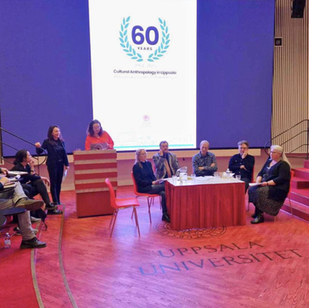
Transcription of Roundtable
When Anthropology celebrated its 60th anniversary at UU in 2023, the development of the subject was discussed.