
Don Kulick
Studying people who are not really there-
With an ERC Advanced Grant, anthropologist Don Kulick is investigating social imperceptibility
How do people become imperceptible, and how does imperceptibility work socially and culturally? These are the questions that anthropologist Don Kulick is exploring in his research project Out of Sight: exploring social (im)perceptibility. The project has been awarded the European Research Council’s most prestigious grant for established researchers, an ERC Advanced Grant.
ERC Advanced Grants are awarded to established researchers with a proven track record of conducting research at the highest international level. For Professor Don Kulick, the grant offers the opportunity to build an international research environment centred on questions about social imperceptibility.
- My aim is to create a new field within anthropology; one that focuses on people who sociologist Erving Goffman called ‘non-persons’. That is, individuals who are not noticed, either because they don’t want to be noticed and/or because they are rendered invisible by others, explains Don Kulick.
Out of Sight consists of six sub-projects. Among other things, the projects examine imperceptible professional roles, such as professional interpreters, academic peer-reviewers, and artists whose artistic practice is based on their anonymity. Other sub-projects investigate how indivuduals actively switch between visibility and invisibility, for example among refugees and Roma people.
-My own fieldwork concerns the meat industry in Australia. Since the 1960s, slaughterhouses there have become both large-scale and also increasingly invisible. The meat industry all over the world wants to stay under the radar. Ideally, we shouldn’t be too curious about how our meatballs are produced, or about where slaughterhouses are located and what actually goes on there. For several decades, I have been conducting research in Papua New Guinea (PNG), and I am now working with PNG migrant workers who come to Australia to work in this industry. They are allowed to do so because few Australians want to work in this sector, even though Australians consume enormous quantities of meat. I am documenting how the PNG workers live and what they think of their lives in Australia.
At the same time, there is something of a counter-movement in Australia, with smaller slaughterhouses being established throughout the country. The people who run those abattoirs want to show that it is possible to produce meat on a small scale, in a humane way.
- They want to make the production of meat visible. My colleague Catie Gressier is looking into this development. Together, we will be able to provide a comprehensive picture of how visibility and invisibility operate within this particular field in Australia and, by extension, in other countries as well.
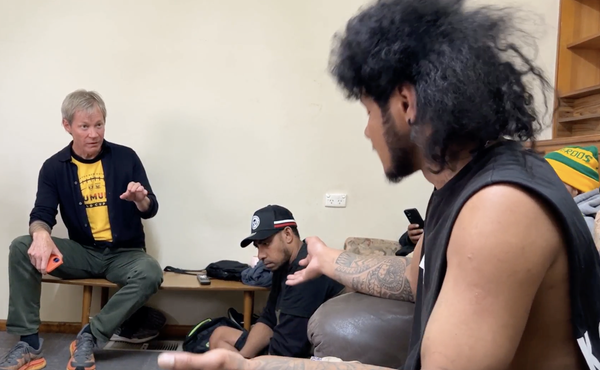
Don talking to PNG meatworkers in Australia, August 2026. Photo: Darja Hoenigman.
Building on research about vulnerability
Don Kulick joined the Department of Cultural Anthropology and Ethnology at Uppsala University as a specially recruited Distinguished University Professor in 2015. Until 2025, he led the interdisciplinary research programme Engaging Vulnerability, which was funded by the Swedish Research Council.
– Engaging Vulnerability was a highly successful initiative that has so far resulted in 17 doctoral theses and at least 15 books. The studies that emerged from the programme show how vulnerability is experienced and can be understood in different contexts. The Out of Sight project is based on the insights I have gained over the years with Engaging Vulnerability. One of these insights is that invisibility and vulnerability do not merely entail suffering or deprivation. Invisibility can be a valuable asset for a wide range of people, for a variety of reasons.
At Uppsala University, the researchers Ana Chiritoiu, Mats Hyvönen, Maria Karlsson, Mahmoud Keshavarz and Sharon Rider are also part of the project.
Actively choosing not to be seen
Viewing willed and unwilled imperceptibility as a continuum, is the underlying principle of the project.
- I’ve always been drawn to the concept of the “non-person”, which pays attention to people whom others overlook. At a piano concert a few years ago, I was struck by the woman dressed in black who was sitting behind the pianist, turning the pages of his sheet music for him while he played. That woman was completely present, at the same time she was completely absent. A fascinating balance. The audience made a conscious choice to overlook her, and she was complicit in rendering herself invisible. That dynamic sowed the seed for the current research project.
Don Kulick observes that there is a divide in how imperceptibility is viewed within academia and in other parts of society.
- In the academy, imperceptibility is seen primarily as an expression of power. Invisibility is portrayed as an injustice, or alternatively as a crude exercise of power whereby people in power control others through invisible surveillance. The people who interest me more are those who want to remain unseen in situations where power dynamics are not a defining factor. Like the woman turning the pages of sheet music at the piano, for example. Those kinds of people feature more often in non-academic texts or films. People love stories about con artists and swindlers, like the character played by Leonardo DiCaprio in the film “Catch Me if You Can”, which was based on an autobiography with the same title. Con artists bring to the fore the cunning dimension of invisibility, the creative and enjoyable dimension. Just like the page-turner, con artists make it clear that invisibility (in this case, invisibility regarding their true identity) is a social feat; it is an achievement. It requires collaboration with others not to see, not to take notice. Paying attention to those dimensions of being imperecptible can enrich our understanding of what imperceptibility is, how it is created and experienced, and how it can change and lead to change.
Don Kulick argues that anthropology can contribute something important to this analysis.
-For example, people who cross borders without the correct documents and permits are often highly skilled at remaining imperecptible. They accumulate knowledge and skills in how to make themselves unnoticeable. As I said earlier, academic literature tends to highlight phenomena like those solely in terms of injustice and oppression. But surely they also are abilities that can bring satisfaction and pleasure. What anthropology can do is to portray people as three-dimensional without sugar-coating the reality. To take an example from my previous research: in Brazil, I worked with travesti sex workers (travestis are individuals born as boys who subsequently modify their bodies using hormones and industrial silicone so that they become very feminine, but they don’t identify as women). Travestis are incredibly oppressed in every way; there is no doubt about that. But if I had portrayed them as unhappy, innocent victims, I would have distorted their lives. They live in an oppressive world, but they are far from broken. They enjoy themselves. They laugh, love, they rob their clients and they assert themselves in ways that are unauthorised and unexpected. A one-sided emphasis on oppression, I think, is often is an act of oppression in itself. That is why, in Out of Sight, I want to emphasise how invisibility can be both a burden and an asset, sometimes at the same time.
Impact within and beyond academia
The aim of the ERC Advanced Grant is to support research with the potential for high impact and which pushes the boundaries of knowledge forward. In addition to developing invisibility as a new field of research, the project may also have an impact beyond academia. During his fieldwork in Australia, Don Kulick has been living in a house with seven workers from Papua New Guinea who work daily in a slaughterhouse.
-The young men I’ve come to know (who refer to themselves and are always referred to by others as “boys”) are actually quite content with a life that is often described in newspapers and reports in sensationalistic language as “modern slavery”. They earn decent Australian wages, which are about 40 times more than what they might earn in PNG, and they are having an adventure that they find exciting. They send money home to their families, who use it to improve their lives. The boys have no qualms about killing and butchering animals; after all, they’ve grown up in communities where people hunt wild boar and other wild animals for food. When I ask them what they thought the first time they saw what their work in the slaughterhouse actually entailed, they all say more or less the same thing: ‘We were scared,’ they say. But not because animals were being slaughtered. They were scared because the work on the slaughter floor moved so quickly. ‘Will I ever be able to keep up with that incredibly fast pace?’ they thought. They felt daunted. I think that small details like that add nuance to our understanding of people’s lives. They bring complexity and colour to lives that would otherwise easily be reduced to flat, homogeneous stereotypes. Papua New Guinean men who work in Australian slaughterhouses are not modern-day slaves. Labels like that do more harm than good, and they can arise because there is a great deal of ignorance about how people actually live and think about their lives. I want to help dispel that ignorance.
Don Kulick argues that, as an anthropologist, one always has a responsibility towards one’s informants, even as it is crucial to be aware of one’s role as a researcher.
- I’ve always worked with people who are vulnerable in various ways. I want to understand their lives and, hopefully, help improve them. In Australia, this takes the form of very practical help: I help the men I work with understand what health insurance is, and I help them navigate the Australian pension system. But I am not an activist. My job is to collect ethnographic material and turn it into knowledge. My role is not to tell people what battles to fight.
Don Kulick takes another example from his research.
- The people in Papua New Guinea among whom I conducted fieldwork for several decades are in the process of losing their ancestral language, which is called Tayap. Today, Tayap is spoken by maybe 40 people. Linguists always ask me if I’m not trying to do something to help “save” it. But if the people who speak the language themselves have no real interest in preserving it, I do not think that it is appropriate for me to try to act like a white saviour and tell them that they really ought to pull themselves together and continue teaching their children their language. No. I am not a missionary who wants to change people, and that sort of patronising colonialism has long ago passed its “sell-by” date. My modest contribution in this case was to spend 30 years writing a 500-page grammar of the Tayap language, which had never before been described. That published grammar means that the language will therefore not be lost entirely when the last speaker passes away in about 25 years or so. If anyone in the future wants to use that grammar to understand the language and perhaps even revive it, fantastic. I’m at their service with whatever help I can offer. But I don’t tell anyone what they should or shouldn’t do with their ancestral language or with their life in general. That’s not my role. My job is to try to understand people, and to make sense of that understanding. Not to lecture them.
For more information about Out of Sight, visit the project’s website.