
Palaeontological collections
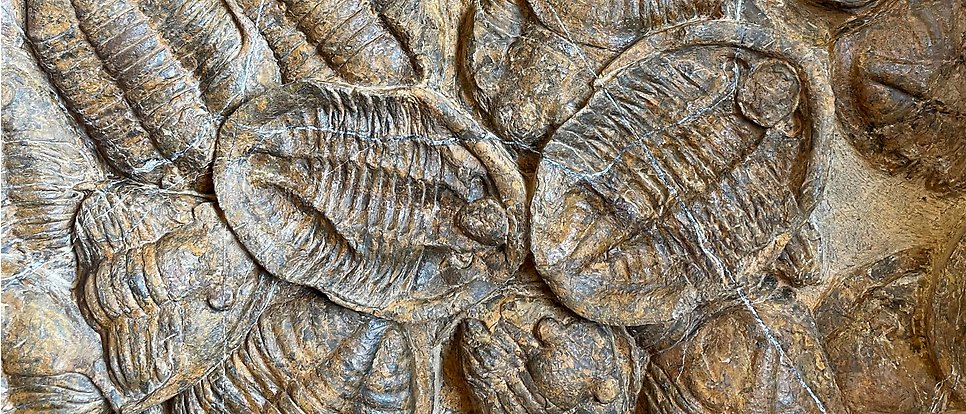
The palaeontological collections at the Museum of Evolution amount to about 300,000 specimens. Collection-based palaeontological research has a 300-year-long tradition at Uppsala University, and our collections are still actively used in research and education by scientists from all over the world.
The Museum of Evolution's collection of fossil vertebrates is the largest in Sweden, with a large number of scientifically described specimens. In terms of scientific history, the collections represent the emergence and development of vertebrate palaeontology as a field of research in Sweden. World-unique sub-collections include fossils from the USA, Svalbard, Madagascar, Germany, England, East Greenland and China. The fossils from China, the so-called Lagrelius collection, uphold a special position, as they came to Uppsala through a bilateral cooperation project between China and Sweden in the 1920s.
Our collections of Swedish invertebrate fossils reflect all areas with fossil-bearing layers in Sweden. The collection's scientific weight is great and it contains fossils from a number of works that were fundamental to the knowledge of Sweden's oldest fossil-bearing layer. Key collections include samples from Cambrian layers in Lapland, Jämtland, Närke and Västergötland as well as historically and stratigraphically important samples from Ordovician layers in Dalarna, Uppland and Öland.
Research loans
Researchers at established research institutions may borrow museum specimens for scientific purposes. Read more about how to apply for a loan.
Important collections

Invertebrates
Our oldest invertebrate collections include fossils collected from 1650 onwards to the early 1800s, when palaeontology appeared as a science in Sweden. The fossils in these old collections were often part of a larger collection of minerals and rocks, of which the collection belonging to Magnus von Bromell is typical. The collection, which was acquired from the Kungl. Vetenskaps-Societeten in Uppsala in 1860, laid the foundation for the fossil collections at the university, which included Swedish fossils described in 1818 by Göran Wahlenberg.
The collection grew during the early 1900s through research projects conducted by Professor Carl Wiman, Sweden's first professor of palaeontology, and his students. One of these, Elsa Warburg, collected unique material from the Late Ordovician in Dalarna. Wiman himself described a large number of fossils from Uppland. A number of pioneering works describing Sweden's oldest fossil-bearing layers from Jämtland, Dalarna, Västergötland and Öland were made at the museum during the 1940s-1960s. In recent years, additional fossils from Lapland, Jämtland, Dalarna, Västergötland and Närke have been added and the collection continues to grow. The museum's type collection of scientifically described invertebrate fossils currently has approx. 15,000 specimens.

Vertebrates
The museum's collection of fossil vertebrates is the largest in Sweden and includes world-unique specimens. In the oldest collections there were only a few specimens of fossil vertebrates, and it was not until Carl Wiman's time that the core of the collection that the museum houses today was added. Between 1908 and 1929, a large number of fossils from the Triassic and Jurassic were collected in Svalbard, which under Wiman's leadership were described in a large number of articles.
During the years 1918-1921, Wiman made extensive discoveries of marine reptiles in Skåne's chalk layers, and at the same time he began to buy mainly fossil reptiles from the USA, England and Germany. The purpose was to build up a reference collection and obtain comparative material as there was no such material in Sweden. In 1921, a large collection of vertebrate fossils from New Mexico was acquired, in 1911 a collection of South American mammal fossils, and in 1930 a collection of sub-fossils from Madagascar.
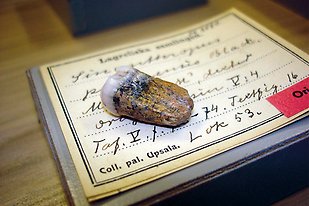
Tooth of Peking man, Homo erectus
A unique collaboration with China began in 1919, and until 1924 hundreds of boxes of fossil mammals, but also dinosaurs, turtles and fish, arrived for Wiman in Uppsala. Among the treasures are teeth from Peking man (now Homo erectus). The collections from China were named the Lagrelius Collection, after patron Axel Lagrelius. The current building of the palaeontological collections was erected precisely to make room for the Lagrelius collection.
In 2026 the Lagrelius collection was designated as a Global Geological Heritage Collection by the International Union of Geological Sciences (IUGS).

Plant fossils
The museum's collection of fossil plants is relatively small. Two sub-collections to mention are plant fossils from Svalbard collected during expeditions in the 1920s, and Pliocene material from southern Japan described by Rudolph Florin.