
The Lagrelius Collection – a Global Geological Heritage Collection and international research infrastructure

Fossil skull of a hyena in the Lagrelius Collection
The Lagrelius Collection of Chinese fossils at the Museum of Evolution, Uppsala University, has been designated a Global Geological Heritage Collection by the prestigious International Union of Geological Sciences (IUGS). This recognizes the Lagrelius Collection as a collection of exceptional international significance, both scientifically and historically.
The Lagrelius Collection contains thousands of Chinese fossils, primarily mammals dating back approximately 1 to 9 million years, as well as dinosaurs, turtles, and fish from a period 73 to 140 million years ago. The fossils arrived to Uppsala University in the early 1920s as the result of a unique collaboration between China and Sweden. Today, it stands as the largest collection of Chinese vertebrate fossils outside of China, a feat made possible by a bilateral agreement. Between 1918 and 1923, approximately 800 crates of fossils were shipped to Uppsala for study. The findings were published in a new scientific journal (Palaeontologica Sinica), established in China with assistance from Sweden.
The collection also includes four original teeth from Peking Man – Homo erectus pekinensis. They were found at Zhoukoudian, near Beijing, a UNESCO World Heritage site, and were discovered in 1921, at a time when the search for the believed Asian origin of early humans was at its most intense. They thus represent the collection’s most significant fossils – historically, culturally, and scientifically. The Lagrelius Collection is named after the industrialist, patron of the arts, and Court Intendant Axel Lagrelius, who secured funding and royal patronage for the project.

Professor Carl Wiman in the Lagrelius Hall, 1938
Sweden in China
From 1914 onwards, the geologist Johan Gunnar Andersson was active in China as a scientific advisor to the Chinese government. Together with the geologists Ding Wenjiang 丁文江 (known in English as V.K. Ting) and Weng Wenhao 翁文灏 he established China’s first geological survey. They jointly developed extensive plans for research, museum activities, and education, initiatives that continued until 1926 and laid the foundations for collaboration and exchange with leading Swedish research centers that persist to this day.
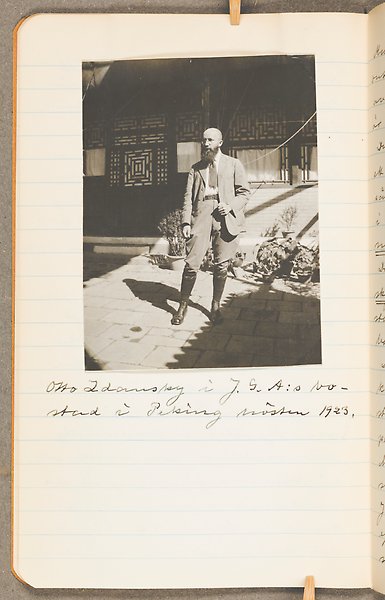
Otto Zdansky at Johan Gunnar Andersson’s house in Peking, 1923
Andersson was a visionary who saw opportunities to advance Swedish interests through cooperation with China. As part of the ambitious research program, he organized numerous expeditions, primarily to collect fossil mammals, but also dinosaurs. Professor Carl Wiman, based in Uppsala, was tasked with organizing the study of the collected vertebrate fossils. A bilateral agreement, involving Uppsala University (represented by Wiman), the Geological Survey, and the Chinese authorities, eventually allowed for all described material to be permanently housed in Uppsala. Financial support was secured through the so-called "China Committee," which included members such as the businessman Axel Lagrelius and the then-Crown Prince Gustaf Adolf.
Between 1921 and 1923, the primary collection work was carried out by a Swedish – Chinese field team led by the young Austrian paleontologist Otto Zdansky. He and other "Vienna students" had arrived in Uppsala in 1920 through the efforts of Swedish student unions as a form of aid during the difficulties following the First World War. Zdansky, a trained vertebrate paleontologist, who had studied under the renowned Othenio Abel in Vienna, began working with Wiman in Uppsala just as the first crates of Chinese fossils arrived. When Andersson requested assistance with collecting in China, it was natural for the assignment to go to Zdansky, as there were no other suitable Swedish candidates at the time.
Temple for fossils

The result of the fieldwork in China is the largest collection of Chinese fossil vertebrates outside of China today. Most notably fossil mammals from the so-called Hipparion fauna. This fauna resembled the one seen on the savannas of the Serengeti today, but included now-extinct species of elephants, rhinoceroses, gazelles, and giraffes, as well as predators such as lions and hyenas. The fauna was distributed across large parts of Eurasia and Africa between 1 and 9 million years ago. A great number of scientific papers by Zdansky, Wiman, and others described these fossils, which today serve as important type and reference specimens.
Zdansky also made a spectacular discovery of teeth belonging to early humans. In the 1920s, everyone was searching for the origin of humanity, then believed to lie in Asia. In 1921, only a few weeks into the excavation of the site known as "Dragon Bone Hill" (Zhoukoudian) near Beijing, Otto Zdansky found a fossilized tooth from an early human. The species was later named Sinanthropus pekinensis (now Homo erectus pekinensis). Today, Zhoukoudian is a UNESCO World Heritage site.
Dinosaurs and fish are other features of the collection, including the sauropod Euhelopus zdanskyi (named after Otto Zdansky himself) and the hadrosaur Tanius sinensis. The entire collection has been named the Lagrelius Collection, in honor of Axel Lagrelius, whose efforts secured the funding for Andersson’s work in China. In 1929, the Swedish Parliament granted funds to construct a museum for Wiman’s institute and the valuable Lagrelius Collection. The building was completed in 1932 and described by the press as a "temple for fossils." At this time, all other fossil collections from the Institute of Mineralogy and Geology were also transferred to the new museum. That same year, Wiman retired. Today, most people know the building as the Paleontological Museum, Paleontologen, or simply "Pallen."
Significance of the collection
The Lagrelius Collection forms the backbone of the Museum of Evolution’s collection of fossil vertebrates. Even after 100 years, these invaluable specimens remain the focus of ongoing research, and scientific papers that directly reference our material are published regularly. The Chinese - Swedish exchange from the early 20th century is unique, an example of successful, non-colonial scientific collaboration at a time when the colonial exploitation of developing nations was the political and cultural norm. Its designation as a geological world heritage collection highlights the collection’s global scientific, historical, and cultural significance. The enduring value of past natural history research and collaboration could not be more clearly demonstrated.

A tooth from Peking Man, Homo erectus pekinensis
Facts: IUGS Geological Heritage Collections

The International Union of Geological Sciences (IUGS) is an international scientific organization that promotes global cooperation within the field of geology.
An IUGS Geological Heritage Collection is a museum collection, or portion thereof, that holds global significance due to its exceptionally high scientific, historical, or educational relevance to the geological sciences.
Jan Ove R. Ebbestad, from the Museum of Evolution, will attend the formal, ceremonial presentation of the newly designated IUGS Geological Heritage sites, taking place November 4–8, 2026, in the Algarvensis Geopark (Portugal). The Lagrelius Collection, housed at the Museum of Evolution, is one of these.