Zoological research

Zoological research at the Museum of Evolution focuses on sponges (Porifera), a group of animals that remains relatively understudied. Sponges were among the earliest animals to evolve on Earth, and they continue to be one of the most important animal groups on the seafloor today.
Our researchers
Paco Cárdenas
Paco Cárdenas has a particular interest in the evolution and relationships (phylogeny) of Demospongiae, the class that accounts for around 83 per cent of all sponge species. He is the world’s leading expert on the order Tetractinellida, a large group comprising more than 1,000 species, most of which inhabit the deep sea. His research draws on data from morphology, genetics, chemistry, biogeography and ecology to document and describe sponge diversity from different parts of the world.
Selected publications
Whole-genome sequencing of the deep-sea sponge Geodia barrettii
For the first time, the genome of a Swedish sponge species has been sequenced. A specimen of the deep-sea sponge Geodia barrettii was collected at a depth of 96 metres in Kosterhavet National Park on Sweden’s west coast, and its entire genome was sequenced.
Sponges have relatively small genomes (144,000 base pairs, compared with 3,117,275,501 base pairs in humans). The studied specimen is now preserved in the collections of the Museum of Evolution.
Geodia barrettii is an ecologically important species and serves as a model organism for studies of microbial symbionts as well as its remarkable chemistry.
Reference
Steffen K., Proux-Wéra E., Soler L., Churcher A., Sundh J. and Cárdenas P. (2023) Whole genome sequence of the deep-sea sponge Geodia barretti (Metazoa, Porifera, Demospongiae). G3 Genes|Genomes|Genetics, jkad192. https://doi.org/10.1093/g3journal/jkad192
Does the North Atlantic sponge Geodia barretti occur in the south-western Indian Ocean?
On a seamount at a depth of 2,236 metres in the south-western Indian Ocean, we discovered what appears to be the sponge Geodia barretti, a species that normally inhabits the deep sea of the North Atlantic. Only a small number of sponge species have been recorded from more than one ocean, making this an unexpected and exciting find that warrants further investigation.
The project is a collaborative effort involving partners in India (Goa) and South Africa (Cape Town).
Reference
Periasamy R., Cárdenas P., Kurian P.J., Ingole B. and Samaai T. (2023) Is the North Atlantic Geodia barretti (Porifera, Tetractinellida, Geodiidae) present on the Southwest Indian Ridge? Zootaxa, 5380(5), 461-474. https://www.mapress.com/zt/article/view/zootaxa.5380.5.3
Publications
Our journals, publication lists and newly described species

Deep Arctic Expedition 2026
Zoological deep sea expedition to explore the sponges of the Arctic

Kullenberg archives
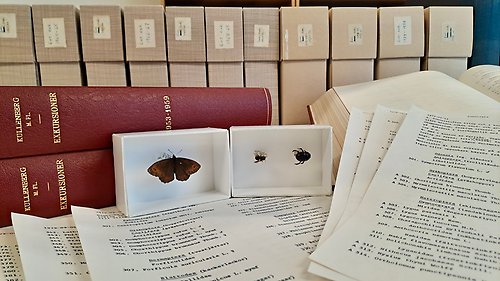
Historical insect inventories