2026 Award Winners
The projects or startups that have been awarded the Attractive Innovation Project award by UU Innovation are regularly presented here.
Epigenovo
A new method opens up biobank tissue samples for epigenetic research
Xingqi Chen has developed methods for analysing epigenetic changes in formalin-fixed tissue samples, both at the whole-tissue and single-cell level. Epigenetic changes influence how genes are read and can provide important insights into the differences between healthy and diseased tissue. In the long term, such knowledge could contribute to improved diagnostics and new treatments.
Most tissue samples stored in biobanks around the world are formalin-fixed. Until now, these samples have been difficult to use for advanced epigenetic analyses because the biological material is affected during the preservation process. The methods developed through Xingqi Chen’s research make it possible to analyse these samples, opening up new opportunities to use existing biobank collections for research into cancer and other diseases.
Epigenovo was established to further develop and commercialise the technology. An investment from W First provides the company with the resources needed to take the next step in its development.
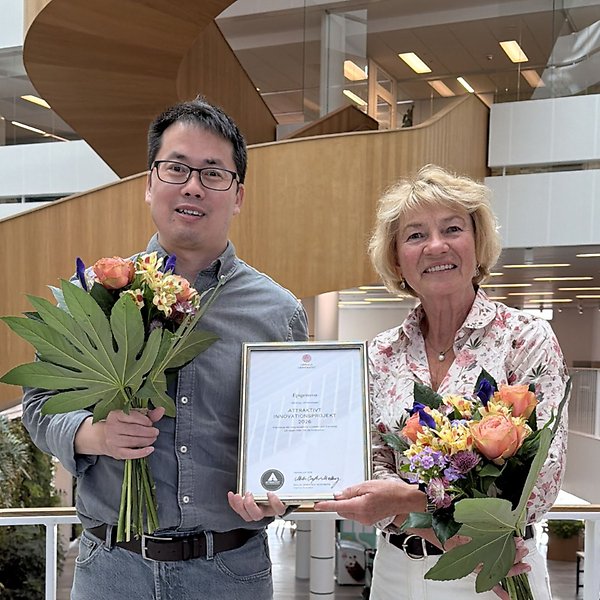
Xingqi Chen at the Department of Immunology, Genetics and Pathology has developed the technology that forms the basis of Epigenovo. Together with CEO Camilla Huse Bondesson, he is working to further develop the innovation and make it available to the research community.
LiFILLERS
New materials for safer and higher‑performance batteries
LiFILLERS is developing novel material solutions for the next generation of batteries. By combining materials in innovative ways, including so‑called fillers, the research team has created a new class of solid electrolytes that enable lithium batteries with improved safety and higher energy density.
The work points towards a new materials platform for solid‑state batteries, where even simple and low‑cost, partly naturally occurring minerals can function as active components. The project is led by Daniel Brandell and Jonas Mindemark at the Department of Chemistry – Ångström, and is currently in an early innovation phase with a focus on validation and further development. Commercial development is supported by UU Invest AB, together with a Proof of Concept grant from the Knut and Alice Wallenberg Foundation.

Daniel Brandell, Professor, and Jonas Mindemark, Senior Lecturer, at the Department of Chemistry – Ångström. They lead LiFILLERS, an innovation project developing new battery materials with the potential to support increased electrification of transport and reduced dependence on fossil fuels.
Nornir Labs
New technology enabling faster diagnostics of drug‑resistant tuberculosis
Nornir Labs is a spin‑off from Johan Elf’s research group at Uppsala University, developing a rapid method to determine antibiotic resistance in tuberculosis bacteria. Today, such tests can take several weeks. The team’s innovation delivers reliable results in roughly 24 hours, enabling faster and more accurate treatment decisions, reducing the risk of transmission, and contributing to the global fight against drug‑resistant tuberculosis – one of the world’s most pressing health challenges.
The company has attracted investment from UU Invest, Navigare First and Leksell Social Ventures, and is now transitioning from academic research to product development.

From left to right: Elias Amselem, Johan Elf, Jimmy Larsson, Petter Knagge and Buu Minh Tran are behind Nornir Labs’ innovation for faster diagnostics of drug resistant tuberculosis. Johan Öhman (not pictured) is also part of the founding team.
LangCube
Board game for language teaching and learning
LangCube is a board game designed to support language learning, with a focus on one of the biggest challenges in learning a new language – grammar. The project was developed by Zekeriya Kazanci, formerly affiliated with the Department of Linguistics and Philology at Uppsala University, with the aim of providing more opportunities to learn both native and new languages.
The starting point was the need for more accessible and motivating ways to practise grammar in foreign languages. Through a pedagogically designed game concept, LangCube offers a new way to combine language exercises with conversation and practical activities. The project is currently in a commercialisation phase: the first version of the game, focused on Turkish, is used by both individuals and organisations. An English version is in development, and further language editions are planned.

Zekeriya Kazanci, a teacher of Turkish, developed LangCube during his time at Uppsala University, where he also received support to realise the idea.