

Signed but Not Sealed: What Arms Control's Ratification Gap Teaches AI Governance

David Sánchez García, Duarte Silva, Akash Solanki & Abirami Raveendranath
This series presents top outputs from the AMC Arms Control & AI Governance Research Sprint. The event held in April 2026, brought together approximately 60 arms control professionals, early-career researchers, and graduate students, to work intensively over two days with the arms control datasets from AMC Data.
In April 2019, the United States did something rare: it "unsigned" a treaty. At the National Rifle Association's annual meeting, President Trump announced that the US would withdraw from the Arms Trade Treaty, a multilateral agreement adopted in 2013 to regulate weapon sales between countries. In practice, the treaty was never ratified by Washington, which would have converted the signature into binding domestic legal obligations.
That space between signing a treaty and actually ratifying it, called the ratification gap, is what our team worked on during the Alva Myrdal Centre's research sprint in April 2026. Working from the AMC Data arms control database – 128 agreements stretching back decades – we strived to understand what can explain the ratification gap, and the implications this may have for AI governance.
Signed, then stalled
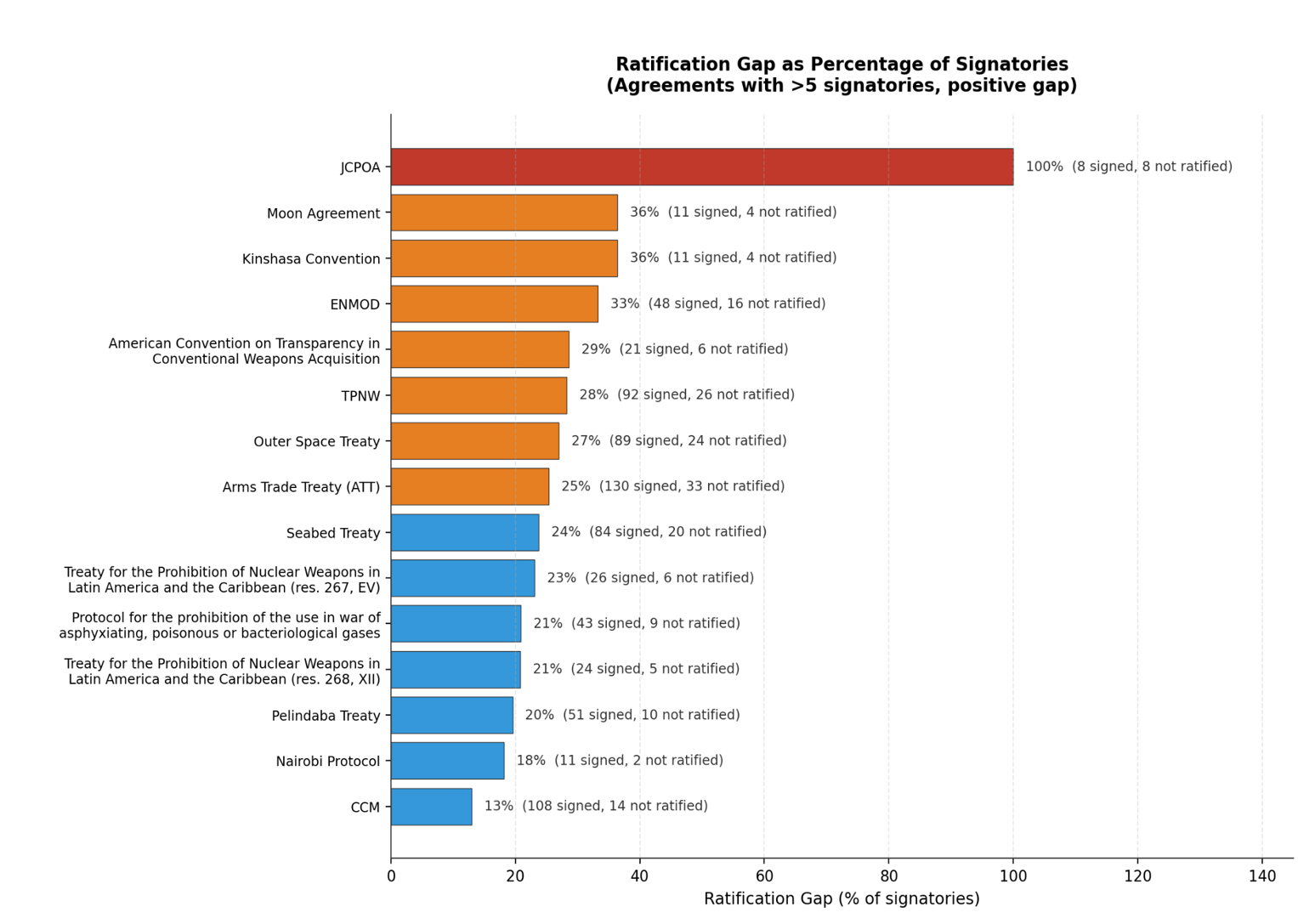
The gap is real and concentrated in a handful of agreements. In absolute numbers, the Arms Trade Treaty carries the largest ratification gap: 33 states have signed but not ratified it. The JCPOA (Joint Comprehensive Plan of Action aka the Iran nuclear deal) shows 100%, but does so by design: it was built as a political agreement to avoid Senate ratification. Some other relevant treaties with large percentages in the ratification gap include the Treaty on the Prohibition of Nuclear Weapons, at 28%; the Outer Space Treaty, at 27%; and the Arms Trade Treaty at 25% (Figure 1).
Agreement design isn’t the issue
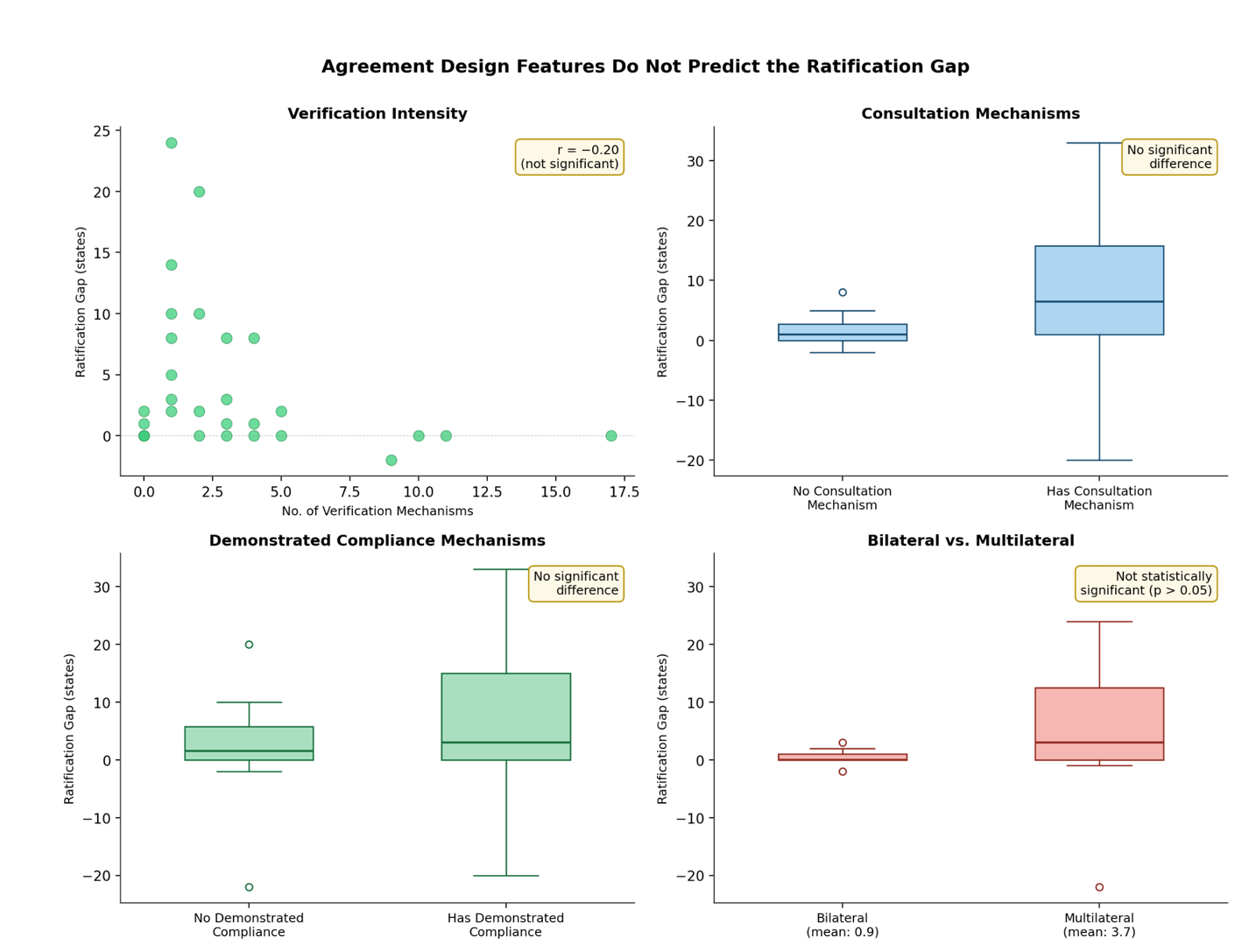
One reasonable intuition is that agreements that are not ratified are designed worse than those that do get ratified. We tested this across several dimensions: how intrusive a treaty’s verification is (using the number of verification mechanisms as a proxy), whether it carries compliance and dispute mechanisms, and whether it is bilateral or multilateral. None of these factors shows a statistically significant relationship with the gap (Figure 2). If anything, more demanding verification is accompanied with a slightly smaller gap: a weak negative correlation, possibly pointing out that credible checks build confidence rather than scaring participants away. The result we’re most confident about is a negative one: how a treaty is engineered tells you very little about whether states will follow through.
It's probably the politics at home
A null result on design cannot tell us what does drive the gap. To understand that, we rely on the existing literature and on individual cases, and both indicate that domestic politics is essential. The United States is a very illustrative case: for a treaty to be ratified, it requires a two-thirds Senate supermajority, which is the highest ratification bar among democracies. The Senate rejected the Comprehensive Nuclear-Test-Ban Treaty in 1999; 20 years later, Trump unsigned the Arms Trade Treaty and walked out of the Iran deal. For another big power like China, on the other hand, ratification issues seem to stem less from legislative gridlock than from strategic calculation and internal bureaucratic back-and-forth between the foreign ministry, the military and line agencies. And everywhere, the clock is ticking: the longer a treaty waits between signature and ratification, the more likely a change of government shifts the very conditions that made signing possible.
The same gap is opening in AI
It can be helpful to understand ratification partly as a form of signalling. States sign to signal alignment with a global norm: a public, low-cost move aimed often at an international audience. They ratify only when domestic constituencies and interest groups absorb the agreement as legitimate, which is slower and more expensive. Signing is signalling; ratifying is institutionalisation.
That same two-step process is structurally visible in AI governance, even if the form is different. The Bletchley (2023) and Seoul (2024) declarations are non-binding – closer to signalling than to anything institutionalised. Biden’s 2023 executive order on AI was rescinded two years later, echoing the pattern of unsigned or abandoned treaties, even if this is a domestic policy reversal. And a systematic assessment of voluntary corporate commitments to the White House found an average compliance of just 53%. The dynamic is the same: consensus at the declaration level, fragmentation at the implementation level.
Three things follow. First, good frameworks are important but not enough: there needs to be durable domestic coalitions – inside legislatures, across electoral cycles, with the public – who can demand restraint on dangerous capabilities. Second, there are important differences between treaties on arms controls and AI: a tougher inspection on arms control does not shrink membership, partly because an army cannot relocate to a laxer jurisdiction; but a company can – and there is some evidence European rules are already nudging firms out, with Meta withholding a model from the bloc and dozens of firms asking Brussels to delay the AI Act in 2025. The arms control result should make us less certain that strict rules push firms abroad – but they might. Third, watch the domestic politi – changes of government, industry lobbying, and regulatory capacity – not the summit photographs.
What can we take away from this? Good agreements matter, but the binding constraint is domestic politics: is anyone at home willing to pay to keep it? And that points to the harder thing the dataset cannot tell us: who, at home, will do the slow and costly work of turning these commitments into binding rules?
Data: Alva Myrdal Centre Arms Control Agreement Database (V2), Uppsala University – 128 agreements across six linked datasets. Some participation figures may differ from current UN Treaty Collection records (the Arms Trade Treaty now records 143 signatories of which 25 are yet to ratify, and the TPNW has 95 countries signed of which 21 have not ratified).