
Matthew Rosenberg defends thesis on new antibacterial leads against C. difficile and E. coli
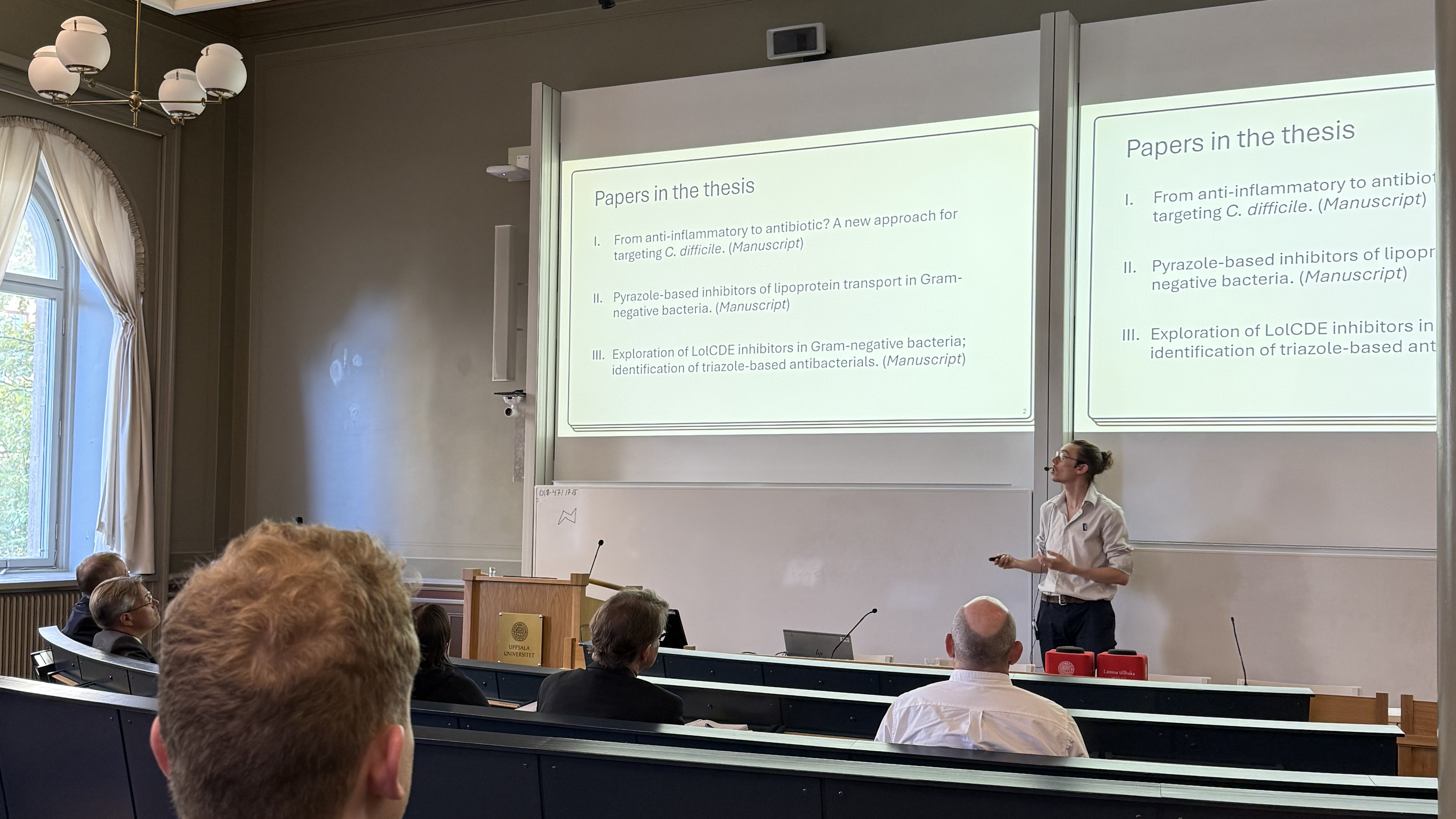
Matthew Rosenberg presenting his thesis work
Matthew Rosenberg successfully defended his PhD thesis, "Synthesis and Structure-Activity Relationships of Antibacterials Against Priority Pathogens," at Uppsala University on 24 September 2026. Matthew is the tenth member of the second cohort of UAC's research school to defend.
Two pathogens with two different problems
Matthew's thesis works on two very different bacteria, each of which makes antibiotic development difficult in its own way.
Clostridioides difficile is the most common hospital-acquired infection in the United States. Its main risk factor is antibiotic use itself. Broad-spectrum antibiotics wipe out the healthy gut bacteria that normally keep C. difficile in check, and once that protective community is gone the infection takes hold and often comes back. What is needed are antibiotics that hit C. difficile and leave the rest of the gut microbiome untouched.
Escherichia coli poses a different problem. As a Gram-negative bacterium, it is protected by a double membrane that keeps most drugs out. Finding compounds that can get through, and new targets inside the cell for them to hit, is one of the central challenges in the field.
From available starting points to an optimized analog series
An old anti-inflammatory drug turned a selective C. difficile inhibitor. Rather than screening from scratch, Matthew started from published data. He mined a dataset of 1100 approved drugs previously checked against bacteria to map potential effects on the microbiome to find now drugs that inhibited C. difficile and nothing else. The best hit was fentiazac, an anti-inflammatory drug from the 1970s. Because its target in C. difficile was unknown, he improved it making and testing one variant after another to learn which parts of the molecule were most important.
He was able to create a compound that suppressed C. difficile while leaving the rest of the test bacterial community largely intact, and it was active against clinical C. difficile isolates covering all five known genetic lineages. To find what it acts on, Matthew grew C. difficile in the presence of the compound until resistant mutants appeared, then sequenced them. Seven of nine carried mutations in the same gene, pointing to DnaE, part of the machinery that copies bacterial DNA, as the likely target.
Pyrazole inhibitors of lipoprotein transport were made safer and more drug-like. In Gram-negative bacteria, a transport system called Lol carries lipoproteins from the inner membrane to the outer membrane, where they hold the envelope together. Blocking the LolCDE complex, which pulls the lipoproteins out of the inner membrane, damages the outer membrane and causes a toxic pile-up of lipoprotein on the inner one. Several LolCDE inhibitors have been reported, but little is known about which features drive their activity, and none has reached clinical trials. Starting from a pyrazole-based hit first reported by AstraZeneca, Matthew systematically varied the two ends of the molecule. He identified structural features, shared with other published inhibitors, that were linked to toxicity and poor metabolic stability, and replaced them with alternatives that improved both potency and drug-like properties. Tests in engineered E. coli confirmed the compounds act on LolCDE: bacteria that lack the lipoprotein, or carry a known resistance mutation in LolC, were no longer affected by the compound.
Changing the core of the molecule produced a new analog series. No one had explored the central ring of these pyrazole inhibitors, even though it holds the molecule together and positions everything else. Matthew moved nitrogen atoms to every feasible position in the ring to see which ones the activity depended on. The results showed that some nitrogens are essential and others can move with surprising freedom. That flexibility allowed to build a new series based on a triazole core. Combined with the results from the previous project, the best triazole was more potent against E. coli, well tolerated by human kidney cells, and stable and soluble enough to develop further. It was also active against several other members of the same bacterial family, including Klebsiella pneumoniae and Yersinia enterocolitica. Tests in engineered strains again confirmed LolCDE as the target.
Why this work matters for AMR
Most antibiotics in use today act on a small number of old targets. Matthew's thesis delivers starting points against two targets with no approved drugs on the market yet: the LolCDE complex in Gram-negative bacteria, and the DNA polymerase subunit DnaE in C. difficile.
The C. difficile work addresses a dangerous side-effect in hospitals. Antibiotics cause C. difficile infection by destroying the gut microbiome, and treating the infection with more broad-spectrum antibiotics can make recurrence more likely. A drug that spares the microbiome could in principle also protect high-risk patients who need antibiotics for other infections. Mining existing microbiome datasets for selective activity builds the most important property, selectivity, into the starting point instead of having to work with that property later in the development.
The LolCDE work provides the kind of detailed structure-activity knowledge that has been missing for this target, and a new triazole series that works across several Enterobacterales. Studies on how these compounds affect the gut microbiome and mouse infection models are already under way.
As Matthew writes in his thesis: "It may take decades of concerted, coordinated effort to wrestle AMR under control, but we'll get there."
We warmly congratulate Matthew on a thesis that opens two new avenues for antibiotic development, and we look forward to following his next steps.

Matthew and faculty opponent Prof. Fredrik Almqvist (Umeå University) during the discussion