Synthetic Pasts
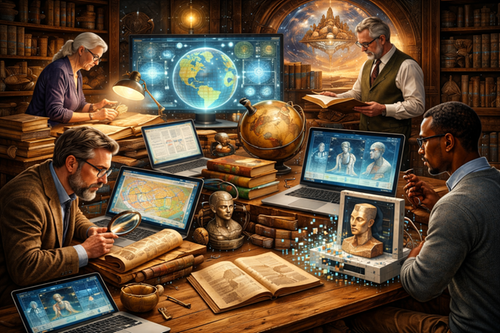
How is history written and used by generative AI models? How can generative AI be understood in relation to a broader and longer history of media technologies? What consequences does generative AI have for knowledge, culture and creativity? These are some of the questions that the Syntethic Pasts project aims to answer.
Details
- Period: 2026-02-01 – 2028-12-31
- Budget: 4,500,000 SEK
- Funder: Marcus and Amalia Wallenberg Foundation
Synthetic Pasts will deploy an experimental approach where we train and interact with open source pre-trained models for generative AI (Stable Diffusion, Mistral, Llama etc), while posing questions of critical and historical nature concerning machine generated historic texts and images. The project will thus provide a controlled research environment meticulously designed to observe and to document the training process of generative AI. The training data chosen, ranges across historical literary fiction, art and comics, scientific images and texts from the 19th and 20th century.
About the project
Artificial Intelligence (AI) challenges widely held notions of human creativity, ethics and law. Through popular, off-the-shelf interfaces, generative AI models can synthesise human-like creative outputs in almost any domain of knowledge or aesthetics. Models such as the much-discussed Dall-E 2, released in 2022, can effortlessly produce synthetic images that, while artificial, nevertheless retain an uncanny aura of historicity. This is possible only through training on massive amounts of data that are necessarily of historical character. As these models figuratively feed on the past, history and historicity figure at the epistemic and ontological centre of this generative technological process. In this project, we study the role and nature of historicity in generative AI by creating synthetic images and texts of historical character, using AI models fine-tuned on specific historical data – ranging across literary fiction, art and comics, scientific images and texts from the 19th and 20th century.
The purpose of this project is to study how and in what ways recent AI-models for synthesising image and text embody notions of history and historicity. We will do so by employing experimental methods and approaches for training and interacting with generative AI-models, while posing questions of critical and historical nature concerning what we call the “synthetic pasts” articulated by these technologies. This will be done in an interdisciplinary setting drawing on scholarly expertise ranging from the history of media and literature, media theory as well as artistic research.
Contribution
The primary significance of the project is that it develops a concrete and practically available method for working with and critically investigating the synthetic cognition of AI-models. While Synthetic Pasts is at first hand focused on the production of synthetic cultural history and the creativity this entails, the method is scalable and can potentially be applied to a variety of fields within the humanities and the social sciences. As such, the project provides innovative epistemological tools for facing the ethical and political challenges posed by generative AI.
The project will further contribute both a practical and a theoretical understanding of human-machine synthetic creativity. More specifically, it offers new ways to investigate how the latent temporalities and historical contexts of media technologies affect historiography and the production of historical and practical pasts. By applying state-of-the art media theory to a meticulously structured workflow, as well as specific application of advanced AI-approaches (fine-tuning of AI systems on historical data), the methodology employs synthetic creativity as a research tool – as a synthetic hermeneutics with the capability of not only creating but also identifying new patterns of historical reality. This method is empirically tested on a variety of historic media and narrative genres, including scientific knowledge (medical discourse) and fiction (literature and comics). The project will therefore produce new knowledge concerning the impacts of generative AI on the interpretation and depiction of events in both the production and dissemination of institutional forms of knowledge as well as non-institutional forms of narrativity.
Collaboration
Synthetic Pasts is hosted by the Department of Archives, Libraries and Museums at Uppsala University (ALM) in collaboration with the Centre for Digital Humanities Uppsala (CDHU).
The project is a collaboration between Uppsala University, Linnaeus university and Echo Chamber, a non-profit organization exploring radical and speculative artistic practices in contemporary comics.
Events and workshops
Humanities Hackathon: AI Generated Texts and Images
The event takes place on 26 May