
New perspectives on existing drugs pave the way for future antibiotics

In a new doctoral thesis at Uppsala University, researchers present alternative approaches to discovering new antibiotics and exploring new targets in Gram-negative bacteria. "Building on data from some early discoveries, we are making good progress towards tackling some of the most important challenges in antibiotic drug discovery” says Matthew Rosenberg, PhD student at the Faculty of Pharmacy
When Alexander Fleming received the Nobel Prize in 1945 for his discovery of penicillin, he already warned of the risks of careless use. 81 years later, the World Health Organization ranks antimicrobial resistance among the greatest threats to global health. The need for new antibiotics is urgent, and in his doctoral thesis at Uppsala University, Matthew Rosenberg presents alternative starting points for the development of future drugs.

Matthew Rosenberg & Colleagues at the Uppsala Biomedical Centre
"I had just completed my Master’s degree in drug discovery and development in New Zealand when I heard about an interesting PhD project here in Sweden. Lindon Moodie at Uppsala University was investigating results from a study of the effects of different non-antibiotic drugs on gut bacteria, to identify new antibacterial compounds. I joined the group in 2020, and we began searching this data for interesting starting points for further development” says Matthew Rosenberg, PhD student at the Department of Medicinal Chemistry.
One challenge in developing new antibiotics is identifying compounds that specifically target disease-causing bacteria without harming beneficial gut bacteria and the microbiome’s protective functions. When Rosenberg analysed data on the anti-inflammatory drug fentiazac, he identified the compound as a potential inhibitor of the disease-causing bacterium C. difficile. After optimising the compound, both potent and selective activity could be confirmed, demonstrating that existing microbiome data can be used to identify new starting points for future antibiotics.
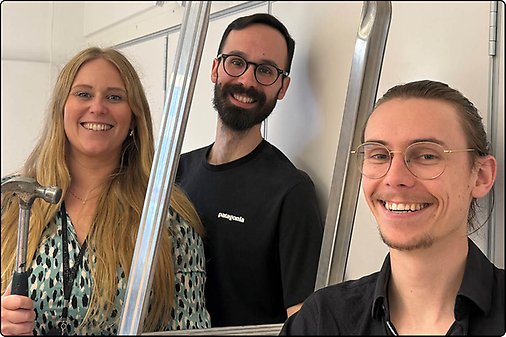
Hammertime • Matthew and co-PhDs Jenny Nilsson & Chris Mitrogiannis nailing their theses in style
"In another study, we focused on LolCDE, a system that transports lipoproteins to the outer membrane of Gram-negative bacteria – a protective barrier that makes it difficult for drugs to enter the bacterium. By optimising LolCDE inhibitors, we were able to design new compounds with improved antibacterial activity and drug-like properties. These results, in turn, highlight the potential of LolCDE as a target for further research into new antibacterial drugs.”
The results are already attracting considerable scientific interest. At the Young Medicinal Chemists’ Symposium in Rome in 2024, Matthew Rosenberg was awarded the Public’s Choice Prize for his presentation. The full research articles will be published soon, and by adding knowledge on the identification and optimisation of existing compounds as starting points for the development of future antibiotics, the results are expected to open important doors in the fight against antimicrobial resistance.
"Our research group has already initiated the next phase based on our results in the two LolCDE papers, and our collaborators elsewhere in Europe have also expressed an interest in taking our C. difficile findings further. The work we’re doing is trying to overcome relevant challenges in an important field, and we think there is a lot of further potential here. After my thesis defense, I’d like to continue my career in Swedish academia, with a focus on using organic chemistry as a tool for understanding and eventually treating infection and disease,” says Matthew Rosenberg.
Facts
- Matthew Rosenberg defends his thesis Synthesis and Structure-Activity Relationships of Antibacterials Against Priority Pathogens Thursday 24 September, 09.00 at Uppsala University Main building, Lecture Hall IV.
- Supervisors are Lindon Moodie and Helen Wang, Uppsala University.
- Opponent at the dissertation is Fredrik Almqvist, Umeå University.
- Matthew Rosenberg is also involved at the Uppsala Antibiotic Center, an interdisciplinary collaboration that brings together all three disciplinary areas at Uppsala University and the Swedish University of Agricultural Sciences.
Contact
Matthew Rosenberg, PhD student
Department of Medicinal Chemistry
Matthew.Rosenberg@ilk.uu.se
text: Magnus Alsne, photo: Mikael Wallerstedt