
Vision:Medfarm reaches the finish line

Vice-Rektor Mats Larhed held a seminar and a panel discussion on Vision:Medfarm. Photo: Robin Widing
After almost six years, it is time to close the book on Vision:Medfarm – the Disciplinary Domain’s goals and strategies initiative. Vice-Rector Mats Larhed looks back on a period that has been both eventful and rewarding.
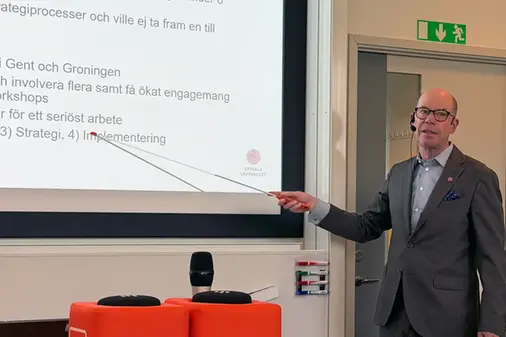
Vice-Rector Mats Larhed shared his experiences from nearly six years of work with Vision:Medfarm. Photo: Robin Widing
As Vision:Medfarm now comes to an end, it marks the conclusion of an initiative that has brought the Disciplinary Domain of Medicine and Pharmacy together around shared goals and strategies. At a closing seminar, Vice-Rector Mats Larhed invited staff to discuss what the initiative has achieved – and which experiences should be carried forward into the next goals and strategies process.
Vision:Medfarm was adopted by the Disciplinary Domain Board in 2021 and has since served as a guide for development work within the Disciplinary Domain. The initiative has encompassed research, education, organisation and collegiality, based on the aim of contributing to better health and a better society through research, education, development and innovation of the highest quality.
“Vision:Medfarm helped us throughout the term of office to prioritise initiatives and structure the work needed to make progress in several development areas, in both education and research. I hope the Disciplinary Domain now stands stronger and is better prepared for, among other things, upcoming quality assurance reviews and ALF evaluations,” says Mats Larhed.
Several goals achieved
Among the clear results are the establishment of the Pedagogical Academy, calls for Clinical Academic Groups (CAG), and work on resource allocation and collegiality. The final report, which is now available, also concludes that several important goals have been achieved, even though all goals and interim goals couldn’t be fully realised.
“I think it was important that we got the Pedagogical Academy up and running and were able to start issuing calls for CAGs to strengthen translational research. I also hope the resource allocation review increased knowledge and understanding of the complex finances of the organisation. It was also very good that we managed to start implementing the proposals from the collegiality review before this spring’s elections.”
Engagement and collegiality important pieces of the puzzle
Broad engagement has been an important part of Vision:Medfarm. From the outset, the work was based on capturing ideas and views from across the entire Disciplinary Domain, including through workshops, working groups and a consultation process. This is also something Mats Larhed particularly highlights, as the initiative now comes to an end. He extends his warm thanks to everyone who has contributed to the process in different ways and to the results that can now be taken forward.
“I strongly believe in bottom-up models for capturing ideas and proposals from across Medfarm, even if not everything can be fully implemented. I also think it is important to communicate the goals and strategies work to the entire organisation – it should not be a purely top-down exercise. I was very pleased by the strong engagement in the Vision:Medfarm project. It was great to see the work gather momentum with such high energy,” Mats Larhed concludes.
As Uppsala University’s new goals and strategies now take shape, the next step awaits the Disciplinary Domain of Medicine and Pharmacy. The experiences gained from Vision:Medfarm therefore represent not only a summary of completed work, but also an important basis for the continued development of Medfarm.
Robin Widing