
Trust but Quantify:
A Composite Scoring Approach to Verification Intensity Across Global Arms Control Treaties
This is an output from the AMC research sprint on arms control & AI governance, that took place online in April 2026.
Team: Dylan Patrick-Lokthai Miars, Makenna Riley, Rebecca Bauman, Yuqin Wang
Introduction
An arms control agreement is only as strong as its ability to verify compliance. Verification mechanisms form the operational backbone of any arms control regime. Yet not all verification tools are created equal. The number of inspection mechanisms, the depth of access granted to inspectors, whether oversight is conducted by the parties themselves or by an independent third party, and whether inspections are automatic or triggered on request all shape whether a treaty can credibly deter cheating.
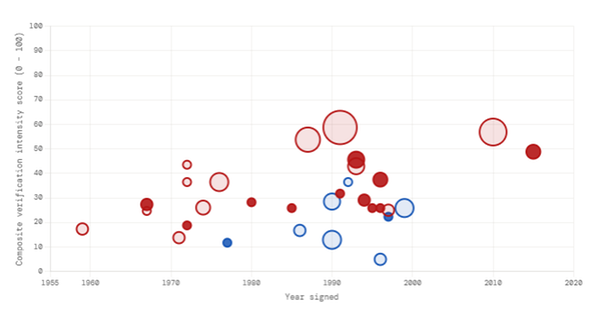
This raises a broader question: Does the international community systematically design stronger verification systems for more dangerous weapons? We address this question using data from 31 arms control agreements in the Alva Myrdal Centre for Nuclear Disarmament’s Arms Control Agreements Database.
To do so, we construct a composite verification intensity score based on six variables: mechanism count, access depth, inspector independence, trigger automaticity, NTM provisions, and phase coverage. We then built an interactive tool that allows users to adjust the weight assigned to each variable and observe how treaty rankings shift in real time.