
Who Watches? Inspector Models in Arms Control and Lessons for AI Oversight
This is an output from the AMC research sprint on arms control & AI governance, that took place online in April 2026.
Team
Philip Chennery, Yerdaulet Rakhmatulla, Joel Christoph, and Joon Baek are alumni of the Youth for Disarmament (Y4D) Forum with backgrounds spanning arms control, AI governance, and quantitative research.
Introduction
This team finds that laterality is the dominant predictor for inspection type, while the disproportionate role of institutional body inspections for adversarial scenarios suggests that institutional credibility really matters. We recommend prioritising bilateral government-to-lab oversight for near-term agreements while building the multilateral institutional groundwork for a long-term international AI inspectorate body
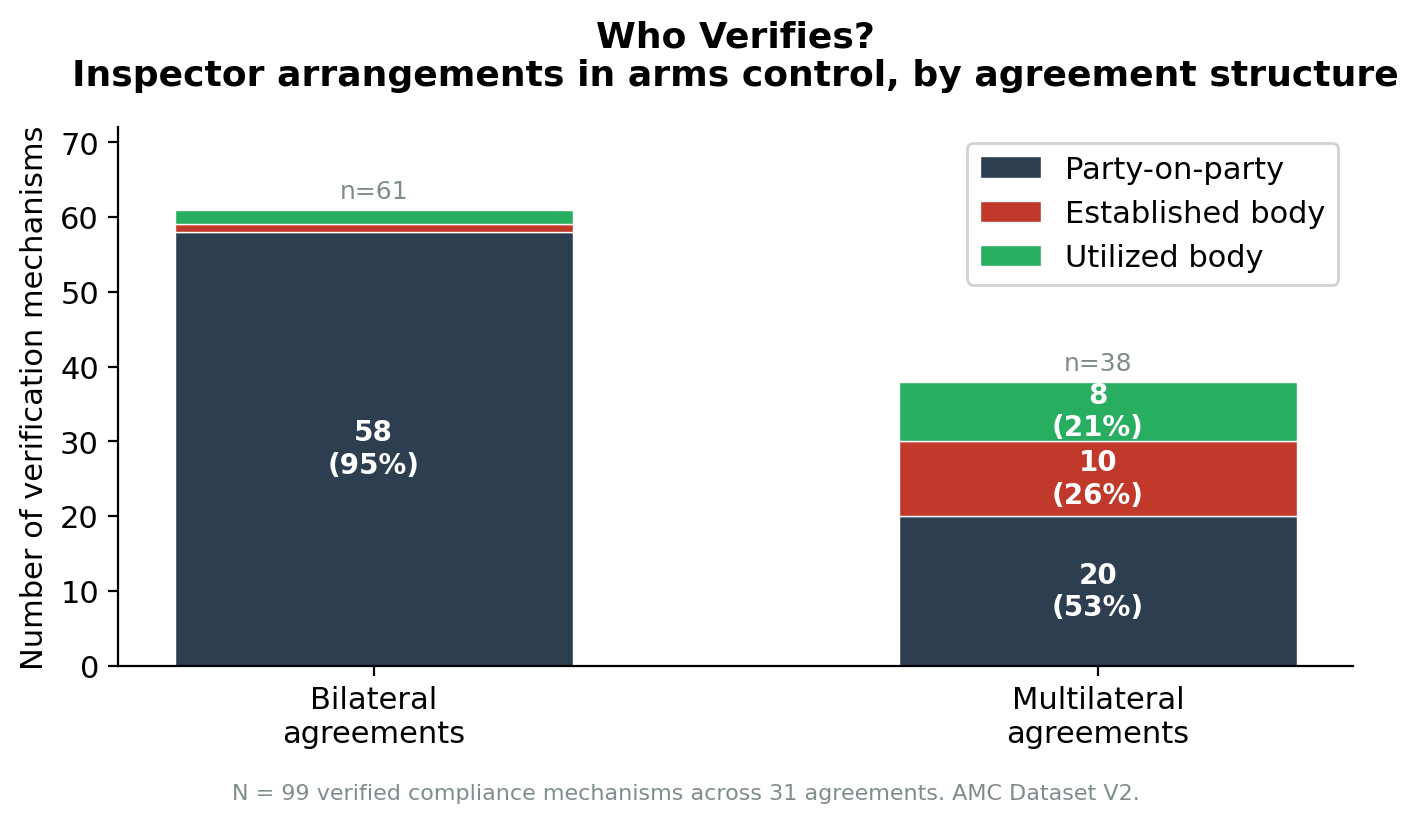
Figure 1 -- "Who Verifies?" Uses the inspector type variable from the vercom dataset, cross-tabulated with laterality from agreement_info (N = 99 verified compliance mechanisms across 31 agreements). Shows that 95% of bilateral mechanisms (58 of 61) are party-on-party, while multilateral agreements diversify: 53% party-on-party, 26% treaty-established body, 21% utilized external body.
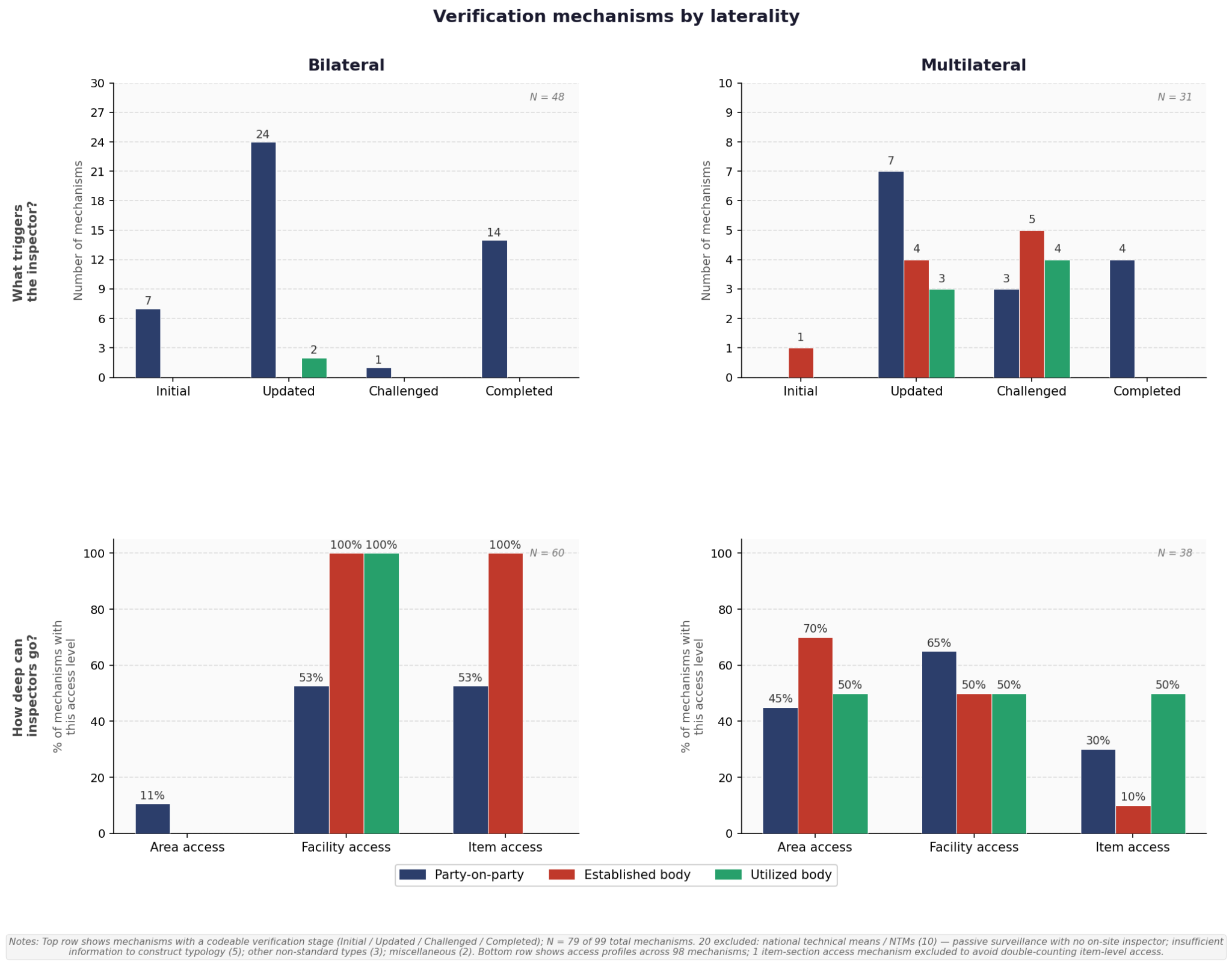
Figure 2 -- "Verification Mechanisms by Laterality" (4-panel composite) Uses verification objective coding and access-level variables from the vercom dataset, split by laterality. Top row: verification objectives (initial, updated, challenged, completed) by inspector type in bilateral vs. multilateral agreements, revealing that challenge inspections cluster in multilateral institutional bodies. Bottom row: access provisions by inspector type and laterality, showing institutional inspectors receive broader area-level access while party-on-party mechanisms concentrate on item-level depth.
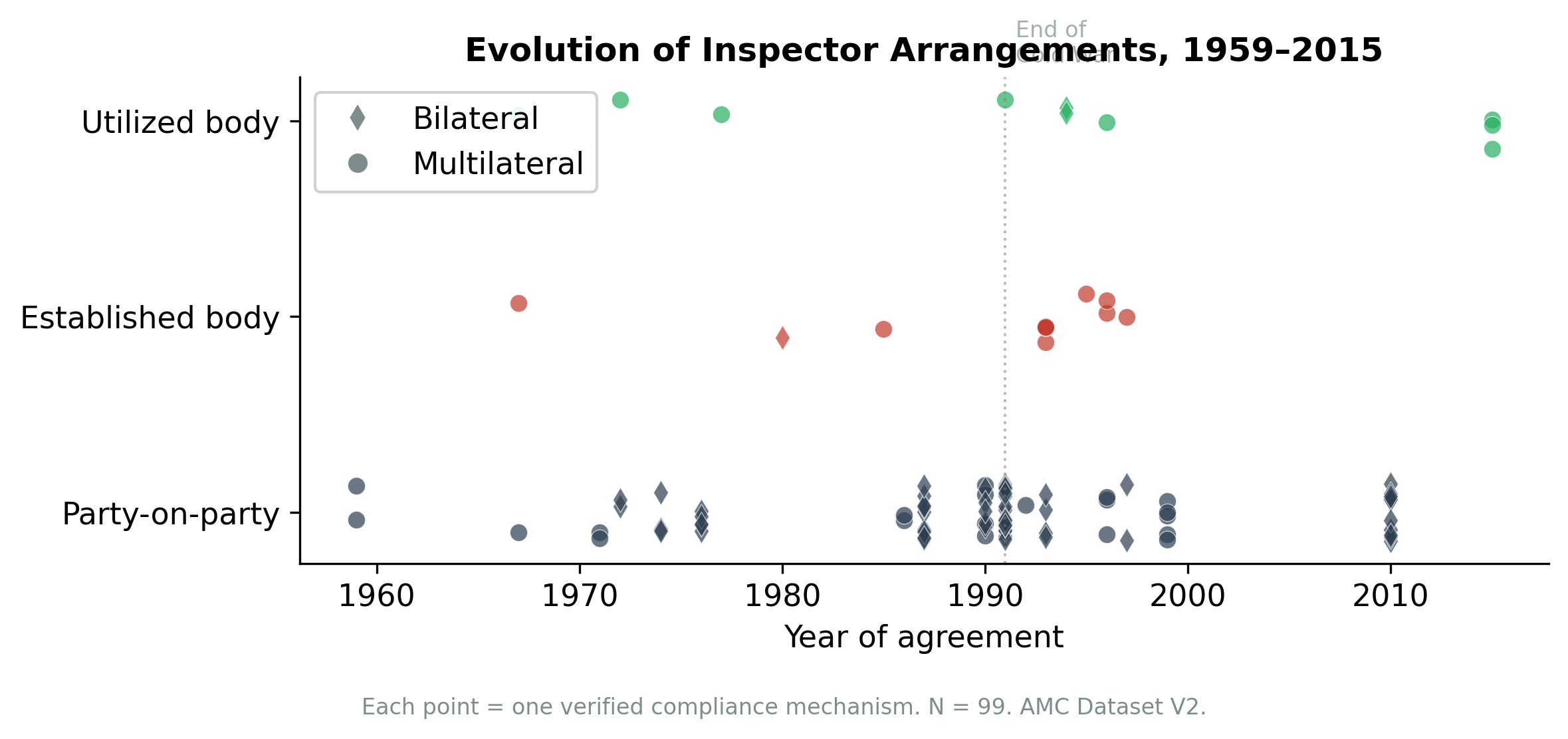
Figure 3 -- "Evolution of Inspector Arrangements, 1959-2015" Plots each of the 99 verified compliance mechanisms by year and inspector type, with marker shape distinguishing bilateral (diamond) from multilateral (circle) agreements. Shows that institutional inspection models emerge primarily in multilateral contexts from the 1960s onward, while party-on-party dominates across all eras.
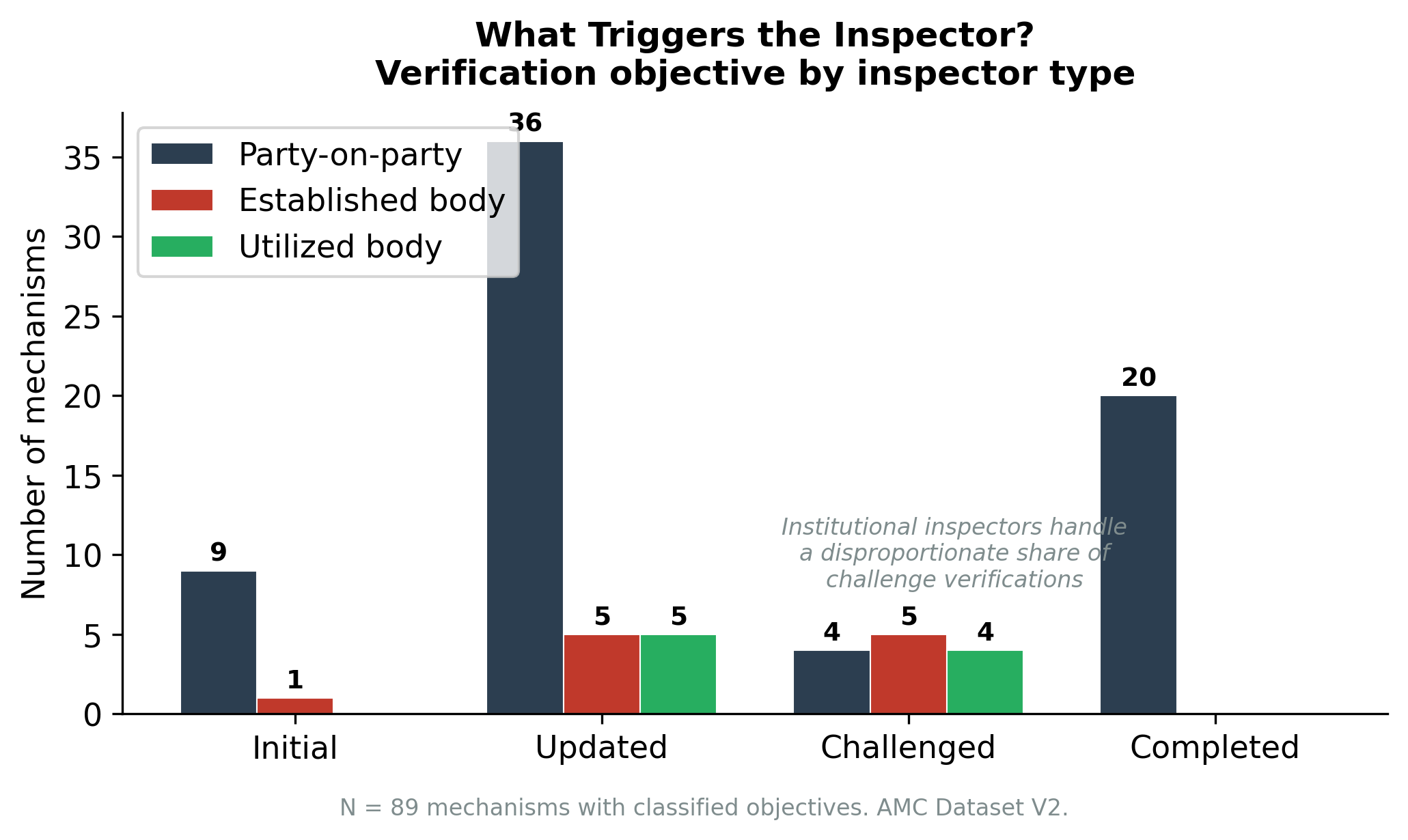
Figure 4 -- "What Triggers the Inspector?" Uses verification objective coding from the vercom dataset, grouped by inspector type across all agreements. Shows that 69% of challenge verifications (9 of 13) are conducted by institutional bodies, despite these representing only 21% of all mechanisms.