
Is this programme right for you?
Quotes about the programme

Benedetta Roncaglio, student from Italy
For me, it was a big cultural shock being able to call professors by their first name and stopping in the hallways to have a chat.
Read the interview with Benedetta
How did you choose your programme and what did you study before?
– Both during my Erasmus and my Bachelor's thesis project, I discovered my passion for the drug discovery and development pipeline, and I wanted to specialise in it with my Master's. This programme would have allowed me to focus on the development of biological therapies, which align with both my interests and background in medical biotechnology. Moreover, my Bachelor's degree had a broad approach, and I was looking for a programme that would allow me to pursue a specific topic, which has worked out perfectly with the programme in Biopharmaceuticals.
What is it like to be an international student?
– Uppsala University, and in general the whole town, is very welcoming when it comes to international students and expats. For this reason, I had no problem feeling a part of it. The programme itself has an incredible number of international students, so I was always surrounded by different inputs and approaches. Even if complex and overwhelming at the beginning, especially given the completely different previous experience that I had during my Bachelor's, I am glad I had this amazing opportunity, because it taught me how to interact productively with people who possess different attitudes and backgrounds.
What is the best thing about studying at Uppsala University?
– Being here gives you the chance to interact with some of the greatest professors and professionals. Moreover, the quality of the research done at the university is outstanding, and being part of it makes me incredibly proud. If you feel like academia might not be the right path for you after all, fear not: here you will have the chance of getting to know people from industry as part of many courses, and you might also get the chance of doing your thesis with one of them.
So to sum up, it is all about the opportunities that this University gives!
How did you experience your first few days in Sweden?
– As an international student, the first few days (and sometimes weeks) will be about getting to know your new surroundings, people, and, sadly, bureaucracy. I spent the days leading up to the start of the programme exploring Uppsala and the areas around it, participating in the welcome activities organised by nations and the student union, organising my paperwork for the tax agency, and looking for a part-time job. It was hectic, but so much fun!
Describe what a normal day is like for you.
– As of now, I am at the finish line of my thesis, so I spend most of my day in the lab, working on my last experiments and writing. After the lab, I usually rush to my job, and after that, I train, because it helps me wind down and stay healthy. Most week nights I stay in and have dinner with my flatmate, but when the weekend comes, I usually go out to the nations and spend time in nature, which is super accessible in Sweden.
How would you describe the relationship between you and your teachers at the University?
– Here in Sweden, professors are friendly and treat you with respect, and hierarchy is not as stiff as in other countries. Most of them are usually down to help you with any university-related problem you might have, and will go the extra mile to make sure that you feel at ease and get help.
Describe the student life.
– This really depends on who you are as a person: Uppsala can give you a crazy student life made of parties and sociality, but can also be very quiet and cosy if that is not for you. The programme itself is quite demanding, but if you have good time-management skills, you will definitely have the chance to spend time doing what you love, whether it's partying hard or joining the knitting club at the nation. In general, nation clubs and organisations suit most people's interests, so keeping busy is never hard!
Three quick questions:
Where do you like to study?
– Geocentrum! I personally love their library, with the warm colours and lots of natural light.
What is your favourite student tradition at Uppsala University?– – Definitely Valborg, where the whole town is buzzing with people and energy. Everyone flows the streets, and the vibes are unmatched.
Where do you see yourself in five years?
– In five years, I see myself pursuing a PhD, or in general, I aim to be at that point in my career where I am knowledgeable enough to be trusted by other people when it comes to their scientific enquiries.
Spring 2026

Moritz Catarinelli, student from Germany
Collaboration between industry and university, innovation centres, and national collaborations such as SciLifeLab rendered Uppsala an ideal place to initiate my career in the biopharma field.
Read the interview with Moritz
How did you choose your programme and what did you study before?
– After graduating from my Bachelor’s in Life Sciences Biology in Munich, I had the opportunity to contribute to different research projects across European institutes. During my research, I realized how much I enjoyed applied science, in particular in the context of biomedicine, biologics, and nanomedicine. Thus, I chose the programme in Uppsala because it is one of the few Master’s programmes in Europe which specifically specialize in biopharmaceutical sciences.
What is it like to be an international student?
– Uppsala is an amazing place to be as an international student! Both the city and university thrive in a multicultural, student-oriented environment, and it’s very easy to connect. Student nations, unions, and other events kick-started my social life. Furthermore, the programme organizers, Uppsala University, and your fellow students are always there if one needs support.
What is the best thing about studying at Uppsala University?
– I think the two major benefits, which greatly complement each other, are the quality of study as well as student life. The Faculty of Pharmacy hosts many renowned experts and has a long history of pharmaceutical and biotechnological innovation, making it a great place to conduct your studies. On the other hand, Uppsala is basically ruled by students, making the vibrant city an ideal place to let off some steam.
How did you experience your first few days in Sweden?
– My first days in Sweden were marked by walks through the local forests—picking mushrooms and wild blueberries. In addition, there was a great ceremony for the new students, followed by a tour through Uppsala’s pubs. I also enjoyed my first Swedish fika and köttbullar. Overall, I felt very welcomed in Sweden :)
What are three things on your schedule this week?
– I’ll conduct a summer research internship at Karolinska Institutet and will get settled in the lab. To stay in shape, I usually go swimming in the beautiful Centralbadet. Moreover, this week is somewhat special, as Sweden celebrates Valborg. Valborg is a big event, particularly in Uppsala, and a great way to welcome the spring.
What is your goal with the programme?
– I want to contribute to the development of tomorrow’s medicine. Gene therapies, CAR T cells, mRNA vaccines, and many other biopharmaceuticals are currently on the rise—and specializing in this growing and industry-relevant field seems like the right move to me. I plan on conducting my PhD in the field of nanoparticle-mediated drug delivery, and the programme at UU prepared me well for the research ahead.
What advice would you give to someone considering applying to this programme?
– In a nutshell: Inform yourself and reach out! Identifying the right programme can be challenging—especially with such a broad offering. For example, UU’s Faculty of Pharmacy offers three distinct Master’s programmes in the field of pharmaceutical sciences, all with slightly different specializations. Before applying, I reached out to current students, read newspaper articles, and informed myself about lecturers—this made my decision easy. If my description of the programme aligns with your interests, I can definitely recommend applying :)
Three quick questions:
What is your favourite place in Uppsala?
– Most certainly the cute café Kvarteret in Rosendal.
Where do you like to study?
– Since it is my favorite café – Kvarteret or Uno café.
Where do you see yourself in five years?
– Wrapping up my PhD project - hopefully enhancing drug delivery for novel protein and gene therapies.
Spring 2026

Jabbar Seek, student from Syria
The programme felt like a natural next step to build on both my academic background and professional experience.
Read the interview with Jabbar
How did you choose your programme and what did you study before?
– I completed a Bachelor’s degree in Pharmacy at Uppsala University, where I developed a strong interest in drug development and pharmacology. After beginning my career as a pharmacist, I frequently encountered patients using biological drugs and heard how life-changing these treatments could be. That experience motivated me to deepen my understanding of biopharmaceuticals and their development.
What is it like to be an international student?
– Although I have been living in Sweden for several years, I still strongly value the international environment of the programme. Studying alongside people from different cultural and academic backgrounds made discussions more dynamic and broadened my perspective on science and healthcare. It also helped me build a global professional network, which I see as very valuable for my future career.
What is the best thing about studying at Uppsala University?
– For me, the best part is the student life and the atmosphere of the city. Traditions like Valborg create a unique sense of community and make student life very memorable. Uppsala is also a beautiful city, especially in the spring when everything is in bloom. In addition, there are many activities and student organisations that make it easy to stay engaged outside of studies.
How did you experience your first few days in Sweden?
– Since I moved to Sweden in 2015, my first experience was some time ago, but I remember it as both exciting and challenging. Adjusting to a new culture and system took some time, but I quickly appreciated the structure, independence, and quality of education. Over time, Sweden has become home, where I feel very comfortable both academically and personally.
Describe what a normal day is like for you.
– A typical day starts at the company where I am conducting my Master’s thesis project. I usually begin with a coffee and a short discussion with my supervisor to plan the day. Then I spend time in the lab performing experiments, followed by data analysis and writing in the afternoon. After work, I often go to the gym or meet friends for dinner.
What is something unique about your programme?
– One unique aspect of the programme is the opportunity to interact with researchers and professionals from the pharmaceutical industry. Being able to ask questions and gain insights directly from experts was very valuable. Another highlight was the international diversity of the programme, which allowed me to connect with people I would not have met otherwise.
How would you describe the relationship between you and your teachers at the university?
– The teachers in the programme were very supportive and inspiring. Many of them are actively involved in cutting-edge research, which brings real-world relevance into the teaching. I felt that they were approachable and always open to questions or discussions, which created a positive and engaging learning environment.
Three quick questions:
What is your favourite place in Uppsala?
– Definitely the botanical garden, it is such an oasis during winter.
What is your favourite student tradition at Uppsala University?– – Valborg.
Where do you see yourself in five years?
– Working in the pharmaceutical industry.
Spring 2026
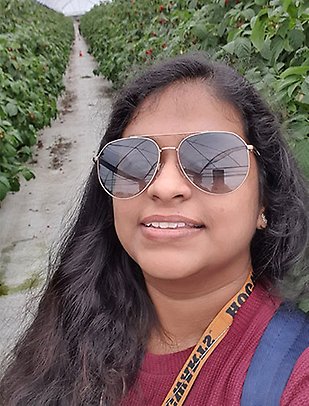
Nivetha Dayanidhi, student from India
Uppsala University has unique and future-looking programmes. It is a place of innovation and research. All my hidden creative ideas came out of me after joining Uppsala university.
Read the interview with Nivetha
How did you choose your programme?
– I wanted to study and research drug development and discovery, where biopharmaceuticals is part of it. It is currently the most up-and-coming form of therapy in the pharmaceutical industry.
What is something special about your programme?
– It is the study of vaccines, antibodies and hormone therapies. This is what present and future health care needs, targeted therapy with fewer side effects. It is a new programme!
What is it like to be an international student?
– Uppsala is the most welcoming place for all international students. I felt at home and safe. The entire city is for students and for their feasibility to live.
What is the best thing about studying at Uppsala University?
– Uppsala University has unique and future-looking programmes. It is a place of innovation and research. All my hidden creative ideas came out of me after joining Uppsala university. Uppsala University showed me that listening to lectures is not the only way to study, group work, assignments and presentations also help to gain knowledge.
– Group work and presentations are the best part of studying, with a lot of research on biologics. I feel that I have gained so much more knowledge after coming to Uppsala. I gained a lot of friends from different countries, from the group work.
Do you remember your first impression of Uppsala? Please tell us!
– Uppsala was very lively and colourful when I arrived in the summer. A lot of events and activities took place to entertain new students.
Name some things you are doing this week!
– There is group work for a theoretical lab presentation, and guest lectures from industries.
What is your reason for studying, or your ultimate goal?
– To become a scientist in biologics for Epilepsy. I am planning to do a PhD after my Master’s and continue my research in biologics.
Three quick questions:
What is your favourite place in Uppsala?
– V-dala nation, a place where a lot happens.
Where do you see yourself in five years?
– As a scientist with a post-doctoral.
Where is the best place to study?
– BMC and the library.
Spring 2023
Contact
- For programme-specific information, please contact programme coordinator Doreen Dobritzsch:
- doreen.dobritzsch@uu.se
- For questions regarding admission requirements, please contact Study Counsellor Christina Ceder:
- pharmmaster@uu.se
- +46 18 471 44 36
- For admissions-related or general information, please contact our applicant support team:
- study@uu.se