
Optical measurements in a controlled environment
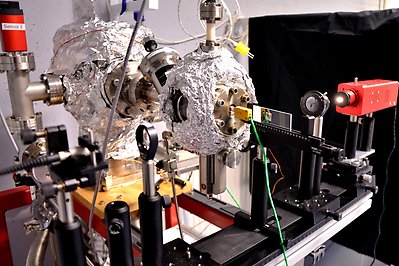
The optical set-up for gas loading experiments (OSFOLD) is designed for measurements of optical transmission while exposing the sample to different gases or temperatures.
These design choices make the set-up an ideal tool for studying photochromic materials—materials that change their optical properties as response to electromagnetic radiation. A recent study for example looked at the kinetics of the photochromic effect on oxygen-containing rare-earth metal hydrides, candidates for smart window applications. Another field of study is the absorption of hydrogen in vanadium thin films with relevance for hydrogen-storage applications.
A light source irradiating white light with 360-2600 nm wavelength, an additional high-intensity LED, and a CCD spectrometer are the main optical elements of this set-up allowing even for pump-probe experiments.
The measurement chamber can be filled with different gases and heated completely up till 150°C ensuring measurement conditions at thermal equilibrium even at higher temperatures.
-
A new setup for optical measurements under controlled environment
Part of Review of Scientific Instruments, 2023
- DOI for A new setup for optical measurements under controlled environment
- Download full text (pdf) of A new setup for optical measurements under controlled environment

-
Kinetics of the photochromic effect in oxygen-containing yttrium hydrides
Part of AIP Advances, 2026
- DOI for Kinetics of the photochromic effect in oxygen-containing yttrium hydrides
- Download full text (pdf) of Kinetics of the photochromic effect in oxygen-containing yttrium hydrides
-
Lattice site location in metal hydride thin films: Ion channeling and phononic properties
Part of Journal of Physics, 2026
- DOI for Lattice site location in metal hydride thin films: Ion channeling and phononic properties
- Download full text (pdf) of Lattice site location in metal hydride thin films: Ion channeling and phononic properties
Features
- Set-up consisting of two vacuum chambers separated by a gate valve.
- First chamber: ultra-high vacuum chamber equipped with a residual gas analyser with a nominal sensitivity of 10-11 mbar for mass 28.
- Second chamber: dedicated to optical measurements and featuring two glass viewports to this aim.
- Gas feeding line allowing for inlet of for example H2, Ar eller O2.
- By heating the entire second chamber via heating bands, measurements can be performed at thermal equilibrium.
- Stabilized tungsten-halogen source providing light in a wavelength range from 360 to 2600 nm.
- High-intensity LEDs ranging from UV (365 nm) to red light (617 nm) for pump-probe experiments mounted perpendicular to the optical line.
- Dichroic mirror for creating two coaxial beams from the reflected pump light and the transmitted probing light.
- CCD spectrometer working in a range of 200-1000 nm.
Contact
- For general questions about the laboratory, please email:
- tandemlaboratoriet@physics.uu.se