
BUP’s 35-year celebratory webinars
To celebrate the Programme’s 35th anniversary in 2026, we will host a series of webinars dedicated to sustainability in the Baltic Sea Region and the ten BUP themes. All colleagues at BUP participating universities are invited to contribute and are welcome to apply to give a presentation.
The content of each webinar will address sustainability with a focus on the ten BUP themes and/or the Baltic Sea Region, and may take the form of a lecture, workshop, seminar, or similar format.

Print screen from one of the early satellite TV courses held by the BUP. Pictured to the right is Lars Rydén, creator of the BUP.
Webinars
Sustainable Tourism and Cultural Exchange
The webinar will be held online on 5 November at 14.00 CET. This is the seventh webinar celebrating BUP’s 35th anniversary in 2026, dedicated to sustainability and the ten BUP themes.
The event will explore how the changing socioeconomic environment influences tourism processes, which in turn bring about transformations in tourism ecosystems. Sustainable tourism is the result of change and responsible development, in which society and its individual communities strive for a more effective and purposeful implementation of the principles of sustainability. Sustainable tourism is an alternative form of tourism that promotes resource conservation and creates new models of tourism activity that protect natural, cultural, and social environments without harming neighbouring ecosystems. The development of sustainable tourism concepts involves the implementation of new, alternative solutions aimed at enhancing the interaction between the natural and cultural environments and promoting responsible cooperation to foster environmental awareness and well-being. In the countries of the Baltic Sea region, diverse and unique models of sustainable tourism are being developed and implemented, based on social, economic, and cultural interaction.
The webinar is organised in collaboration with the BUP National Centre in Lithuania, at Klaipeda University.
Register to take part in the 'Sustainable Tourism and Cultural Exchange' webinar.
A Zoom link will be sent to the email address you registered with before the webinar.
The webinar will feature the following presentations:
Key Challenges in Sustainable Tourism Development
The presenter will be Sr. Lect. Dr. Daumantas Bočkus at the Klaipeda University Social Geography and Tourism Department.
Transformation of the Tourism Labour Market in the Context of Sustainability
The presenter will be Prof. Dr. Daiva Labanauskaitė at the Klaipeda University Economics and Management Department.
Forest-based Therapies and Recreation for Sustainable Tourism: Exploring Attitudes and Preferences
The presenter will be Prof. Dr. Diana Šaparnienė at the Klaipeda University Social Geography and Tourism Department.
Mediating Role of Rural Tourism in Developing the Countryside in Poland and Ukraine
The presenter will be Assist. Dr. Sergii Iaromenko at Odesa National University of Technology, Ukraine, and Poznan University of Economics and Business, Poland.
Social Innovations and Digital Education for Community-based Tourism Promotion
The presenter will be Assoc. Prof. Dr. Eduardas Spiriajevas at the Klaipeda University Social Geography and Tourism Department.
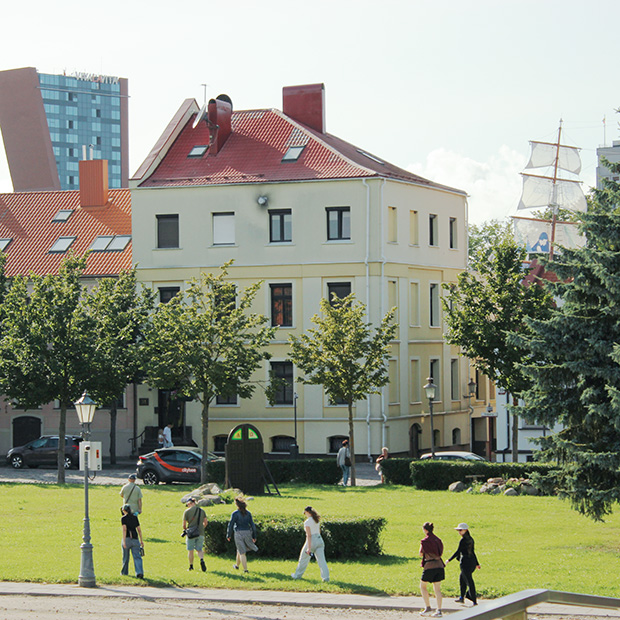
Photo: Hanna-Triinu Järvine
The green transition in small cities and regions
This webinar will be held online on 26 November at 14.00 CET. The event will focus on the green transition, which is arriving in small cities and regions, from new energy and digital infrastructure to hydrogen plants and green steel. This is the eighth webinar celebrating BUP’s 35th anniversary in 2026, dedicated to sustainability and the ten BUP themes.
Technology makes the green transition possible, but governance determines whether it succeeds: how different levels of government work together, and how far citizens have a real voice. This webinar brings two perspectives: how multilevel governance shapes participation and legitimacy in Europe’s twin transition, and why small host communities accept or contest the large projects that the transition brings.
The webinar will feature the following presentations:
Making Europe’s Twin Transition Work in Cities and Regions
Presented by Giga Mukutadze, Doctoral researcher, Transition for Secure and Sustainable Societies (TS3) Group, Department of Social Sciences and Philosophy, University of Jyväskylä, Finland.
Big projects, small places: how communities see the green transition
Presented by Dr Ehsan Marzban, Postdoctoral researcher, Transition for Secure and Sustainable Societies (TS3) Group, Department of Social Sciences and Philosophy, University of Jyväskylä, Finland.
A Zoom link will be sent to the email address you registered with before the webinar.
Register to take part in the 'The green transition in small cities and regions' webinar.
Photo: University of Jyväskylä
Upcoming webinars
The dates for upcoming webinars are yet to be set.
Registrations to upcoming webinars will open at a later time, announcement will be shared in the BUP Weekly and on the BUP website.
Previous webinars
'Designing circular recovery: from safe materials to restored ecosystems'
This webinar explored how Safe and Sustainable by Design (SSbD) can guide the development of safer, circular, and bio-based materials. It brought together approaches for assessing chemicals and nanomaterials with innovations in recyclable biopolymers, bio-based plastics and next-generation textile chemistries. The webinar was held online on 1 October.
The webinar also highlighted how these approaches can contribute to ecosystem and soil restoration, including in contexts affected by war, by linking material innovation with circularity, environmental safety and resilient recovery.
The webinar featured the following presentations:
Safety and Sustainability Assessment of Chemicals and Nanomaterials
This presentation introduced the CheMatSustain project and DTU’s work on the safety and sustainability assessment of chemicals and nanomaterials. It highlighted how Life Cycle Assessment (LCA), Risk Assessment (RA), and Absolute Environmental Sustainability Assessment (AESA) can support Safe and Sustainable by Design (SSbD) approaches. The presentation discussed how these methods can be applied throughout material development and product innovation to support informed decision-making and the development of safer and more sustainable materials. The speaker was Dr. Ahmed Waqas at the Technical University of Denmark (DTU).
Bio-based Plastics from Organic Waste: Soil-Regenerative Biopolymers and the Role of Safe-and-Sustainable-by-Design (SSbD)
This presentation introduced INSOIL, which develops soil-regenerative biopolymers from organic waste that are fully recyclable and support carbon-neutral production. It highlighted the role of the Safe-and-Sustainable-by-Design (SSbD) framework in developing innovative bio-based plastics and advancing sustainable material solutions. The speaker was Jutta Hildenbrand at the IVL Swedish Environmental Research Institute.
Towards the Next Generation of Safe, Circular and Bio-based Textiles: The TEX4GREEN Project
How can the textile industry reduce its dependence on fossil-based chemicals while improving safety, sustainability, and circularity? TEX4GREEN addresses this challenge by developing innovative bio-based textile chemistries under the Safe and Sustainable by Design (SSbD) framework. The project combines renewable feedstocks, circular design principles, and comprehensive environmental and safety assessments to create high-performance coatings, surfactants, and dyes for technical and consumer textiles. This presentation introduced the project's vision, technological developments, and expected environmental benefits, highlighting the importance of SSbD as a key enabler of Europe's transition towards a competitive, resilient, and toxic-free textile sector. The presenters were Dr. Jelena Barbir at Hamburg University of Applied Sciences (HAW Hamburg) and Arantxa Ballesteros at ITENE.
Safe, Circular and Bio-based Solutions for Recovery
This presentation highlighted the urgent need for safe, sustainable, and circular solutions for post-conflict recovery, with a particular focus on ecosystem restoration and soil rehabilitation in war-affected areas. It explored how bio-based plastics from organic waste, soil-regenerative biopolymers, bio-based fibers, and phytoremediation strategies can be combined to support resilient land restoration and circular value chains. The presentation also discussed the role of Safe and Sustainable by Design (SSbD) principles in developing environmentally sound materials and solutions that contribute to safer reconstruction, sustainable ecosystem management, and long-term circularity. The speaker was Dr. Maria Fedoruk at Hamburg University of Applied Sciences (HAW Hamburg).
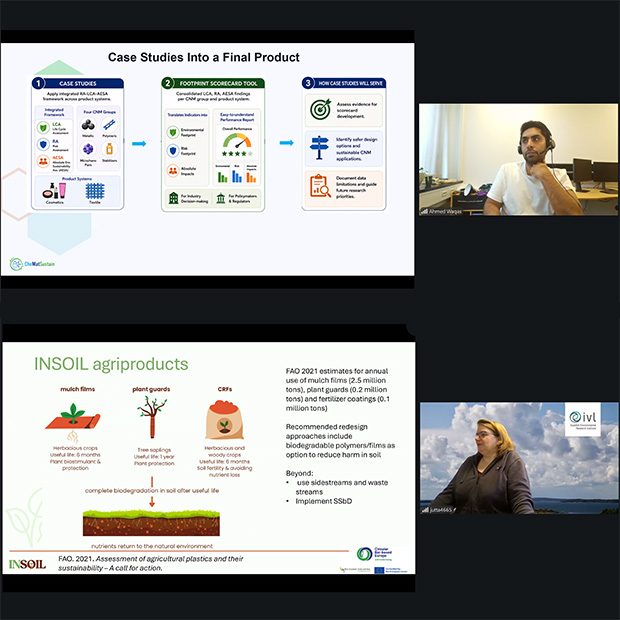
Print screens from the presentations given by Ahmed Waqas (top) and Jutta Hildenbrand (bottom).
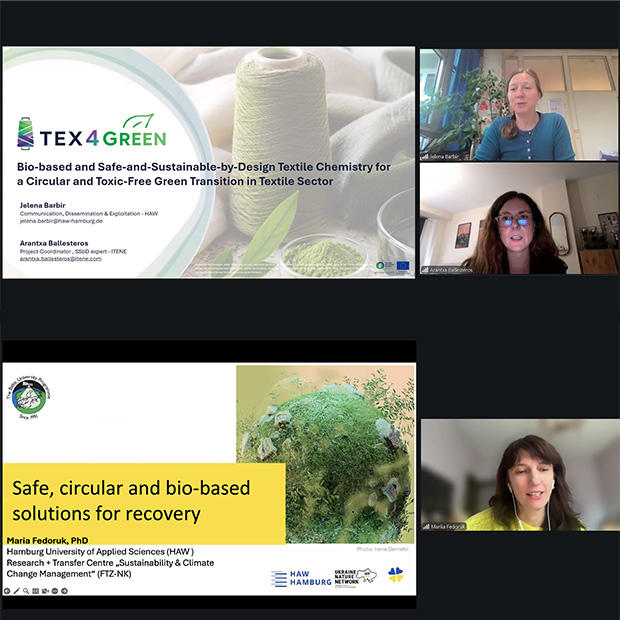
Print screens from the presentations given by Jelena Barbir & Arantxa Ballesteros (top) and Maria Fedoruk (bottom).
'Can We Drink Digital Water?'
This webinar focused on water safety and how water consumption influences the Baltic Sea Region. It was held on 21 May and the participants were invited to contribute with questions to broaden the discussion.
Artur Magnuszewski (University of Warsaw) gave a talk titled 'Can we measure the sustainability using water consumption?'. There are different ways to measure water resources and their use. One popular is the index of water availability - volume of river runoff divided by number of citizens in a year - (Falkenmark, 2005). Another way used recently is the Water Exploitation Index (WEI). For sustainability at the lowest personal level, it can be used as the volume of water used per person per day. Questions raised were: How much water do you use daily and how is this consumption controlled in the digital era? What is the meaning of green water, blue water, black water and grey water? Is the water from the tap healthy?
Inga Grinfelde (Latvia University of Life Sciences and Technologies) explored the question of whether we can drink digital water. In an era of artificial intelligence, digital twins, and data-driven hydrology, this provocative question highlights a critical reality. No model or algorithm can replace safe, clean drinking water, which remains essential for human health and survival. As water safety becomes increasingly sensitive due to pollution, climate change, and emerging contaminants, the responsibility of water engineers grows not only to model systems but to ensure a reliable, high-quality water supply for society. The talk called for a new educational paradigm that integrates AI innovation with strong scientific understanding, ethical responsibility, and a deep commitment to safeguarding safe drinking water for present and future generations.
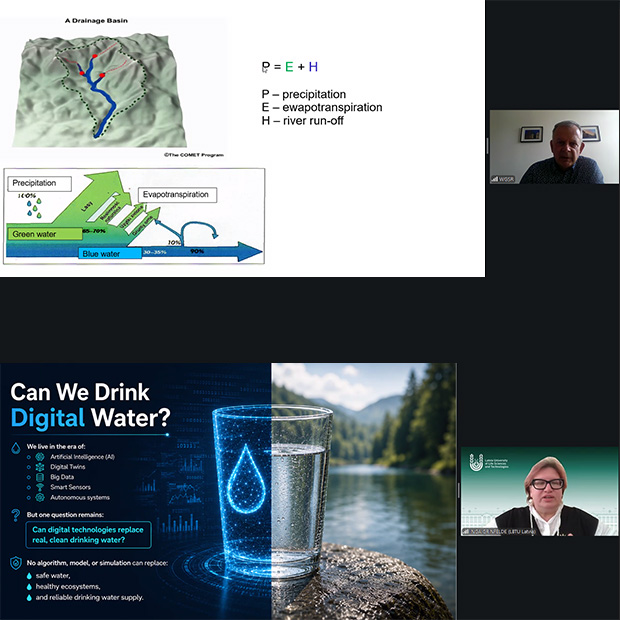
Print screens from the presentations given by Artur Magnuszewski (top) and Inga Grinfelde (bottom).
'Nature-Based Solutions and Public Participation'
This webinar explored the relationship between nature-based solutions (NbS) and public participation. It was held on 23 April and the participants could contribute with questions to broaden the discussion.
The webinar targeted students, researchers, policymakers, and practitioners interested in urban sustainability, participatory planning, and collaborative governance. The session began with an introduction by Małgorzata Blicharska (Uppsala University/UUniCORN), who provided context and background on nature-based solutions and then moderate the webinar.
Following the introduction, Bianka Plüschke-Altof (Tallinn Technical University and Tallinn University) and Bradley Loewen (Norwegian University of Science and Technology) presented their research on ‘Transforming the City with NbS: Unpacking Tensions of participatory sustainability transition projects’.
Nature-based solutions (NbS) are increasingly promoted as a way to address urban environmental and climate challenges while improving the quality of life in cities. At the same time, participatory planning is widely encouraged to ensure the legitimacy and acceptance of sustainability initiatives. Policy frameworks such as Horizon Europe and the New European Bauhaus emphasise collaborative and transdisciplinary approaches involving citizens, researchers, and public authorities.
Typically part of one-off, externally funded project-based initiatives operating largely outside established planning and governance systems, practitioners in NbS projects, however, frequently encounter obstacles when trying to integrate public participation into NbS planning and ensure long-term results.
Based on cross-case analysis of several urban NbS projects in Northern Europe, the research examines the tensions encountered in participatory NbS planning. Reflecting on these empirical insights from practice, the presenters discuss strategies that planners, researchers, and project organisers use to navigate these tensions and engage in transformative planning, hence simultaneously work towards more inclusive and effective approaches to NbS and sustainability transitions.
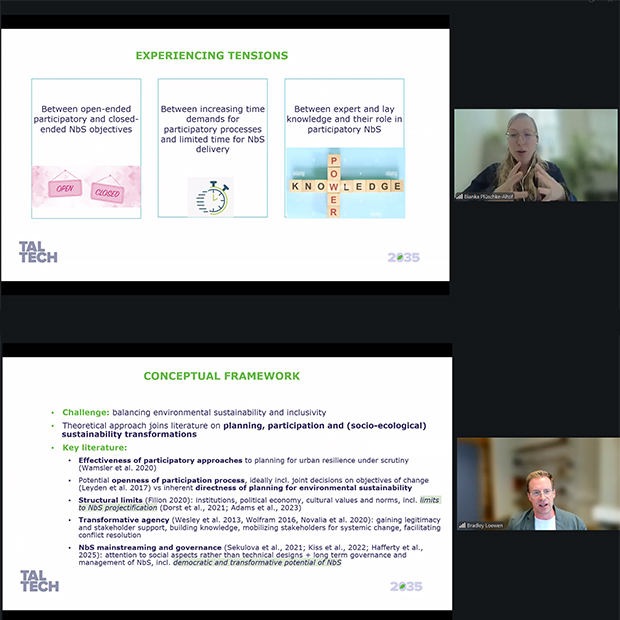
Print screens from the presentation given by Bianka Plüschke-Altof (top) and Bradley Loewen (bottom).
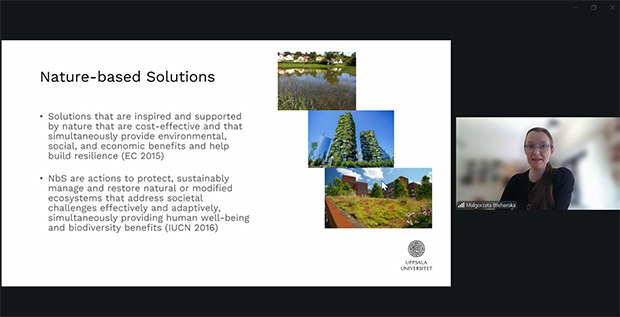
Print screen from the introduction given by Małgorzata Blicharska.
'How Not to Eat the Planet'
This webinar explored, through two talks, how what we eat influences the environmental status of the planet and how everyday practices can contribute to sustainability. It was held on 19 March at 14 CET.
These were the two presentations that were given during the webinar:
Amanda Wood (Swedish University of Agricultural Sciences) – 'How diets can support healthy people on a healthy planet'
We know that the foods we eat affect our health, but our diets also influence the health of the planet. This talk explored the many ways in which our diets impact environmental sustainability - for better and for worse - and described what we can eat to keep both people and the planet healthy and thriving. Starting from a global view on what foods are produced, eaten and wasted, and moving down to a local Nordic perspective on diets, listeners learned about dietary shifts that can make a positive impact on themselves and the planet.
Rūta Pelikšienė (Kaunas University of Technology) – 'Veganism, Stereotypes, and Everyday Climate Action'
Climate change discussions often focus on energy, transport, and industry, yet the climate impact of what we eat remains largely overlooked. This talk explored the climate relevance of vegan practices and why their potential is often underappreciated. Drawing on sociological research and accessible data, it examined how cultural norms and stereotypes shape public perceptions of veganism and influence people’s willingness to engage with plant-based eating. By reframing veganism as a spectrum of everyday practices rather than an all-or-nothing lifestyle, the session invited participants to reconsider how food choices relate to climate action. This presentation offered an engaging and practical perspective, leaving participants with concrete ideas for how gradual shifts toward plant-based eating can contribute to meaningful climate action.
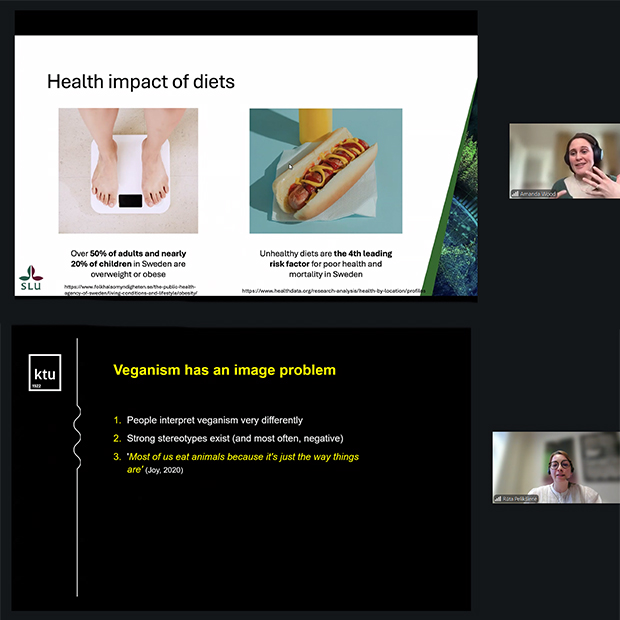
Print screens of the presentations given by Amanda Wood (top) and Rūta Pelikšienė (bottom).
'Human and Environmental Consequences of War in Ukraine: Short- and Long-Term Impacts'
This webinar explored how war reshapes ecosystems, public health, and critical infrastructure in Ukraine. It was held on 26 February. During the event, about 60 participants from BUP participating universities took part.
The event contained three focused presentations by Ukrainian researchers that examined environmental resilience and flood risks in Transcarpathia, the targeting and degradation of water bodies as both victims and instruments of war, and the emerging links between armed conflict, environmental exposure, and human health:
- ‘Water bodies of Ukraine as victims and weapons of war’, presented by Viktor Karamushka, National University of Kyiv-Mohyla Academy.
- ‘Environmental Resilience of Transcarpathia during Wartime: Flood Risks, Infrastructure Degradation, and Emerging Anthropogenic Pressures’, presented by Svitlana Delegan-Kokayko, Uzhhorod National University.
- ‘War, Environment, and Cancer: Lessons from Ukraine’, presented by Olexiy Kovalyov, Zaporizhzhia State Medical and Pharmaceutical University.
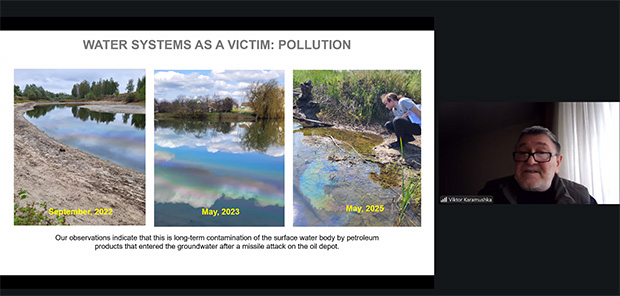
Print screen of the presentation given by Viktor Karamushka.
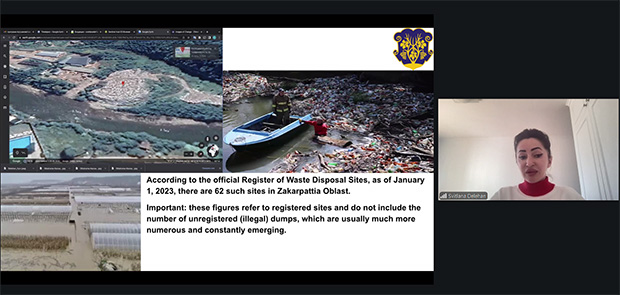
Print screen of the presentation given by Svitlana Delegan-Kokayko.
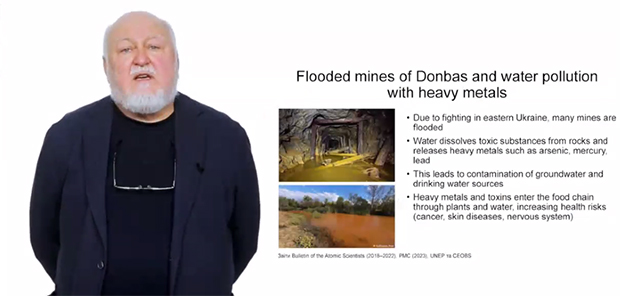
Print screen of the presentation given by Olexiy Kovalyov.
'Education for Sustainability in Times of Polycrisis'
This webinar explored the evolution of ESD and its current state, together with insights and perspectives from the participants. It was held on 12 February. During the event, about 40 participants from BUP participating universities took part.
This was the first webinar in a series celebrating BUP’s 35th anniversary in 2026, dedicated to sustainability and the ten BUP themes.
Climate change, extreme weather events, global pandemics, financial instability, political and military conflicts, and the rapid evolution of AI – these are interconnected challenges shaping our world today, often emerging simultaneously and unpredictably.
Questions that were considered at the webinar: How do these polycrisis conditions influence Education for Sustainable Development (ESD)? Are higher education institutions in the Baltic Sea region truly “walking the ESD talk”? What obstacles do university educators face, and what expectations are students bringing to the table?
The presenters were PhD Aleksandra Halaim (Uppsala University) and PhD Cecilia Lundberg (Åbo Akademi University).

Print screens of the presentations given by Cecilia and Aleksandra.

The participants answered the question "I one word - what motivates you to use ESD in your teaching?". Here is a word cloud with their replies.