
Miao group
To understand and engineer cyanobacteria
Our research
The research in Miao group focuses on understanding and engineering cyanobacteria, photosynthetic microorganisms that use sunlight and carbon dioxide to support their growth. Cyanobacteria have enormous potential as sustainable cell factories because they can convert solar energy and CO₂ directly into biomass and useful products. We combine high-throughput functional genomics, systems biology, metabolic engineering, and synthetic biology to understand how these organisms work and to develop new applications in sustainable biotechnology.
Group members
Publications
-
Part of Plant Physiology, p. 397-408, 2024
- DOI for Absence of alka(e)nes triggers profound remodeling of glycerolipid and carotenoid composition in cyanobacteria membrane
- Download full text (pdf) of Absence of alka(e)nes triggers profound remodeling of glycerolipid and carotenoid composition in cyanobacteria membrane

-
Part of Current opinion in chemical biology, p. 69-76, 2020
- DOI for Current processes and future challenges of photoautotrophic production of acetyl-CoA-derived solar fuels and chemicals in cyanobacteria
- Download full text (pdf) of Current processes and future challenges of photoautotrophic production of acetyl-CoA-derived solar fuels and chemicals in cyanobacteria
-
Part of Biotechnology for Biofuels, p. 1-13, 2019
- DOI for Improved lipid production via fatty acid biosynthesis and free fatty acid recycling in engineered Synechocystis sp. PCC 6803
- Download full text (pdf) of Improved lipid production via fatty acid biosynthesis and free fatty acid recycling in engineered Synechocystis sp. PCC 6803
-
Modular engineering for efficient photosynthetic biosynthesis of 1-butanol from CO2 in cyanobacteria
Part of Energy & Environmental Science, p. 2765-2777, 2019
- DOI for Modular engineering for efficient photosynthetic biosynthesis of 1-butanol from CO2 in cyanobacteria
- Download full text (pdf) of Modular engineering for efficient photosynthetic biosynthesis of 1-butanol from CO2 in cyanobacteria
-
Part of Metabolic engineering, p. 42-48, 2018
- DOI for Protein engineering of α-ketoisovalerate decarboxylase for improved isobutanol production in Synechocystis PCC 6803
- Download full text (pdf) of Protein engineering of α-ketoisovalerate decarboxylase for improved isobutanol production in Synechocystis PCC 6803
-
Enhancement of photosynthetic isobutanol production in engineered cells of Synechocystis PCC 6803
Part of Biotechnology for Biofuels, 2018
- DOI for Enhancement of photosynthetic isobutanol production in engineered cells of Synechocystis PCC 6803
- Download full text (pdf) of Enhancement of photosynthetic isobutanol production in engineered cells of Synechocystis PCC 6803
-
Part of Metabolic Engineering Communications, p. 45-53, 2017
- DOI for Isobutanol production in Synechocystis PCC 6803 using heterologous and endogenous alcohol dehydrogenases
- Download full text (pdf) of Isobutanol production in Synechocystis PCC 6803 using heterologous and endogenous alcohol dehydrogenases
-
Part of ACS Synthetic Biology, p. 1270-1278, 2015
Current research grants
May 2026 - present:
NordForsk, Next-Generation Nordic Network for Plant and Algal Sugers (grant number 241958).
January 2025 - present:
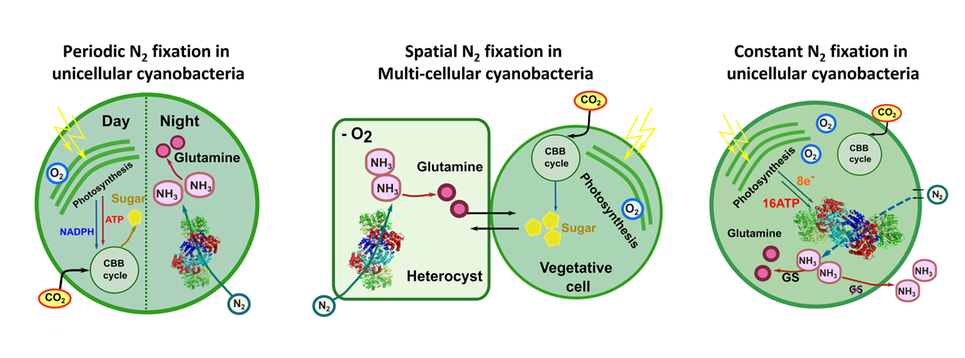
FORMAS Career grant for early-career researchers 2024, Eco-Nfix: Engineering nitrogen fixation in a fast-growing cyanobacterium for sustainable bio-fertilizer production (grant number 2023-01059, project number 2024-00580).
October 2023 - present:
NovoNordisk, Plant Science, Agriculture and Food Biotechnology, Postdoctoral Fellowships 2022, Development of Sustainable Biofertilizer Production via High Throughput Protein Engineering in Cyanobacteria (grant number NNF22OC0079940).
October 2023 - present:
STINT Mobility Grants for Internationalisation.
Contact
- If you are interested in our research, you are welcome to contact Rui Mao.
- Rui Miao