
The page is under construction
Di Yu – Turning immune engineering into life-saving treatments
Our research focuses on developing next-generation immunotherapies that harness the immune system to treat cancer. The aim is overcome treatment resistance and improve outcomes, particularly in solid tumours. By bridging cutting-edge science with clinical translation, our goal is to turn innovative concepts into safe, scalable therapies that reach patients in need.
We work with two main types of advanced therapies: engineered immune cells, known as CAR-T cells, and oncolytic viruses – viruses that are designed to selectively infect and kill cancer cells.
Smarter CAR-T therapies
CAR-T cells are a form of personalized medicine, where a patient’s own immune cells are reprogrammed in the laboratory to recognize and attack tumour cells (Figure 1). While this approach has been highly successful in some blood cancers, many challenges remain. Tumours can escape detection, resist treatment, or create environments that weaken the immune response.
Our work aims to overcome these barriers by designing smarter and more powerful CAR-T therapies that not only target cancer directly but also activate the broader immune system.
The film on the right shows CAR-T cells killing lymphoma cancer cells (Daudi). Cancer cells are in red; CAR-T cells are in green. The film on the left shows a control with T cells that are not CAR-T cells. Film by Paola Contreras and Di Yu.
Close-up of CAR-T cells killing a cancer cell. Film by Paola Contreras and Di Yu.
Oncolytic viruses
Concurrently, we are developing oncolytic adenoviruses – genetically modified viruses capable of selectively targeting and eliminating cancer cells while also promoting anti-tumour immune responses. These therapies provide a complementary approach, especially for solid tumours where current modalities may have limited effectiveness.
Furthermore, oncolytic viruses can be engineered to deliver therapeutic transgenes, thereby enhancing their overall efficacy. ELC-201 and Adf35(OGN) are among the oncolytic virus candidates currently under investigation as we prepare for forthcoming clinical trials.
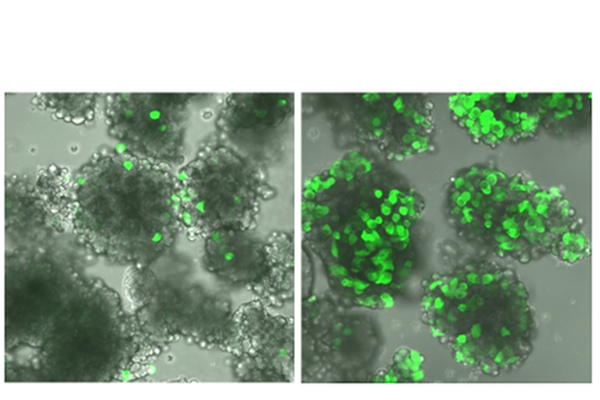
Oncolytic adenovirus increased its infectivity drastically after viral surface engineering. Left – before surface engineering, right – after engineering. Photo by Di Yu.
Patient benefit
Yet another key part of our research is bringing these technologies closer to patients. This involves not only discovering new therapeutic approaches, but also ensuring they can be produced safely, consistently, and at a scale suitable for clinical use.
We work closely with clinicians, engineers, and industry partners to translate innovations from the laboratory into early clinical studies. Through this interdisciplinary approach, our goal is to expand the reach of effective immunotherapies to more patients, especially those with currently unmet medical needs.
Ultimately, our research is driven by a simple ambition: to turn scientific discoveries into real treatments that improve and save patients’ lives.
Gruppmedlemmar
Publications
-
Part of Molecular Cancer Therapeutics, p. 469-479, 2026
- DOI for Shaping Tumor Microenvironment by Amplifying the Complement Cascade for Improved Immune Response in Pancreatic Cancer Model
- Download full text (pdf) of Shaping Tumor Microenvironment by Amplifying the Complement Cascade for Improved Immune Response in Pancreatic Cancer Model

-
Part of Cancer Gene Therapy, p. 297-305, 2025
- DOI for Biodistribution and toxicity evaluation of oncolytic adenovirus Adf35(OGN) in Syrian hamster and mouse
- Download full text (pdf) of Biodistribution and toxicity evaluation of oncolytic adenovirus Adf35(OGN) in Syrian hamster and mouse
-
Part of Upsala Journal of Medical Sciences, 2025
- DOI for Evaluation of drug delivery vehicles for improved transduction of oncolytic adenoviruses in solid tumor tissue
- Download full text (pdf) of Evaluation of drug delivery vehicles for improved transduction of oncolytic adenoviruses in solid tumor tissue
-
Part of Cancer Immunology and Immunotherapy, 2025
- DOI for Pre-clinical safety and efficacy evaluation of Helicobacter Pylori neutrophil-activating protein (NAP)-armed CAR-T cells targeting B cell lymphomas
- Download full text (pdf) of Pre-clinical safety and efficacy evaluation of Helicobacter Pylori neutrophil-activating protein (NAP)-armed CAR-T cells targeting B cell lymphomas
-
Survival of Transplanted Allogeneic Beta Cells with No Immunosuppression
Part of New England Journal of Medicine, p. 887-894, 2025
-
Enhanced Cellular Uptake through Nanotopography-Induced Macropinocytosis
Part of Advanced Functional Materials, 2024
- DOI for Enhanced Cellular Uptake through Nanotopography-Induced Macropinocytosis
- Download full text (pdf) of Enhanced Cellular Uptake through Nanotopography-Induced Macropinocytosis
-
Part of Molecular Therapy Nucleic Acids, 2024
- DOI for Targeting ZC3H11A elicits immunogenic cancer cell death through augmentation of antigen presentation and interferon response
- Download full text (pdf) of Targeting ZC3H11A elicits immunogenic cancer cell death through augmentation of antigen presentation and interferon response
-
VLDLR mediates Semliki Forest virus neuroinvasion through the blood-cerebrospinal fluid barrier
Part of Nature Communications, 2024
- DOI for VLDLR mediates Semliki Forest virus neuroinvasion through the blood-cerebrospinal fluid barrier
- Download full text (pdf) of VLDLR mediates Semliki Forest virus neuroinvasion through the blood-cerebrospinal fluid barrier
-
CD4+ T cell-induced inflammatory cell death controls immune-evasive tumours
Part of Nature, p. 1033-1040, 2023
- DOI for CD4+ T cell-induced inflammatory cell death controls immune-evasive tumours
- Download full text (pdf) of CD4+ T cell-induced inflammatory cell death controls immune-evasive tumours
-
Complementarity-determining region clustering may cause CAR-T cell dysfunction
Part of Nature Communications, 2023
- DOI for Complementarity-determining region clustering may cause CAR-T cell dysfunction
- Download full text (pdf) of Complementarity-determining region clustering may cause CAR-T cell dysfunction
-
Part of Frontiers in Immunology, 2023
- DOI for Proinflammatory allogeneic dendritic cells enhance the therapeutic efficacy of systemic anti-4-1BB treatment
- Download full text (pdf) of Proinflammatory allogeneic dendritic cells enhance the therapeutic efficacy of systemic anti-4-1BB treatment
-
Tailoring vascular phenotype through AAV therapy promotes anti-tumor immunity in glioma
Part of Cancer Cell, p. 1134-1151, 2023
- DOI for Tailoring vascular phenotype through AAV therapy promotes anti-tumor immunity in glioma
- Download full text (pdf) of Tailoring vascular phenotype through AAV therapy promotes anti-tumor immunity in glioma
-
A qPCR-Based Method for Quantification of RCA Contaminants in Oncolytic Adenovirus Products
Part of Frontiers in Molecular Biosciences, 2022
- DOI for A qPCR-Based Method for Quantification of RCA Contaminants in Oncolytic Adenovirus Products
- Download full text (pdf) of A qPCR-Based Method for Quantification of RCA Contaminants in Oncolytic Adenovirus Products
-
Part of Acta Pharmacologica Sinica, p. 977-991, 2022
-
Part of Nature Biomedical Engineering, p. 830-841, 2022
- DOI for CAR T cells expressing a bacterial virulence factor trigger potent bystander antitumour responses in solid cancers
- Download full text (pdf) of CAR T cells expressing a bacterial virulence factor trigger potent bystander antitumour responses in solid cancers
-
Part of Oncoimmunology, 2022
- DOI for Intratumoral administration of pro-inflammatory allogeneic dendritic cells improved the anti-turnor response of systemic anti-CTLA-4 treatment via unleashing a T cell-dependent response
- Download full text (pdf) of Intratumoral administration of pro-inflammatory allogeneic dendritic cells improved the anti-turnor response of systemic anti-CTLA-4 treatment via unleashing a T cell-dependent response
-
Part of MOLECULAR THERAPY-ONCOLYTICS, p. 356-366, 2021
- DOI for Concurrent expression of HP-NAP enhances antitumor efficacy of oncolytic vaccinia virus but not for Semliki Forest virus
- Download full text (pdf) of Concurrent expression of HP-NAP enhances antitumor efficacy of oncolytic vaccinia virus but not for Semliki Forest virus
-
Part of MOLECULAR THERAPY-ONCOLYTICS, p. 37-46, 2021
- DOI for IFN-I-tolerant oncolytic Semliki Forest virus in combination with anti-PD1 enhances T cell response against mouse glioma
- Download full text (pdf) of IFN-I-tolerant oncolytic Semliki Forest virus in combination with anti-PD1 enhances T cell response against mouse glioma
-
Part of Nano Letters, p. 2224-2231, 2021
-
Separable Microneedle Patch to Protect and Deliver DNA Nanovaccines Against COVID-19
Part of ACS Nano, p. 14347-14359, 2021
-
Part of Cell Death and Disease, 2020
- DOI for Characterization of virus-mediated immunogenic cancer cell death and the consequences for oncolytic virus-based immunotherapy of cancer
- Download full text (pdf) of Characterization of virus-mediated immunogenic cancer cell death and the consequences for oncolytic virus-based immunotherapy of cancer
-
Antischistosomal Properties of Hederacolchiside A1 Isolated from Pulsatilla chinensis
Part of Molecules, 2018
- DOI for Antischistosomal Properties of Hederacolchiside A1 Isolated from Pulsatilla chinensis
- Download full text (pdf) of Antischistosomal Properties of Hederacolchiside A1 Isolated from Pulsatilla chinensis
-
Part of Oncoimmunology, 2018
- DOI for Cancer vaccine based on a combination of an infection-enhanced adenoviral vector and pro-inflammatory allogeneic DCs leads to sustained antigen-specific immune responses in three melanoma models
- Download full text (pdf) of Cancer vaccine based on a combination of an infection-enhanced adenoviral vector and pro-inflammatory allogeneic DCs leads to sustained antigen-specific immune responses in three melanoma models
-
CD93 promotes β1 integrin activation and fibronectin fibrillogenesis during tumor angiogenesis
Part of Journal of Clinical Investigation, p. 3280-3297, 2018
- DOI for CD93 promotes β1 integrin activation and fibronectin fibrillogenesis during tumor angiogenesis
- Download full text (pdf) of CD93 promotes β1 integrin activation and fibronectin fibrillogenesis during tumor angiogenesis
-
Part of Experimental dermatology, 2018
-
Multiple nuclear-replicating viruses require the stress-induced protein ZC3H11A for efficient growth
Part of Proceedings of the National Academy of Sciences of the United States of America, 2018
-
Part of Oncoimmunology, 2018
-
Part of Scandinavian Journal of Immunology, p. 341-341, 2017
-
Part of Molecular Therapy, p. 288-288, 2017
-
Part of Molecular Cancer Therapeutics, p. 1705-1716, 2017
-
Part of MOLECULAR THERAPY-ONCOLYTICS, p. 67-75, 2017
- DOI for Insertion of the Type-I IFN Decoy Receptor B18R in a miRNA-Tagged Semliki Forest Virus Improves Oncolytic Capacity but Results in Neurotoxicity
- Download full text (pdf) of Insertion of the Type-I IFN Decoy Receptor B18R in a miRNA-Tagged Semliki Forest Virus Improves Oncolytic Capacity but Results in Neurotoxicity
-
Multiple viruses rely on the stress-induced protein ZC3H11A for efficient replication
2017
-
Part of Neuroendocrinology, p. 54-66, 2017
-
Part of Clinical Cancer Research, p. 1519-1530, 2017
-
Part of PLOS ONE, 2016
- DOI for A Multiplex Protein Panel Applied to Cerebrospinal Fluid Reveals Three New Biomarker Candidates in ALS but None in Neuropathic Pain Patients
- Download full text (pdf) of A Multiplex Protein Panel Applied to Cerebrospinal Fluid Reveals Three New Biomarker Candidates in ALS but None in Neuropathic Pain Patients
-
Part of CANCER IMMUNOLOGY RESEARCH, 2016
-
Part of Virology, p. 44-50, 2016
-
Long-term episomal gene transfer for safe engineering of T cells for adoptive cell therapy of cancer
Part of CANCER IMMUNOLOGY RESEARCH, 2016
-
Prospects to improve chimeric antigen receptor T-cell therapy for solid tumors
Part of Immunotherapy, p. 1355-1361, 2016
-
Part of EMBO Molecular Medicine, p. 702-711, 2016
- DOI for Safe engineering of CAR T cells for adoptive cell therapy of cancer using long-term episomal gene transfer
- Download full text (pdf) of Safe engineering of CAR T cells for adoptive cell therapy of cancer using long-term episomal gene transfer
-
Part of Advanced Functional Materials, p. 3907-3915, 2015
-
Part of Science Signaling, 2015
-
Part of Journal of immunotherapy (1997), p. 155-162, 2014
-
Part of Molecular Therapy, 2014
-
Part of Molecular Therapy Methods & Clinical Development, 2014
-
Part of Molecular Therapy, 2014
-
Long-term episomal gene transfer for safe engineering of T-cells for adoptive cell therapy of cancer
Part of Human Gene Therapy, 2014
-
Part of Journal of Immunology, p. 2287-2296, 2014
-
Adenovirus for Cancer Therapy: With a Focus on its Surface Modification
2013
-
Part of PLOS ONE, 2013
- DOI for Adenovirus Serotype 5 Vectors with Tat-PTD Modified Hexon and Serotype 35 Fiber Show Greatly Enhanced Transduction Capacity of Primary Cell Cultures
- Download full text (pdf) of Adenovirus Serotype 5 Vectors with Tat-PTD Modified Hexon and Serotype 35 Fiber Show Greatly Enhanced Transduction Capacity of Primary Cell Cultures
-
Part of Molecular Therapy, p. 2008-2018, 2013
- DOI for An infection-enhanced oncolytic adenovirus secreting H. pylori neutrophil-activating protein with therapeutic effects on neuroendocrine tumors
- Download full text (pdf) of An infection-enhanced oncolytic adenovirus secreting H. pylori neutrophil-activating protein with therapeutic effects on neuroendocrine tumors
-
Part of Human Gene Therapy, p. 766-775, 2013
- DOI for Tat‐PTD‐modified Oncolytic Adenovirus Driven by the SCG3 Promoter and ASH1 Enhancer for Neuroblastoma Therapy
- Download full text (pdf) of Tat‐PTD‐modified Oncolytic Adenovirus Driven by the SCG3 Promoter and ASH1 Enhancer for Neuroblastoma Therapy
-
Part of Journal of Virology, p. 13114-13123, 2011
- DOI for Adenovirus with Hexon Tat-Protein Transduction Domain Modification Exhibits Increased Therapeutic Effect in Experimental Neuroblastoma and Neuroendocrine Tumors
- Download full text (pdf) of Adenovirus with Hexon Tat-Protein Transduction Domain Modification Exhibits Increased Therapeutic Effect in Experimental Neuroblastoma and Neuroendocrine Tumors
-
Part of Gene Therapy, p. 1052-1062, 2011
-
Armed CAR-T cells directed against IL13Rα2 show potent activity against glioblastoma
NaN
-
NaN
-
Complementary-determining region clustering causes CAR-T cell dysfunction
NaN
-
NaN
-
Preclinical evaluation of CAR20(NAP)-T cells for B cell lymphoma
NaN
-
NaN
-
NaN