
Genetic risk scores: towards more precise and preventive healthcare
Common diseases such as heart attacks, cancer and blood clots cause significant suffering and high costs to society. Yet healthcare lacks the tools to identify people at high risk at an early stage. Using genetic information – particularly polygenic risk scores – can help change this.
The Clinical Academic Group for Genetic Risk Assessment works to introduce polygenic risk scores into Swedish healthcare and to develop more personalised prevention and treatment.
What are polygenic risk scores?
Unlike traditional genetic analyses, which look for single rare mutations, polygenic risk scores are based on information from hundreds or thousands of common genetic variants. Each variant contributes a small part of the overall risk, but together they can reveal a person's inherited vulnerability to various diseases – regardless of family history.
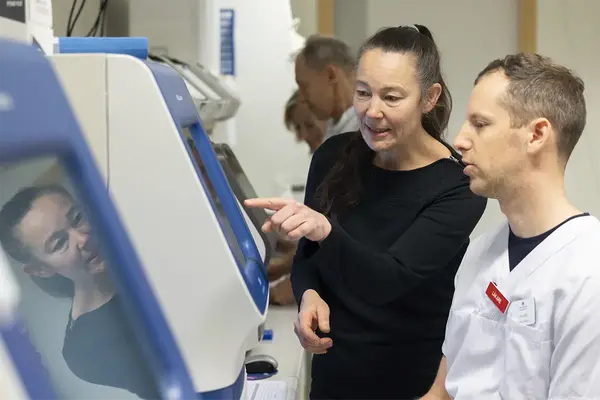
Specialists from several medical and analytical disciplines collaborate to bring polygenic risk scores into clinical use. Photo: Mikael Wallerstedt.
Our mission and goals
Our aim is to introduce genetic risk scores into Swedish healthcare and to develop more personalised prevention and treatment. We work to develop, evaluate and implement polygenic risk scores in clinical practice.
We focus on diseases where international research has made substantial progress and where risk scores may provide clear clinical value.
We work to:
- Evaluate the clinical use of polygenic risk scores for selected diseases
- Develop workflows and decision-support tools for healthcare staff
- Test how risk information can be integrated into genetic assessment, screening and treatment
- Conduct clinical pilot studies in Swedish healthcare settings
- Carry out health-economic analyses of the cost-effectiveness of introducing polygenic risk scores
- Examine ethical aspects and develop educational materials and tools for healthcare staff and patients
What does the project involve?
The Clinical Academic Group for Genetic Risk Assessment brings together expertise in medical genetics, genomics, biostatistics, pharmacogenomics, health economics, cardiology, psychiatry, cancer care and several other healthcare fields. Over the course of four years, we will investigate how polygenic risk scores can be used in different disease areas within healthcare.
Breast cancer
Polygenic risk scores are already used internationally to identify women with an increased risk. In Sweden, we will assess whether risk scores can be integrated into clinical genetic assessment. Women with a high genetic risk may be offered earlier and more intensive screening programmes, which increases the chances of early detection and improves prognosis.
Cardiomyopathies
A quarter of patients today receive a molecular diagnosis based on a specific mutation. For many, the disease is driven by the combined effect of many genetic variants. By identifying these high-risk patients early, healthcare providers can monitor and treat them more actively, thereby improving their prognosis.
Hypercholesterolaemia and coronary artery disease
There are already established polygenic risk scores for coronary artery disease. This information can be used for more personalised treatment, for example when deciding how and when to prescribe cholesterol‑lowering medication.
Personalised use of medication
Genes also affect how we metabolise and respond to different medicines. For example, they can influence:
- Which medicines work best for an individual
- What dosage is most suitable
- Which medicines should be avoided due to the risk of side effects
This is particularly relevant in psychiatry, where treatment responses vary greatly, and in contraceptive use, where the risk of blood clots, depression or breast cancer differs between individuals.
Why is this important and how does it benefit patients?
Common diseases such as cancer, cardiovascular disease and mental illness affect about a quarter of Europe’s adult population. This leads to significant suffering, extensive sick leave and high healthcare costs.
Despite this, healthcare today lacks effective tools to identify individuals at high risk early enough. By using genetic risk scores, healthcare may detect vulnerability before disease develops and thereby:
- Introduce preventive measures at an early stage
- Adapt and optimise treatment according to the individual’s genetic profile
- Reduce the risk of side effects through more suitable medication choices
- Use healthcare resources more efficiently
- Provide patients with better conditions for a healthier life and improved quality of life
For patients, this means more predictable and personalised care. Because genetic risk scores are based on variations we are born with, the test only needs to be performed once. The information can then be used throughout life to support screening, follow-up and treatment decisions.
Organisation
Project leaders
- Åsa Johansson, Professor of Medical Genetics, Department of Immunology, Genetics and Pathology
- Niklas Dahl, Senior Consultant at Clinical Genetics and Professor of Clinical Genetics, Department of Immunology, Genetics and Pathology
Contributors
- Daniel Eriksson, Resident Physician (ST) in Clinical Genetics, Department of Immunology, Genetics and Pathology
- Eva‑Lena Stattin, Docent and Senior Consultant in Clinical Genetics, Department of Immunology, Genetics and Pathology
- Inna Feldman, Docent in Health Economics, Department of Public Health and Caring Sciences
- Filipa Sampaio, Docent in Health Economics, Department of Public Health and Caring Sciences
- Jessica Nordlund, Docent at the Department of Medical Sciences and Head of Unit for SNP&SEQ, National Genomics Infrastructure (NGI), SciLifeLab
- Mia Wadelius, Professor of Clinical Pharmacogenomics, Department of Medical Sciences
- Fotis Papadopoulos, Professor and Senior Consultant in Clinical Psychiatry, Department of Medical Sciences
- Panagiotis Baliakas, Senior Lecturer and Senior Consultant in Clinical Genetics, Department of Immunology, Genetics and Pathology, and Scientific Director, Clinical Genomics Uppsala, SciLifeLab
- Hannes Karlsson, Doctoral Student and Resident Physician (ST) in Clinical Genetics, Department of Immunology, Genetics and Pathology