
Materials modification by ion beams
Ion beams can be used to manipulate material properties. At the Tandem Laboratory we use ions in a wide range of energies, from low keV to several MeV, for many different applications.
If you want to order implantations or are interested in other services within ion beam modification of materials (IBMM), check our user access page.
keV ion implantations
We make use of keV ion implantations to change the electronic properties of materials. The most prominent example is the creation of specific dopant concentrations in semiconductors. This method is also used to produce Ohmic contacts. Ion implantations can even lead to the formation of nanoparticles with electronic or optical properties different from the bulk material.
We are currently developing capabilities for low-energy implantations aiming for energies of a few keV and below. With ions of such low energies, it will be possible to dope 2D materials.
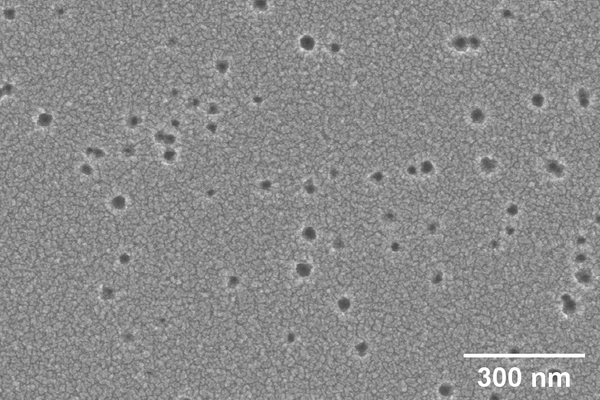
Scanning electron microscopy image of a polyimide sample that has been irradiated with a 3.25 MeV oxygen beam.
Nanostructure engineering
Energetic ions can create nanostructures in materials such as pores, hillocks or tracks. At the Tandem Laboratory, we among others study how keV ions can produce pores in membranes for potential filter applications. By irradiating a material through a patterned mask, we can also selectively implant ions and create structures with different chemical composition creating for example magnetic nanoarrays.
Much research on nanostructure formation has been done in the GeV ion energy regime. We are now investigating to which extent MeV ions that require much smaller accelerators and other instrumentation can be used instead. As an example, we have used MeV ions to produce etchable tracks in polyimide membranes.
Ion irradiations
Besides precise tailoring of electronic and structural characteristics, ion irradiations can also be used to create damage. Irradiations can amorphize single-crystalline materials, which for example allows researchers to analyse their annealing behaviour. At the Tandem Laboratory, we also test radiation hardness of different materials and components as ion irradiations can effectively simulate high-radiation environments such as space or nuclear reactors.
Selected publications
-
Part of ACS Applied Materials and Interfaces, p. 28009-28019, 2026
- DOI for Tuning TiO2 memristors by defect engineering: From short-term memory to recoverable long-term resistance states
- Download full text (pdf) of Tuning TiO2 memristors by defect engineering: From short-term memory to recoverable long-term resistance states

-
Mobility of Single Vacancies and Adatoms in Graphene at Room Temperature
Part of Small, 2025
- DOI for Mobility of Single Vacancies and Adatoms in Graphene at Room Temperature
- Download full text (pdf) of Mobility of Single Vacancies and Adatoms in Graphene at Room Temperature
-
Proton irradiation-induced cracking and microstructural defects in UN and (U,Zr)N composite fuels
Part of Journal of Materiomics, p. 906-918, 2024
- DOI for Proton irradiation-induced cracking and microstructural defects in UN and (U,Zr)N composite fuels
- Download full text (pdf) of Proton irradiation-induced cracking and microstructural defects in UN and (U,Zr)N composite fuels
-
Ion Track Formation and Nanopore Etching in Polyimide: Possibilities in the MeV Ion Energy Regime
Part of Macromolecular materials and engineering, 2024
- DOI for Ion Track Formation and Nanopore Etching in Polyimide: Possibilities in the MeV Ion Energy Regime
- Download full text (pdf) of Ion Track Formation and Nanopore Etching in Polyimide: Possibilities in the MeV Ion Energy Regime
-
Part of Physica Status Solidi. Rapid Research Letters, 2024
- DOI for Position‐Selective Introduction of Ferromagnetism on the Micro‐ and Nanoscale in a Paramagnetic Thin Palladium Film
- Download full text (pdf) of Position‐Selective Introduction of Ferromagnetism on the Micro‐ and Nanoscale in a Paramagnetic Thin Palladium Film
Contact
- For general questions about the laboratory, please email:
- tandemlaboratoriet@physics.uu.se