
Safer care for children with Hospital Dogs

Liona och Luna are two of few Hospital Dogs in Sweden with permission to work in the hospital. Photo: Robin Widing
As Ann Edner is appointed Docent at Uppsala University, she brings with her an unusual combination of experience. As a paediatrician, neonatologist, and researcher, she has devoted much of her professional life to children in highly vulnerable situations. She now wants to develop this work with the help of Hospital Dogs.
Something changes in the room.
Together with nurse Anita, Clara’s parents, Elin and Anders Lundberg, have arranged a surprise for their daughter, who is about to undergo an ultrasound examination at the paediatric and adolescent cardiology clinic at Uppsala University Hospital. The surprise is named Liona, and she is a so-called Hospital Dog (Sjukhushund®).
The anxiety fades, replaced by Clara’s beaming smile, which seems to light up the whole room as Liona steps inside and then calmly lies down beside Clara in the hospital bed, allowing herself to be hugged.
The reason this surprise is even possible is Ann Edner, newly appointed Docent at the Department of Women’s and Children’s Health. Ann describes herself as a clinician at heart. She says she has never been particularly interested in titles, but has been driven above all by meeting patients and making a tangible difference in healthcare. Research came later in her career, but her interest in children’s vulnerability, ethics and holistic care has been with her for a long time.

Ann Edner, newly appointed Docent at the Department of Women's and Children's Health, has a passion for dogs in the hospital. Photo: Robin Widing
“As a docent, I want to help strengthen this field of research at Uppsala University. I also want to increase knowledge about the difference between Hospital Dogs and other types of dog-assisted teams working in health and social care outside hospital settings,” says Ann Edner, and continues:
“I have always loved my clinical work. I came into research a little later and usually say that I am a late bloomer. But in severe illness, care is not only about medical equipment; it is about people. Children may be seriously ill, but they are still just children,” says Ann Edner.
Her doctoral thesis focused on Sudden Infant Death Syndrome (SIDS), and during her career she has worked in neonatal care, paediatrics, and medical ethics, among other areas. She was also involved in the establishment of Sweden’s first children’s hospice, Lilla Erstagården. There, it became clear how important environment, security and presence can be when children and families find themselves in difficult situations.
From clinical experience to a field of research
Her interest in Hospital Dogs grew out of the same holistic perspective. Ann Edner grew up with dogs herself and early on saw the strong relationship many children have with animals. When she later saw what Livia, Sweden’s first Hospital Dog, could contribute to a healthcare environment, it marked the beginning of more systematic work and a route into research.
“The dog is humanity’s oldest friend and represents an unconditional presence. They can contribute something that people cannot always achieve. That was where my vision developed, to integrate this into clinical practice,” says Ann Edner.
Since then, she has worked to build a concept in which Hospital Dogs are not seen as a pleasant sideline, but as a potential part of healthcare. Her research has focused on patient safety, allergens, healthcare hygiene, and effects on children’s well-being, among other areas.
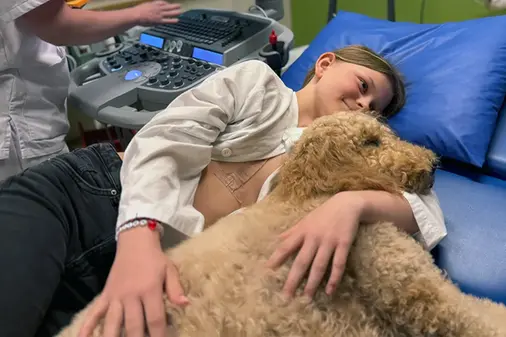
The hospital dog Liona layed comfortably and calm by Clara's side while she was about to undergo an ultrasound examination. Photo: Robin Widing
If there were any doubts about whether the dogs spread as sense of well-being around them, they quickly disappear once Clara has completed her ultrasound examination.
“The whole experience has been incredibly positive. Clara was anxious about the ultrasound because it was that particular examination that started everything for us, with a long hospital stay in Gothenburg. She was afraid, because the last time she had the examination, she was not allowed to go home. But this time, having the dog present gave her an incredible sense of security and meant it ended on a positive note,” says her mother, Elin.
Carefully tested and trained dogs
The fact remains, however, that Hospital Dogs are currently only permitted at Uppsala University Hospital, Mälarsjukhuset, Gävle Hospital and Hudiksvall Hospital. According to Ann Edner and others, the reason is concern about allergies, bacterial transmission, and other related risks.
“But Hospital Dogs differ from other types of dog-assisted teams in health and social care. The dogs are specially selected, tested and trained to be able to work in a hospital environment. They have non-shedding coats, are tested for allergens, undergo regular bacterial cultures and are followed up through veterinary checks according to specific protocols. They are washed and cared for according to clear routines and are trained, among other things, not to lick patients,” says Ann.
Each dog also works together with a trained Hospital Dog instructor. This is crucial, Ann Edner explains. The instructor must be able to read the dog’s signals while also understanding the healthcare environment, the patient’s situation, and the medical risks.
“It takes time to train both dogs and instructors, and it is important that the right expertise is in place. The dog instructor must have healthcare training and full control of the dog’s signals. It is about being able to read the smallest signs of stress and act accordingly,” she says.
Safety issues have been central from the outset. An important part of the research has therefore been to show how the dogs can work in a way that is safe for patients, even in acute hospitals, where hygiene and infection control requirements are high. Allergy and hygiene aspects have been essential to introducing the activity into clinical care.
“The effect on children is at the heart of this for me, but in order to implement the activity, allergy and hygiene issues must be ensured. That is why this has been crucial,” says Ann Edner.

The well-being of children in health care has always been Ann Edner's goal. Her research on hospital dogs is a mean to that end. Photo: Robin Widing
Making the difficult a little easier
At Uppsala University Hospital, Hospital Dogs are used primarily in paediatric care. This may involve children who are afraid of blood tests, treatments, or examinations.
Marianne van Rooijen, Hospital Director and former division manager in women’s and children’s healthcare, describes how views of Hospital Dogs have changed over time.
“Initially, there was a great deal of concern. At the same time, many people intuitively feel that the dogs make a positive contribution: children become calmer and parents experience the situation as safer. But hygiene and allergy aspects were central objections. As routines have developed and the activity has become more established, resistance has decreased,” says Marianne van Rooijen.
She also highlights that the dogs can be significant for both patient safety and workflows in healthcare.
“There is also a clear patient safety aspect. Shorter and calmer examinations reduce risks and create better workflows. There are therefore also financial and organisational benefits,” says Marianne van Rooijen.
Dogs in play therapy
Luna, the other Hospital Dog working at Uppsala University Hospital on this day, jumps from a small trampoline onto a table, then down onto a bench and under a chair. Right now, she is not following her Hospital Dog instructor, Sofie Östman, who is nevertheless standing a few metres away in the room, but Liam. He has undergone treatment for his cancer and, now that it is finished, is allowed to play with Luna in a room.
“It feels really good to meet Luna,” says Liam.
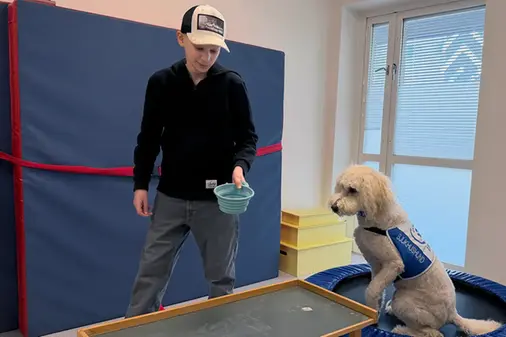
Liam get's a moment of play therapy together with the hospital dog Luna after an examination. Photo: Robin Widing
It is the third time the two have met after Liam’s treatment. Since Liam has come in from home and does not have a room of his own, they meet in a physiotherapy room that Ann has booked. Ann’s own research shows that a safe, unbroken chain of healthcare hygiene is very important on both the dog and patient sides, but that the room itself is not a determining factor.
“After the treatment, it is great fun to play with the dogs,” says Liam, as he confidently guides Luna through the course.
For Ann Edner, it is precisely the combination of the human and the medical that makes the field important. She does not want Hospital Dogs to be introduced on loose grounds, but for the work to rest on research, clear routines, and professional handling. This is also why their use at Uppsala University Hospital is based, among other things, on three research articles authored by Ann herself.
“My starting point has always been the well-being of children and families. That is why evidence-based effects are crucial,” she says.
Research with a view to wider use
Ann Edner sees several possible areas of development ahead. These include ongoing or planned projects linked to maternity care, child and adolescent psychiatry, and treatments where children need extra support to cope with difficult procedures.
At the same time, she emphasises that development must take place slowly and safely.
“There is a risk associated with unregulated actors in the sector. Future development is about more structured training, potentially regional training nodes, and long-term certification. Dogs are perishable in this sense and require continuous training and maintenance,” says Ann Edner.
For Ann Edner, the work is ultimately about improving the care environment for children and families in situations where much else is difficult to influence. Children such as Clara and Liam.
“A visit like this once a week during the long time we were admitted to the hospital in Gothenburg would have been worth its weight in gold,” says Clara’s father, Andreas Lundberg.
Robin Widing
Definition of Hospital Dog (Sjukhushund®)
Non-shedding: Does not shed hair.
Puppy tested: Evaluated for suitability from an early age.
BPH tested: Has completed the Beteende- och Personlighetsbeskrivning
Hund (BPH) assessment.
Suitability tested: Assessed for suitability for hospital work.
Regular veterinary checks: Undergoes regular veterinary testing
according to a specially designed protocol.
Vaccinated: Basic vaccinations, including rabies and leptospirosis.
Allergen tested: Tested for allergens, a so-called hypoallergenic dog.
Bacteria cultured: Regular bacterial cultures are performed to exclude multiresistant bacteria.
Well cared for: Maintained in excellent health and condition.
Washed: Washed with shampoo at least once a week.
Trained: Trained to follow specific behaviours, such as not licking.
Guideline adherence: Cared for according to scientifically developed guidelines from a research project.
Certified: Certified by “Sjukhushund i Sverige AB.”
Quality assured: Regularly checked by “Sjukhushund i Sverige.”
Previous research
Wretman, C., Risberg, A., Grönlund, H. and Edner, A. (2025), Negligible Allergen Presence in Hospital Dogs After Washing. Acta Paediatrica, 114: 2322-2328.
Edner, A., Lindström-Nilsson, M., Melhus, Å. (2021), Low risk of transmission of pathogenic bacteria between children and the assistance dog during animal-assisted therapy if strict rules are followed. Journal of Hospital Infection, 115: 5–9