
New honorary doctors at the Faculty of Medicine
and Faculty of Pharmacy
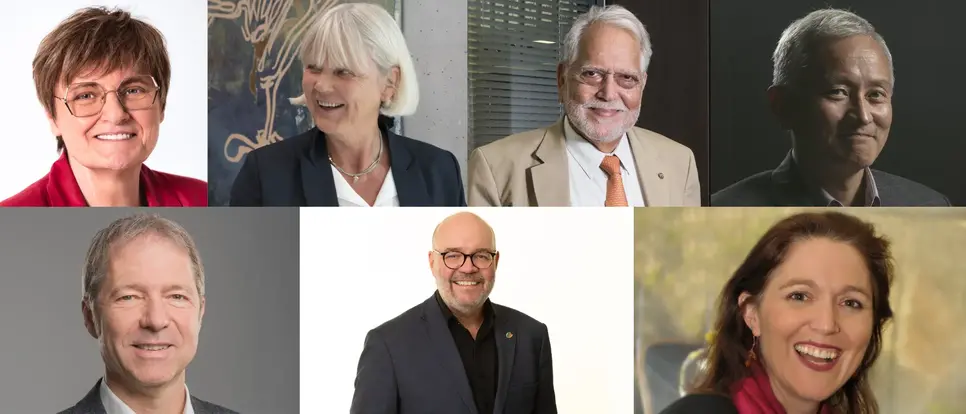
Seven new honorary doctors have been appointed by the Faculty of Medicine and the Faculty of Pharmacy.
The Faculty of Medicine and Faculty of Pharmacy at Uppsala University have appointed the 2027 honorary doctors.
Honorary doctors at the Faculty of Medicine 2027

Katalin Karikó. Photo: István Sahin-Tóth
Katalin Karikó
Katalin Karikó is a Hungarian-American biochemist whose research has been instrumental in the development of mRNA as a medical tool. For several decades, she studied the potential of mRNA as a therapeutic treatment, despite repeated setbacks and cuts in research funding.
Together with immunologist Drew Weissman, she developed principles to generate modified nucleosides-containing mRNA that make it possible to use the technology without triggering harmful immune reactions. This work laid the foundation for the mRNA vaccines that could be developed rapidly against SARS-CoV-2 when the COVID-19 pandemic broke out. For their discoveries, Karikó and Weissman were awarded the Nobel Prize in Physiology or Medicine in 2023.
Karikó also has a personal connection to Uppsala University, and to the work of Carl Linnaeus. In her Nobel Lecture at Uppsala Biomedical Centre (BMC) on 13 December 2023, she spoke about the significance of being invited to lecture at Linnaeus’ university. She also described how Carl Linnaeus had inspired her scientific approach as early as her teenage years, when she undertook her first school science project, and how his systematic approach has remained a guiding principle throughout her career as a researcher.

Gerd Kvale. Photo: Lina Lyngstad
Gerd Kvale
Gerd Kvale is Professor Emerita of Clinical Psychology at the University of Bergen and an internationally leading researcher in the treatment of mental as well as complex chronic health conditions. Kvale is the woman behind the Bergen 4-Day Treatment (B4DT), an intensive treatment method for anxiety and obsessive-compulsive disorders (OCD) that has demonstrated strong and reproducible clinical results and has been adopted internationally. In recognition of this innovation, she was awarded the Research Council of Norway’s Innovation Award in 2022.
Kvale’s research combines clinical psychology with medicine, neuroscience, and biological mechanisms to understand and optimise treatment outcomes. Among other things, she played a significant role in establishing the Bergen Center for Brain Plasticity at Haukeland University Hospital and was named by TIME Magazine in 2018 as one of the world’s 50 most influential people in health.
Her collaboration with Uppsala University dates to her doctoral studies in 1994 and her early work in psycho-oncology. The collaboration has included joint supervision of doctoral students and new research projects and has subsequently been strengthened through research into the development and implementation of treatment methods for complex and chronic health conditions.

George Chrousos. Photo: Yannis Seferos
George P. Chrousos
George P. Chrousos is an internationally leading paediatrician and researcher whose work has transformed our understanding of how the human body responds to stress. His research has shown how the endocrine system interacts with the brain and immune system to maintain the body’s physiological balance, and how chronic stress can contribute to conditions such as depression, diabetes, and inflammatory diseases.
Chrousos has also identified new disease mechanisms, including a genetic condition that affects the body’s sensitivity to stress hormones. His research has had implications for both diagnosis and treatment and encompasses more than 1,000 scientific publications. He is among the world’s most highly cited researchers and has held leading positions at both the National Institutes of Health in the United States and at the University of Athens.
Chrousos’ research is highly relevant to both the Faculty of Medicine and the Faculty of Pharmacy. His mentorship and ability to facilitate international collaborations have been valued and have contributed to research successes in endocrinology, psychiatry, immunology, and metabolism. His work has also had clinical implications for complex conditions such as depression, metabolic syndromes, and autoimmune diseases.

Hideho Okada.
Hideho Okada
Hideho Okada is an internationally recognised physician and researcher who has worked in translational immunotherapy for brain tumours for more than three decades. By combining clinical experience with advanced laboratory research, he has contributed to the development of new forms of immunotherapy in which patients’ own T cells are trained or modified to recognise and attack tumour cells.
One of Okada’s most groundbreaking contributions is the discovery of cytotoxic T-lymphocyte (CTL) epitopes in glioma-associated antigens, including epitopes derived from tumour-specific alternative splicing. His research has contributed to both new treatment methods and improved ways of assessing how patients respond to immunotherapy, thereby laying the foundation for more precise and personalised treatment of gliomas.
Okada was named the 2025 Göran Gustafsson Lecturer in medicine, and has previously been an invited speaker at the Rudbeck Seminars. He also has an active collaboration with Professor Magnus Essand and Adjunct Senior Lecturer Mats Hellström at the Department of Immunology, Genetics and Pathology at Uppsala University.

Ralf Bartenschlager
Ralf Bartenschlager
Ralf Bartenschlager’s research focuses primarily on hepatitis viruses, particularly hepatitis C virus, but also on flaviviruses such as dengue virus. His work has provided crucial knowledge about viral life cycles, and particularly the replication of hepatitis C virus.
Bartenschlager developed an experimental replicon system that made it possible to study the intracellular steps of the viral replication cycle in cell culture. This system has been crucial to the development of new and highly effective medicines against hepatitis C. Today’s treatments cure more than 95 per cent of patients and have been developed based on knowledge and methods to which his research has contributed. Among other honours, he was awarded the Robert Koch Prize in 2015 and the Lasker-DeBakey Clinical Medical Research Award in 2016.
Bartenschlager has a long-standing collaboration with Uppsala University and has on several occasions been an invited speaker at Nordic meetings on antiviral treatment and drug resistance in Uppsala. In 2024–2025, Dario Akaberi, previously a doctoral student with researchers at Uppsala University, conducted his postdoctoral research in Bartenschlager’s laboratory. Continued collaboration could, among others, contribute to the development of antiviral medicines against dengue virus and other flaviviruses, for which effective therapies are still lacking.
Honorary doctors at the Faculty of Pharmacy 2027

Gerard D. Wright. Photo: McMaster University/Georgia Kirkos
Gerard (Gerry) D. Wright
Gerard (Gerry) D. Wright is Professor in the Department of Biochemistry and Biomedical Sciences at McMaster University and former Director of the Michael G. DeGroote Institute for Infectious Disease Research. He is regarded as one of the world’s leading researchers in antibiotic resistance and the discovery of new antibiotics.
Wright has pioneered methods for identifying antibiotics from nature by using soil-dwelling microorganisms as a source of previously unknown bioactive molecules. His research into ancient sediments and pristine cave environments has shown, among other things, that antibiotic resistance is an ancient phenomenon that predates human use of antibiotics by more than four million years.
Wright collaborates closely with the ENABLE-2 antibiotic platform, which is led by Uppsala University. In 2023, Wright was additionally appointed as the Göran Gustafsson Lecturer in Medicine at Uppsala University.
He is an elected Fellow of both the Royal Society of Canada and the American Academy of Microbiology and has received numerous awards. In 2016, he was appointed McMaster Distinguished University Professor, the highest academic honour at McMaster University.

Anneke Hesseling
Anneke Hesseling
Professor Anneke Hesseling is one of the world’s leading researchers in childhood tuberculosis, a global health problem that has long received limited attention. As Director of the Desmond Tutu TB Centre at Stellenbosch University in South Africa, where she is Distinguished Professor in Paediatrics and Child Health, she leads research focused on improving the detection, prevention, and treatment of tuberculosis in children.
For more than 20 years, Hesseling has combined clinical work with research. Her studies have shown, among other things, how drug doses need to be adapted for children and have contributed to shorter and more effective tuberculosis treatments and prevention strategies. Several of her research findings have directly influenced international WHO guidelines and has enabled much-needed access to better treatment.
Hesseling has collaborated closely with the Department of Pharmacy at Uppsala University since the early 2010s. The collaboration focuses on optimising drug dosing for the treatment of tuberculosis in children and has so far resulted in 20 joint peer-reviewed articles and WHO guidelines. Her collaboration with Uppsala also includes joint participation in international research networks and exchanges between researchers and doctoral students in Sweden and South Africa.
Robin Widing
Who can become honorary doctor?
Honorary doctor, doctor honoris causa, is a title conferred on individuals who have made outstanding scientific contributions or in some other way promoted research at the university. It is always the faculties themselves that confer honorary doctorates, not the Vice-Chancellor or the University management.