
ACT! Summer School
The summer school, titled 'Observation, Modelling and Acting for Sustainable Land-Use in the Context of Climate Change and Biodiversity' was an interdisciplinary, research-intensive learning event focused on land-use and land-cover change and sustainable land-use. It took place at the Estonian University of Life Sciences in Tartu on 10–17 August 2026. The event was organised in the framework of the EU-funded Europe-LAND and SUNRISE projects, in collaboration with The Baltic University Programme (BUP), and with contributions from the CS4Change project.
The summer school was organised by the Estonian University of Life Sciences in collaboration with Hamburg University of Applied Sciences (HAW Hamburg) and the BUP Coordinating Secretariat.
The academic programme combined an introduction to Land Systems Science with lectures and practical workshops addressing land-use and land-cover change, remote sensing and Earth observation, IACS and agricultural spatial data, drones and environmental monitoring, agent-based modelling, land-use policy and foresight, Living Labs, stakeholder engagement, and sustainable land-use planning.
The first three days combined lectures, parallel sessions and hands-on methodological training with preparation for group research. Participants then developed research proposals, took part in a field excursion, and spent three days carrying out collaborative research projects in and around Tartu. The programme concluded with preparation and presentation of group results. The overall format was designed to connect theoretical and methodological training with application to concrete land-use challenges.
Outcomes of the event
Participants worked in six research groups addressing: IACS and remote-sensing data; Living Labs; restoration and re-use of former military areas; land-use governance; drone-based wetland mapping; and recreational land uses and their environmental implications. Each group developed a research proposal, conducted field-based and/or analytical work, and presented its results at the end of the summer school.
The group work produced concrete research outputs and established new collaborations between participants and faculty. Several groups continued developing their work after the Summer School, including towards potential research publications. In particular, the Living Lab group developed and tested a framework for applying Living Lab approaches in research training, with a related publication under development. Additional information about the group work can be found on the Europe-LAND website.
Beyond the individual research outputs, the school provided participants with practical experience of international and interdisciplinary research collaboration, including research design, data collection and analysis, fieldwork, methodological application, teamwork and presentation of results.

Participants, experts and organisers at the summer school. Photo: Estonian University of Life Sciences
Evaluation of the event
The post-event evaluation received 19 responses and showed a consistently positive assessment of the summer school. On a 10-point scale, the overall experience compared with participants’ expectations received an average score of 9.2/10, with 18 of 19 respondents (95%) rating it 8 or higher and 15 rating it 9 or 10.
The quality of teaching content and preparedness of lecturers received an average score of 9.0/10, while the relevance of the teaching to participants’ expectations and training needs was rated 8.8/10. The value of the group/case-study research period in terms of skills and experience gained received an average score of 9.1/10, with 18 of 19 respondents rating it 8 or higher.
Open comments particularly appreciated the quality and accessibility of the faculty and tutors, the international learning environment, practical and field-based components, and the opportunity to apply methods through group research. Suggestions for improvement included providing more time and earlier preparation for group research, clearer advance information on some practical arrangements and assignments, and adjusting the balance and density of some teaching and practical sessions. These points will be considered in planning future editions.
Quotes from participants
“The opportunity to learn from different perspectives, discuss real-world case studies and interact with participants from diverse backgrounds made the experience especially valuable.”
“What I liked most was the seamless integration of theory with hands-on practice. The immediate application of newly acquired knowledge—from lectures directly to workshops, and then to field data collection and group research projects—made the learning experience incredibly immersive and effective.”
“The diversity of backgrounds of participants helps in learning.”
“I really liked how comprehensive it was, from gaining new knowledge to all the field trips where we got to experience Estonia, as well as meeting new people and making new contacts for my future research.”
Organiser voice
”The research-intensive format helped connect lectures and methodological training with collaborative application. The involvement of tutors in the six research groups was particularly useful in supporting participants in developing feasible research questions and producing concrete outputs within the available time. The international composition of the participant and faculty groups supported exchange across disciplines, institutions and national contexts. The participation of students from 11 BUP participating universities also provided a substantial BUP dimension to the event and opportunities for connections between students within the network.
The organisers thank The Baltic University Programme, the participating institutions, faculty and tutors, and the supporting projects for their contributions to the Summer School.”
- Anton Shkaruba, Chair of Environmental Protection and Landscape Management at the Estonian University of Life Sciences
Participant evaluations
- Communication with the organisers received average scores of 9.5/10 both before and during the school.
- The design and implementation of the introductory phase, including introductory activities and field excursions, received an average of 9.3/10
All overall ratings were made on a scale from 1 to 10, where 1 is considered negative and 10 is considered positive
Images from the summer school

Photo: Minami Tsuchikura
Welcome lecture by the organiser, Prof. Anton Shkaruba.

Photo: Minami Tsuchikura
Lecture on 'Frontiers of Land Systems Science for Climate Change and Biodiversity Governance' by Prof. Alexander Prischepov, Aarhus University.

Photo: Estonian University of Life Sciences
Introduction to the Europe-LAND project by Minami Tsuchikura, HAW Hamburg.

Photo: Minami Tsuchikura
Presentation and discussion of the group work topics. During the summer school, students worked in six groups on different research projects.

Photo: Minami Tsuchikura
Visit to one of the study sites in Anne Kanal, where one of the groups conducted a study on recreational land use.

Photo: Minami Tsuchikura
City tour of Tartu.

Photo: Minami Tsuchikura
Excursion to the Viru Bog.
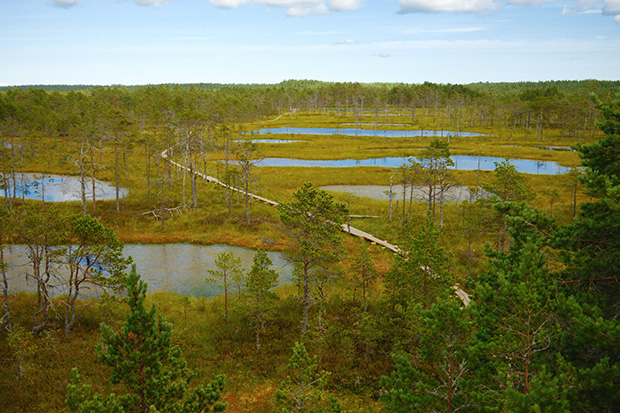
Photo: Minami Tsuchikura
The landscape of the Viru Bog.