
Nikos Fatsis-Kavalopoulos
Routine hospital diagnostics miss several forms of antibiotic resistance entirely. Nikos Fatsis-Kavalopoulos builds the measurements that make them visible, and turns those into tools clinical laboratories can actually use.
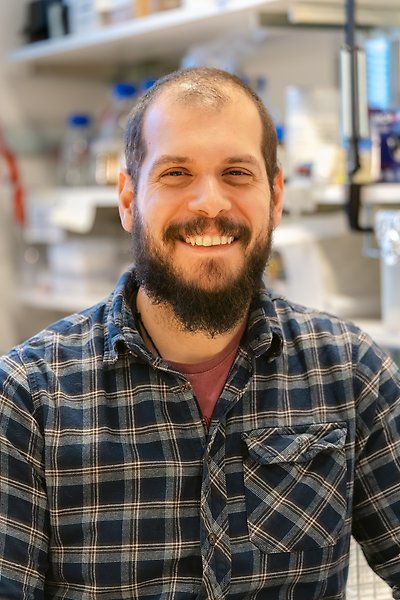
Associate Professor
Department of Medical Biochemistry and Microbiology at Uppsala University
Research focus and interests
- Medical and clinical diagnostics development
- Method and assay development for infectious diseases
- Rare phenotypic responses to antibiotics
- Antibiotic synergy and antagonism
- Clinical trials
- Tools to study and enable phage therapy schemes
Research expertise and methodologies
- Antibiotic interaction quantification at scale design and application of assay systems determination of synergy in antibiotic combinations in clinical cohorts, extended to sub-inhibitory interaction measurement.
- Detection and characterisation of heteroresistance: population analysis profiling and PAP-AUC classification, droplet microfluidics for the detection of very rare resistant subpopulations.
- Microfluidics, microfabrication and lab-on-chip development: design, prototyping and validation of microfluidic devices from 3D-printed and cast molds, including multiplex chips for rapid phenotypic AST, biofilm resistance-selection chips, and precision cell assembly platforms.
- Rapid phenotypic antibiotic susceptibility testing:development of prototype rAST systems to industrial standards, from component design through biological validation, in both academic and company settings.
- Commercialisation of diagnostic technology translation of laboratory diagnostics into products and companies, from invention disclosure and innovation funding through company formation and technical leadership.
- Clinical cohort studies linking diagnostics to patient outcomes: retrospective and prospective study design in bloodstream infection cohorts, integrating susceptibility phenotypes, whole-genome sequence data and clinical metadata to test associations with mortality, ICU admission and treatment failure.
- Phage therapy and phage–antibiotic combination dynamics: quantification of bacterial response dynamics to phage exposure, characterization of phage–antibiotic interactions, and assessment of combination strategies against resistant clinical isolates.
Ongoing research projects
Antibiotic interactions in clinical isolates
We develop and apply CombiANT, an assay based on passive antibiotic gradients that makes interaction testing cheap enough to run at scale. Our data show that synergy and antagonism are strain-specific and unpredictable from the individual drug MICs. We run interaction profiles for other groups, and seek collaborators with strain collections or cohorts where combination therapy outcomes are known.
Heteroresistance and its clinical consequences
We study rare resistant subpopulations that survive treatment despite an isolate testing susceptible. Routine testing misses most of them, and in bloodstream infections we find heteroresistance associated with ICU admission, mortality and relapse.
Diagnostics for phenotypes current methods miss
We build the measurement tools this work requires, including droplet microfluidics for detecting very rare resistant subpopulations, multiplex chips for rapid phenotypic susceptibility testing, and deep learning-based read-out of interaction assays. We collaborate on assay development and on applying these platforms beyond our current organisms and drug classes.
Translation into practice
Very interested and somewhat experienced in bringing the lab platforms toward clinical use, in the form of newfound and startup diagnostic ventures
Publications
-
A high-throughput fluidic chip for rapid phenotypic antibiotic susceptibility testing
-
Part of Frontiers in Cellular and Infection Microbiology, 2022
- DOI for A Microfluidic Chip for Studies of the Dynamics of Antibiotic Resistance Selection in Bacterial Biofilms
- Download full text (pdf) of A Microfluidic Chip for Studies of the Dynamics of Antibiotic Resistance Selection in Bacterial Biofilms

-
Part of PLOS ONE, 2016
- DOI for A Modular and Affordable Time-Lapse Imaging and Incubation System Based on 3D Printed Parts, a Smartphone, and Off-The-Shelf Electronics
- Download full text (pdf) of A Modular and Affordable Time-Lapse Imaging and Incubation System Based on 3D Printed Parts, a Smartphone, and Off-The-Shelf Electronics
-
A Multiplex Fluidic Chip for Rapid Phenotypic Antibiotic Susceptibility Testing
Part of mBio, 2020
- DOI for A Multiplex Fluidic Chip for Rapid Phenotypic Antibiotic Susceptibility Testing
- Download full text (pdf) of A Multiplex Fluidic Chip for Rapid Phenotypic Antibiotic Susceptibility Testing
-
-
Part of Frontiers in Medicine, 2023
- DOI for Antibiotic use during coronavirus disease 2019 intensive care unit shape multidrug resistance bacteriuria: A Swedish longitudinal prospective study
- Download full text (pdf) of Antibiotic use during coronavirus disease 2019 intensive care unit shape multidrug resistance bacteriuria: A Swedish longitudinal prospective study
-
Beyond the FIC index: the extended information from fractional inhibitory concentrations (FICs)
Part of Journal of Antimicrobial Chemotherapy, p. 2394-2396, 2024
- DOI for Beyond the FIC index: the extended information from fractional inhibitory concentrations (FICs)
- Download full text (pdf) of Beyond the FIC index: the extended information from fractional inhibitory concentrations (FICs)
-
CombiANT: Antibiotic interaction testing made easy
Part of PLoS biology, 2020
- DOI for CombiANT: Antibiotic interaction testing made easy
- Download full text (pdf) of CombiANT: Antibiotic interaction testing made easy
-
Part of PLOS Digital Health, 2025
- DOI for CombiANT reader: Deep learning-based automatic image processing tool to robustly quantify antibiotic interactions
- Download full text (pdf) of CombiANT reader: Deep learning-based automatic image processing tool to robustly quantify antibiotic interactions
-
Part of npj Digital Medicine, 2026
- DOI for Droplet microfluidics with image texture quantification for detection of rare antibiotic-resistant subpopulations from bloodstream infections
- Download full text (pdf) of Droplet microfluidics with image texture quantification for detection of rare antibiotic-resistant subpopulations from bloodstream infections
-
2025
-
Part of Science Advances, 2025
- DOI for Droplet microfluidics-based detection of rare antibiotic-resistant subpopulations in Escherichia coli from bloodstream infections
- Download full text (pdf) of Droplet microfluidics-based detection of rare antibiotic-resistant subpopulations in Escherichia coli from bloodstream infections
-
Part of Scientific Reports, 2025
- DOI for Fast detection of synergy and antagonism in antifungal combinations used against Candida albicans clinical isolates
- Download full text (pdf) of Fast detection of synergy and antagonism in antifungal combinations used against Candida albicans clinical isolates
-
Part of Lab on a Chip, p. 1071-1081, 2019
- DOI for Formation of precisely composed cancer cell clusters using a cell assembly generator (CAGE) for studying paracrine signaling at single-cell resolution
- Download full text (pdf) of Formation of precisely composed cancer cell clusters using a cell assembly generator (CAGE) for studying paracrine signaling at single-cell resolution
-
Heteroresistance and clinical outcomes: much still to be understood – Authors' reply
Part of The Lancet Microbe, 2025
- DOI for Heteroresistance and clinical outcomes: much still to be understood – Authors' reply
- Download full text (pdf) of Heteroresistance and clinical outcomes: much still to be understood – Authors' reply
-
Part of Scientific Reports, 2019
- DOI for Modular microfluidic systems cast from 3D-printed molds for imaging leukocyte adherence to differentially treated endothelial cultures
- Download full text (pdf) of Modular microfluidic systems cast from 3D-printed molds for imaging leukocyte adherence to differentially treated endothelial cultures
-
Piezo1 activation attenuates thrombin-induced blebbing in breast cancer cells
Part of Journal of Cell Science, 2022
- DOI for Piezo1 activation attenuates thrombin-induced blebbing in breast cancer cells
- Download full text (pdf) of Piezo1 activation attenuates thrombin-induced blebbing in breast cancer cells
-
Part of EBioMedicine, 2022
- DOI for Potential risks of treating bacterial infections with a combination of β-lactam and aminoglycoside antibiotics: A systematic quantification of antibiotic interactions in E. coli blood stream infection isolates
- Download full text (pdf) of Potential risks of treating bacterial infections with a combination of β-lactam and aminoglycoside antibiotics: A systematic quantification of antibiotic interactions in E. coli blood stream infection isolates
-
2019
-
Part of The Lancet Microbe, 2025
- DOI for Prevalence, misclassification, and clinical consequences of the heteroresistant phenotype in Escherichia coli bloodstream infections in patients in Uppsala, Sweden: a retrospective cohort study
- Download full text (pdf) of Prevalence, misclassification, and clinical consequences of the heteroresistant phenotype in Escherichia coli bloodstream infections in patients in Uppsala, Sweden: a retrospective cohort study
-
Part of Microbiology Spectrum, 2025
- DOI for Sublethal interaction factor (SIF), a growth-based method to analyze antibiotic combinations at sub-inhibitory concentrations
- Download full text (pdf) of Sublethal interaction factor (SIF), a growth-based method to analyze antibiotic combinations at sub-inhibitory concentrations
-
Part of Nature Communications, 2025
- DOI for Vancomycin heteroresistance (hVISA) in MRSA links to treatment failure and supports a revised PAP-AUC threshold
- Download full text (pdf) of Vancomycin heteroresistance (hVISA) in MRSA links to treatment failure and supports a revised PAP-AUC threshold
-
Within-species variability of antibiotic interactions in Gram-negative bacteria
Part of mBio, 2024
- DOI for Within-species variability of antibiotic interactions in Gram-negative bacteria
- Download full text (pdf) of Within-species variability of antibiotic interactions in Gram-negative bacteria