
Stem cells survived unexpectedly rough space travel

“When the cells came back, they didn’t look normal, but we were still cautiously optimistic,” says Elena Kozlova. Photo: Tobias Sterner, Bildbyrån
Stem cells sent to the International Space Station (ISS) were subjected to considerably greater stresses than the researchers had anticipated. Nevertheless, some of them survived and retained their ability to develop into nerve cells. Stem cells in 3D-printed support structures fared particularly well, according to research by Professor Elena Kozlova.
In early 2024, a type of stem cell known as neurospheres (i.e. clusters of neural stem cells) that had been laboratory cultivated were sent to the International Space Station (ISS) to be exposed to microgravity.
The return trip was delayed several times due to bad weather in the landing zone. As a result, the cells were outside controlled culture conditions for longer than anticipated – beyond the limit of what they were expected to survive.
When they finally arrived at the laboratory at the Uppsala Biomedical Centre (BMC), no one knew whether it would be possible to complete the experiment.
“When the cells came back, they looked different, but we were still cautiously optimistic. It looked as though there were only small fragments of neurospheres in some groups, but not all of them. Only the cells that had previously been in space on the sounding rocket had survived. So we changed the medium and waited. Then some of the cells recovered and began to grow, very slowly,” explains Elena Kozlova.
A month later, the experiments could begin. The results have now been analysed and are presented in an article in NPJ Microgravity.
The 3D structure protected the cells
Despite being subjected to severe stress, some of the cells survived. After recovery, they were still able to develop into nerve cells and glial cells and functioned normally in the researchers’ tests.
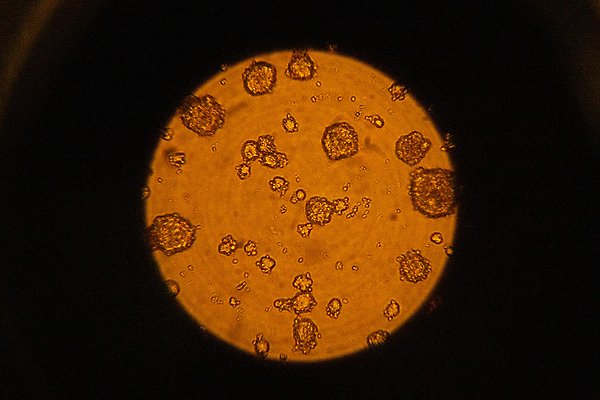
Stem cells viewed through a microscope during a photo shoot prior to the experiment, in December 2023. Photo: Tobias Sterner, Bildbyrån
A key finding is that cells placed in 3D-printed support structures fared particularly well across all groups. They survived and continued to divide.
“Thanks to the experiment being extended, we were able to see just how significant the 3D-printed structure was for the cells’ survival.”
The research is being conducted in an international network involving researchers from the US, the UK, Italy, Switzerland and other countries.
“Together, the research groups are using various methods to extract as much knowledge as possible from the valuable material collected during space flights,” says Elena Kozlova.
Significance for future space flights
The results may have implications for future manned space flights, enabling injuries and illnesses to be treated on site. One possibility the researchers are investigating is the future ability to grow cells and tissues for treatment and transplants.
The researchers are using iPSC technology, which was awarded the Nobel Prize in 2012.
“Using this method, we can take cells from the patient’s skin and convert them into iPSCs, i.e. induced pluripotent stem cells. From these cells, we can, in practice, generate any type of cell,” says Elena Kozlova.
The research may also prove useful on Earth. Among other things, the group is investigating how microgravity affects cells and tissues linked to back pain and type 1 diabetes. In upcoming experiments, the researchers will attempt to recreate the effects of microgravity in the laboratory.
Annica Hulth
Publication
Boundary cap neural crest stem cells exhibit remarkable resilience to environmental stressors associated with International Space Station mission, NPJ Microgravity. (Robert Fredriksson, Yilin Han, Xiangyi Du, Craig A. Sexton, Povilas Barasa, Federica Zanotti, Nicola B. Hamilton, Keisuke Ito, Barbara Zavan & Elena N. Kozlova)