
Master's Programme in Classical Archaeology and Ancient History
120 credits
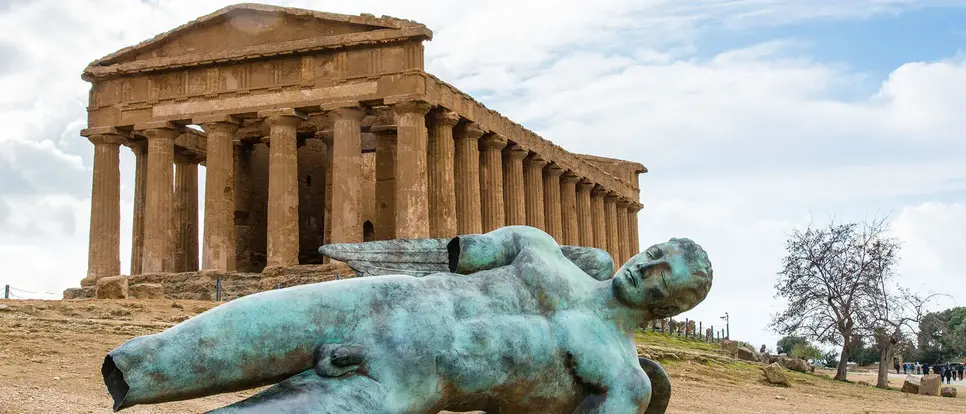
Much of what we take for granted today has its origin in the classical cultures around the Mediterranean. The Master's Programme in Classical Archaeology and Ancient History gives you a broad education in the history, archaeology, art, religion and philosophy of the ancient world. You will learn to analyse historical processes and phenomena through fascinating source material. You will also choose to specialise in an area and write an academic thesis.
Application and entry requirements
Expand the information below to show details on entry requirements, programme-specific documents, selection criteria and tuition fees.
Autumn 2026 Autumn 2026, Uppsala, 100%, On-campus, English
- Location
- Uppsala
- Pace of study
- 100%
- Teaching form
- On-campus
- Instructional time
- Daytime
- Study period
- 31 August 2026–4 June 2028
- Language of instruction
- English
- Entry requirements
-
Academic requirements
A Bachelor's degree, equivalent to a Swedish Kandidatexamen, from an internationally recognised university. The main field of study must be classical archaeology and ancient history.
Language requirements
Proficiency in English equivalent to the Swedish upper secondary course English 6. This requirement can be met either by achieving the required score on an internationally recognised test, or by previous upper secondary or university studies in some countries.
- Selection
-
Students are selected based on an overall appraisal of previous university studies and a statement of purpose.
Tuition fee-paying students and non-paying students are admitted on the same grounds but in different selection groups.
- Fees
- If you are not a citizen of a European Union (EU) or European Economic Area (EEA) country, or Switzerland, you are required to pay application and tuition fees.
- First tuition fee instalment: SEK 57,000
- Total tuition fee: SEK 228,000
- Application deadline
- 15 January 2026
- Application code
- UU-M5020
- Supporting documents
-
In addition to the general supporting documents, you also need to submit a programme-specific statement of purpose (1 page).
Check the application guide for information on how to apply and what other supporting documents you need to submit.
Expand the information below to show details on entry requirements, programme-specific documents, selection criteria and tuition fees.
Autumn 2027 Autumn 2027, Uppsala, 100%, On-campus, English
- Location
- Uppsala
- Pace of study
- 100%
- Teaching form
- On-campus
- Instructional time
- Daytime
- Study period
- 30 August 2027–3 June 2029
- Language of instruction
- English
- Entry requirements
-
Academic requirements
A Bachelor's degree, equivalent to a Swedish Kandidatexamen, from an internationally recognised university. The main field of study must be classical archaeology and ancient history.
Language requirements
Proficiency in English equivalent to the Swedish upper secondary course English 6. This requirement can be met either by achieving the required score on an internationally recognised test, or by previous upper secondary or university studies in some countries.
- Selection
-
Students are selected based on an overall appraisal of previous university studies and a statement of purpose.
Tuition fee-paying students and non-paying students are admitted on the same grounds but in different selection groups.
- Fees
- If you are not a citizen of a European Union (EU) or European Economic Area (EEA) country, or Switzerland, you are required to pay application and tuition fees.
- First tuition fee instalment: SEK 57,000
- Total tuition fee: SEK 228,000
- Application deadline
- 15 January 2027
- Application code
- UU-M5020
- Supporting documents
-
In addition to the general supporting documents, you also need to submit a programme-specific application summary sheet.
Check the application guide for information on how to apply and what other supporting documents you need to submit.
About the programme
If you are interested in Mediterranean archaeology and ancient history, this programme was made for you! Much of what we take for granted in politics, economy and culture has its roots in antiquity. In this programme, you will learn to analyse and communicate a cultural heritage which is central to European identity.
You will take a mixture of compulsory and elective courses during the programme. The Department of Archaeology, Ancient History and Conservation offers courses in Archaeology, Classical Archaeology and Egyptology every semester. You can also choose courses from other subjects if you want to broaden your education further.
The Department of Archaeology, Ancient History and Conservation at Uppsala University strives for excellence in its teaching and research and is currently ranked highly in the subject of Archaeology (QS World University Rankings 2026).
Upon completion of a Master's degree in Classial Archaeology and Ancient History our students have numerous transferable skills that enable them to find work in for example contract archaeology, cultural heritage management, tourism, tour leaders and guides, jobs requiring Geographical Information Systems (GIS) within local and national government agencies or as educators, teachers, and researchers.
Student profile
The programme is international. Swedish students represent the majority, with others coming from elsewhere in Europe and North America. Students come from a background in Classical Archaeology and Ancient History. The student group is based in Uppsala and is usually 5–10 students per year.
Career
Previous students have found work as:
- archaeologists
- museum curators and educators
- investigators for the public sector
- tour leaders and guides
- cultural writers
- teachers
- researchers
Graduates have found jobs working within tourist information (Destination Uppsala), the police force, and jobs requiring Geographical Information Systems (GIS) within local and national government agencies, and museums in Sweden and internationally. With a Master's degree in Classical Archaeology and Ancient History, you are able to apply for further PhD studies in this field.
The department holds networking events in the areas of archaeology, museums and cultural heritage management where you can meet alumni who can provide insights into the job market as you prepare to graduate.
Content
The duration of the full programme is two years and is worth 120 credits, but you can also choose to complete your studies in one academic year leading to a Master of Arts (60 credits) in Classical Archaeology and Ancient History.
The programme starts with two compulsory courses, followed by a range of elective courses offered by the Department of Archaeology, Ancient History and Conservation, or by other departments at the Faculty of Arts. The compulsory courses are taken together with students from the Master's Programmes in Archaeology and in Egyptology.
You will design your education according to your own interests. At the beginning of the first semester, you will establish an Individual Study Plan (ISP) together with the programme coordinator or Director of Studies. At that time, you will decide how to plan your studies: which courses to take, when to write your Master's thesis, etc. The ISP is revised every semester, or more often if needed.
The Department offers a number of courses, which normally run at 50% of a full-time study load. The idea being that you should read two courses in parallel, or read one course while working on your thesis project.
Apart from the courses offered by the Department, which vary from semester to semester over a two-year cycle, you can choose to do an internship (worth 7.5 or 15 credits) or take an individually designed in-depth or a method course (7.5 credits) relevant to the field.
You will write a 45-credit Master's thesis. It is divided up into modules and written over several semesters. You can choose to devote your full attention to the thesis, or read a course at the same time.
Courses within the programme
Below is an example of what the programme outline might look like for the full two-year programme. If you follow the one-year programme, you will do your Master's thesis during the second semester.
Semester 1
- Perspectives on the Past: Applied Theory and Method, 7.5 credits (compulsory)
- The Craft of Research, 7.5 credits (compulsory)
- Elective courses, 15 credits
Semester 2
- Thesis module 1, 7.5 credits
- Elective courses, 22.5 credits
Semester 3
- Thesis module 2, 7.5 credits
- Elective courses, 22.5 credits
Semester 4
- Thesis module 3, 30 credits.
Learning experience
Teaching typically includes two to four hours of seminars and lectures each week.
Between seminars, you are expected to read and digest texts and sometimes also discuss them with other students. Some courses have a more practical orientation, such as internships and courses on Geographical Information Systems (GIS). You are expected to study 40 hours per week throughout the programme.
Course assessment is normally continuous based on your active participation in seminars and assessed work. The assessment may also consist of a longer essay submitted at the end of the course.
The programme is taught in English. Written assignments can be submitted in either English or Swedish.
Degree
The programme leads to the degree of Master of Arts (120 credits) with Classical Archaeology and Ancient History as the main field of study. After one year of study, it is possible to obtain a degree of Master of Arts (60 credits).
Is this programme right for you?
Read interviews with our students.

Register your interest
Let us guide you through the application process with helpful updates and reminders.

Contact
- For programme-specific information, please contact the director of studies Carl-Gösta Ojala:
- carl-gosta.ojala@arkeologi.uu.se
- For admissions-related or general information, please contact our applicant support team:
- study@uu.se
Student at Uppsala University
As a student, you will find information about your studies in the Student Gateway.