
Help reduce and change plastic consumption

One of Sweden’s national environmental objectives is to have net zero greenhouse gas emissions by 2045. To achieve this objective, emissions from the incineration of plastics need to be reduced. The image is from plastics recycling at Segerstedthuset. Photo: Anders Berndt, Uppsala University.
Uppsala University’s plastics consumption needs to change to help reduce our climate footprint. This requires many employees to get involved in making these changes.
One of Sweden’s environmental objectives states that Sweden should have net zero emissions of greenhouse gases into the atmosphere by 2045. To achieve this objective, emissions from the incineration of plastics need to be reduced. In total, only 9–10 per cent of all plastics produced are recycled, while the rest are incinerated.
This means that all companies and organisations (and individuals) need to review how they are producing, using and recycling plastics. This also applies to Uppsala University. Some efforts have been made and are being made at the University, but it is essential that more staff with a detailed knowledge of their organisation actively help to reduce and change their plastic consumption.
As part of the Uppsala Climate Protocol network, Uppsala University has adopted a number of climate challenges for the period 2024–2027. One is to reduce the amount of plastic that goes to incineration. This challenge entails gradually reducing what gets incinerated until 2030.
Why reduce the amount of plastic that gets incinerated?
In Sweden, most of our plastic waste is incinerated. The energy in the plastic is often used to generate electricity or for district heating, but burning plastics also results in large emissions of greenhouse gases.
Sweden has therefore adopted a net zero target for greenhouse gas emissions by 2045 as one of its national environmental objectives. To achieve this objective, emissions from burning plastics must be reduced.
“Vattenfall would prefer not to accept the University’s plastic waste for incineration at its district heating plant in Uppsala, because this fossil-based plastic contributes to large net emissions of greenhouse gases,” says Mikael Olsson, environmental chemist at BMC campus management.
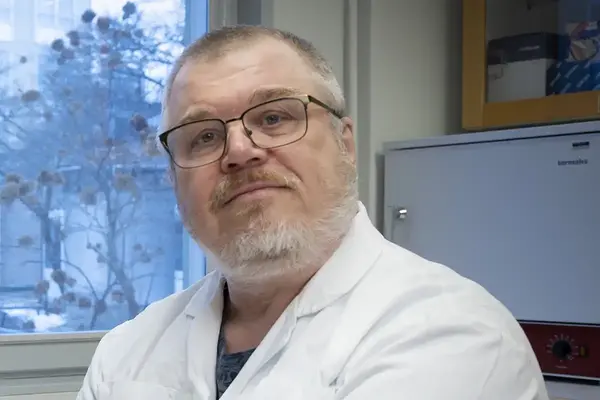
Mikael Olsson, environmental chemist at BMC campus management. Photo: Mikael Wallerstedt, Uppsala University.
The University continuously imposes requirements in its procurements to reduce the amount of plastic in both products and packaging materials. This is an important measure to reduce the University’s climate footprint. But more measures are needed and it is crucial that staff who know their organisation at a detailed level are involved and contribute to this effort.
Four angles
One way to change plastics consumption is to study how it is used from these four angles:
- Minimise plastic consumption
- Replace fossil plastics with bio-based plastics
- Sort plastics so that they can be recycled
- Minimise transport of plastic waste.
Minimise consumption
One example of minimising plastic consumption is that the cleaning service at the University have switched from plastic bags to paper bags for compostable waste. Another example is the decision to remove wastepaper baskets at all desks, which has reduced the use of plastic bin liners.
Replace fossil plastics with bio-based plastics
If using plastic is necessary, as far as possible we should be using bio-based plastics. Here too, there are examples from the cleaning service at the University, who have replaced plastic bin liners with bin liners made from bio-based plastic.
“Here it’s important to point out that the goal is fossil-free products. Products made from recycled plastic are a dead end that can risk delaying and hampering progress in our climate efforts. Bio-based is really the only sensible choice given Sweden’s unique opportunities with its own raw material. Here we can influence purchasing systems, processes and suppliers, and best of all would be if we could start to cooperate systematically with other universities,” says Mikael Olsson.
Sort plastics for recycling
In order to recycle plastic, it must be sorted by type. The problem is that there are many different types of plastic. To a user, one type of plastic looks very much like another unless it has some kind of marking.
But there are exceptions. The best example where we can easily separate out a specific type of plastic is plastic bottles that can be returned for a small cash refund. They are all made of PET plastic and can be easily reused as they are collected without being mixed with other types of plastic.
Since the University buys large quantities of the same plastic products, it is possible to collect certain types of plastic for recycling separately, although this is difficult for ordinary households.
For example, two types of plastic are sorted at both BMC and Ångström campuses alongside the usual recycling fraction of plastic packaging. These are shrink and stretch film, and polypropylene.
“We collect these two plastic fractions because Ragn-Sells has established separate recycling flows for these two types in addition to plastic packagings,” says Teresa Sigurdsson, administrator at Ångström campus management.

At Ångström campus, two specific types of plastic are collected for recycling to reduce the amount of plastic that gets incinerated. Photo: Anders Berndt, Uppsala University.
Minimise transport needs
All waste must be transported somewhere, and this of course has its own climate impact. For example, Mikael Olsson sees opportunities to significantly reduce shipments of plastic waste from BMC if equipment to compress the waste were to be purchased.
“By compressing plastic waste, we can reduce the need for shipments by perhaps up to 80 per cent,” says Olsson.
Everyone can do something
This is of course a difficult and complex issue that cannot be solved overnight, and not everyone can do everything. But everyone can do something.
Even small things make a difference, and often it can be easier to start simple and let things grow in complexity over time.
Anders Berndt
Uppsala Climate Protocol
- A network started by Uppsala Municipality in 2010.
- It consists of about 40 organisations.
- The members of the network have taken on various climate challenges.
Information about Uppsala Climate Protocol on the Staff Gateway
Read more
Share good examples!
Are you doing something positive in this context at your department/equivalent? The editorial team would love to hear from you, so that we can share more examples to help and inspire others.